The Economics of Sports Betting and State Lotteries

I don't watch much TV, but I have been noticing substantial numbers of sports betting commercials when I do watch a movie. Here's the economic analysis by Aakash Gupta, based on a talk by Warren Buffett, who urges that these are taxes on stupidity and that the government shouldn't play people for suckers.

Warren Buffett, in his first sit-down since stepping down as Berkshire CEO, gave the cleanest indictment of legalized gambling in a decade. He called it a tax cut for the wealthy. The math proves him exactly right.

Americans wagered $165 billion at legal sportsbooks in 2025. They lost $16 billion of that. FanDuel pulled $6 billion of the losses. DraftKings pulled $5.3 billion. Every state with legal mobile sports betting collected a tax on the bettor side. New York alone took in over $1.2 billion in 2025 sports betting tax revenue.

Layer the lottery on top. State lotteries generate over $90 billion a year. The bottom half of income earners account for roughly 70% of total spend. The average lottery player makes $38,000. A household earning $20,000 spends three times more on tickets than one earning $30,000. The implicit tax rate, meaning whatever the state keeps after prizes, runs 30 to 50% depending on the game. No other revenue source in America has that base and that rate.

The structural design is the engine. A single straight sports bet carries a hold of 4 to 5%. A four-leg parlay carries a hold above 30%. FanDuel and DraftKings spent five years rebuilding their apps to make parlays the default product. FanDuel's blended hold rate hit 11.4% in 2025, up from roughly 7% in 2022. The product got worse for the customer and the customer wagered more anyway.

Now look at the substitution. Nine US states have no state income tax. Seven of those nine run state lotteries. Seven of those nine have legalized sports betting. The states most committed to never taxing wealth are the same states running the largest extraction machines on people who cannot afford to lose. Read it as policy.

Continue ReadingThe Economics of Sports Betting and State Lotteries

“I’m Communist with my Family . . . “

Brivael - FR makes sense here:
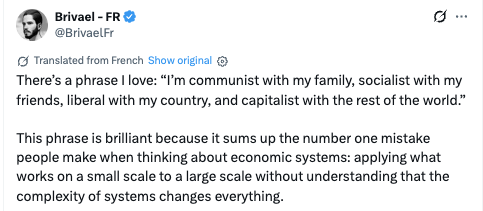
There’s a phrase I love: “I’m communist with my family, socialist with my friends, liberal with my country, and capitalist with the rest of the world.”

This phrase is brilliant because it sums up the number one mistake people make when thinking about economic systems: applying what works on a small scale to a large scale without understanding that the complexity of systems changes everything.

Communism with your family works. You share everything, you don’t keep score, each person gives according to their abilities and receives according to their needs. And it works. Because you’re 4 or 5 people, you know everyone intimately, trust is total, cheating is impossible to hide, and love replaces economic incentives.

Socialism with your friends works too. A group of 20-30 people. You share restaurant bills, you help a buddy move, you lend a hand without keeping count. Reciprocity is natural because you know each person and your reputation is on the line.

But as soon as you scale up to a country, 68 million people, everything falls apart. Why? Because the complexity of systems is non-linear. Organizing 5 people is trivial. Organizing 50 is difficult. Organizing 50 million is a problem of fundamentally different complexity. It’s not just “harder.” It’s qualitatively a different problem.

At large scale, you no longer know the people. Trust disappears. Cheating becomes invisible. Free riders proliferate. The information needed to coordinate 68 million people exceeds the capacity of any central planner. This is the economic calculation problem of Mises (1920) and the dispersed knowledge of Hayek (1945). A central brain can’t process the information that millions of market prices transmit in real time.

That’s exactly why communism produces happy families and dead countries. The model doesn’t scale. Not because people are mean. Because the complexity of systems makes centralized coordination impossible beyond a certain threshold.

And that’s the fundamental judgment error that most people who subscribe to Marxist theses make. They take their experience of sharing in a family or among friends, a model that works for 5-20 people, and they extrapolate it to 68 million people while completely ignoring the emergence of complexity. “If it works at home, it should work for the country.” No. The physics of complex systems says exactly the opposite.

The free market is the only system that scales. Because it doesn’t depend on personal trust, nor on good will, nor on an omniscient planner. It depends on prices that transmit information, incentives that align behaviors, and competition that corrects errors. It’s a system designed to work with strangers, at any scale.

Be communist with your family. Socialist with your friends. And liberal with everything else. Because the size of the system determines the model that works. Not your good intentions.


Continue Reading“I’m Communist with my Family . . . “

Jimmy Carr’s Short Funny Wise Lecture on Communism

Jimmy Carr: Communism make perfect sense in our own families, but it doesn't scale up:

Jimmy: "I don't know, you might object to capitalism. And Ticketmaster a very good example of the capitalist market. And capitalism is a terrible system, apart from all the fucking others. A bunch of young people seem to have fallen in love with communism. the fuck is going-. Communism is a great idea. Wrong species! Think about capitalism. It kind of leans into what we are. We're quite self interested. It works."

"What's your name? [Audience member]: "Sam... Define communism for me. Define communism."

Jimmy: "From each according to their abilities to each according to their needs. Yeah, It just doesn't scale. Everyone is a communist. All of you are communists. With your family. If you've got kids, you're a fucking communist at home, each according to their needs. You take care of them. Of course you do. And as things get wide in your local community, you might be a socialist, try and help everyone out. And then you get up to nation state level, and you go, "Yeah, fuck those guys."

There's always going to be an in-group preference. I'm sorry, but you're human beings. Unlucky. The problem with American communism, which is, you know, woke, is better described as American Marxism. And what it is is, instead of trying to redistribute wealth, which is a perfectly reasonable thing to want to do, they want to redistribute status, and that is a recipe for fucking madness."

Continue ReadingJimmy Carr’s Short Funny Wise Lecture on Communism

Getting Things Done

How to get things done? I'm going to use some of these ideas by George Mack. Here's one of the nine suggestions:

Get a giant whiteboard in your home - My most contrarian belief: We could increase the global economy by 2-3% just by installing large whiteboards in every home. The whiteboard forces you to commit Kidlins’ law: If you write the problem down clearly, then the matter is 50% solved. With a whiteboard, it’s more like 70%; there’s an extra 20% because it stays there over the next few days, whispering into your creative subconscious whenever you walk past it.

Continue ReadingGetting Things Done