“I’m Communist with my Family . . . “

Brivael - FR makes sense here:
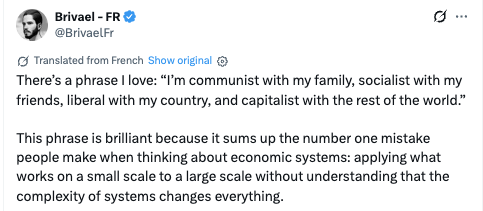
There’s a phrase I love: “I’m communist with my family, socialist with my friends, liberal with my country, and capitalist with the rest of the world.”

This phrase is brilliant because it sums up the number one mistake people make when thinking about economic systems: applying what works on a small scale to a large scale without understanding that the complexity of systems changes everything.

Communism with your family works. You share everything, you don’t keep score, each person gives according to their abilities and receives according to their needs. And it works. Because you’re 4 or 5 people, you know everyone intimately, trust is total, cheating is impossible to hide, and love replaces economic incentives.

Socialism with your friends works too. A group of 20-30 people. You share restaurant bills, you help a buddy move, you lend a hand without keeping count. Reciprocity is natural because you know each person and your reputation is on the line.

But as soon as you scale up to a country, 68 million people, everything falls apart. Why? Because the complexity of systems is non-linear. Organizing 5 people is trivial. Organizing 50 is difficult. Organizing 50 million is a problem of fundamentally different complexity. It’s not just “harder.” It’s qualitatively a different problem.

At large scale, you no longer know the people. Trust disappears. Cheating becomes invisible. Free riders proliferate. The information needed to coordinate 68 million people exceeds the capacity of any central planner. This is the economic calculation problem of Mises (1920) and the dispersed knowledge of Hayek (1945). A central brain can’t process the information that millions of market prices transmit in real time.

That’s exactly why communism produces happy families and dead countries. The model doesn’t scale. Not because people are mean. Because the complexity of systems makes centralized coordination impossible beyond a certain threshold.

And that’s the fundamental judgment error that most people who subscribe to Marxist theses make. They take their experience of sharing in a family or among friends, a model that works for 5-20 people, and they extrapolate it to 68 million people while completely ignoring the emergence of complexity. “If it works at home, it should work for the country.” No. The physics of complex systems says exactly the opposite.

The free market is the only system that scales. Because it doesn’t depend on personal trust, nor on good will, nor on an omniscient planner. It depends on prices that transmit information, incentives that align behaviors, and competition that corrects errors. It’s a system designed to work with strangers, at any scale.

Be communist with your family. Socialist with your friends. And liberal with everything else. Because the size of the system determines the model that works. Not your good intentions.
Continue Reading“I’m Communist with my Family . . . “

Our Class Problem. The Populism Problem of the Super-Rich

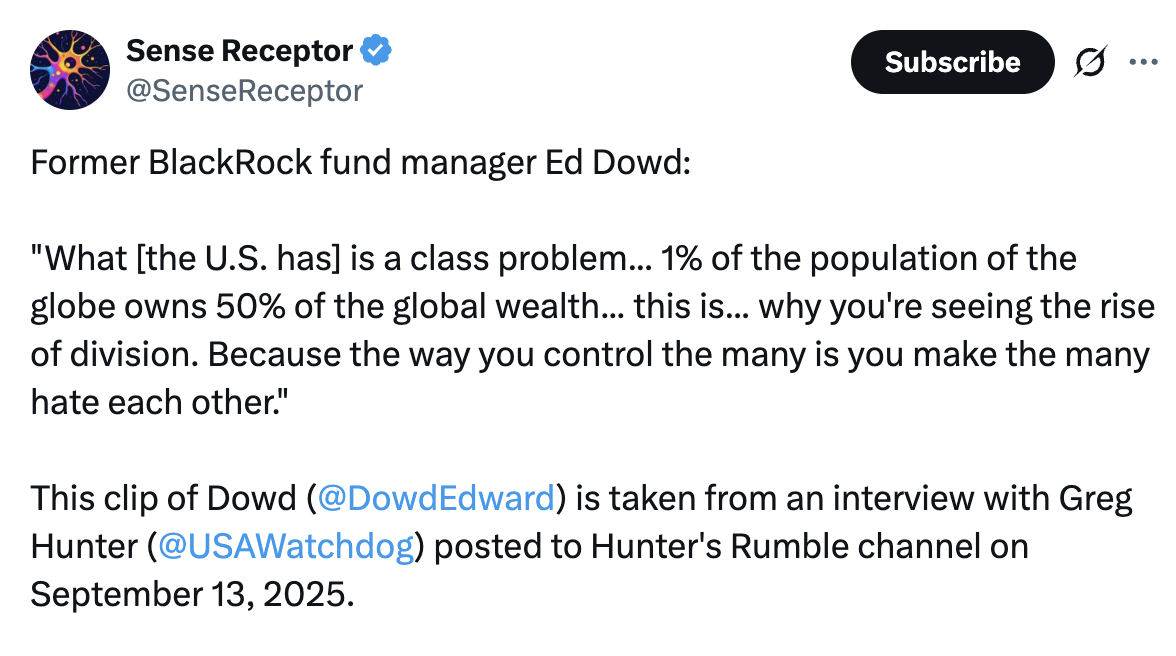
Ed Dowd, former BlackRock fund manager.

"What [the U.S. has] is a class problem... 1% of the population of the globe owns 50% of the global wealth... this is... why you're seeing the rise of division. Because the way you control the many is you make the many hate each other."

"What we have in this country is a class problem. We have, you know, 1% of global wealth is the 1% of the population of the globe owns 50% of the global wealth. So this is a class issue. It's been going on for a long time, since the great financial crisis and since 2000. And we have, And this is not just a US Problem. This is a global problem.

"And when we get to these types of situations they're cured one of two ways. The elites pay an existential price and or the system collapses and they're forced to share the wealth again. So this is how it's done.

"I'm not suggesting it's imminent, but this is why you're seeing the rise of populism, and this is also why you're seeing the rise of division. Because, the way you control the many is you make the many hate each other. You make the pitchfork guy look at the torch guy and say, hey, the torch guys are trying to take our pitchforks. And that's what's going on today. We got all this finger pointing. This is a class issue. It's not a black, white, Hispanic, left, right, Muslim. This is a class issue."

Continue ReadingOur Class Problem. The Populism Problem of the Super-Rich

Status and Power Seeking on the Backs of the Unfortunate

The elites portray themselves as good-doers. The could be some of that, of course, but there is a Machiavellian side to such displays too. Rob Henderson explains:

Elite overproduction happens when a society produces too many people who believe they deserve high status. To get there, they often try to align themselves with genuinely marginalized groups in order to unseat the current elites and replace them. A lot of the time, when you hear someone loudly criticizing elites, what you’re really hearing is an audition to join them—an attempt to co-opt the suffering of people who are actually mistreated.

Even if someone has never personally experienced hardship, they can point to history or to the struggles of people who share their traits and say: they suffered, I’m like them, therefore you should give me power. That might mean a spot at a university, a job at a prestigious firm, or some other coveted position.

What’s interesting is how this shift away from individualism and toward group identity makes it possible for someone who’s only ever known affluence and comfort to be rewarded, so long as they share something in common with a historically marginalized group. Meanwhile, the people who really have been mistreated may get nothing. And yet people seem surprisingly willing to go along with it.

Continue ReadingStatus and Power Seeking on the Backs of the Unfortunate

The Disastrous Effect of US Trade Policy on the US Middle Class

I agree with David Sacks here. To see the disastrous effects of US trade policy on the US middle class, take a road trip through America's many decimated town and small cities.

BTW, a lot of the people who worked these middle class jobs were men. How are men doing in education and the job market now that many of these jobs no longer exist? Steve Stewart-Williams tells us in his article, "The Other Half: Six gender gaps we rarely talk about" Here are his conclusions:

  • Young Women Now Often Out-Earn Young Men
  • Boys Are Falling Behind at School
  • Fewer Men Are Finishing College
  • More Men Die on the Job
  • Men’s Health Gets Less Funding
  • Men Are More Likely to Take Their Own Lives

Continue ReadingThe Disastrous Effect of US Trade Policy on the US Middle Class