
“I’m Communist with my Family . . . “

Brivael - FR makes sense here:
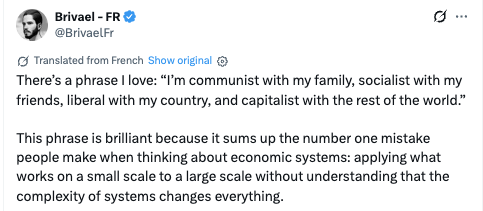
There’s a phrase I love: “I’m communist with my family, socialist with my friends, liberal with my country, and capitalist with the rest of the world.”

This phrase is brilliant because it sums up the number one mistake people make when thinking about economic systems: applying what works on a small scale to a large scale without understanding that the complexity of systems changes everything.

Communism with your family works. You share everything, you don’t keep score, each person gives according to their abilities and receives according to their needs. And it works. Because you’re 4 or 5 people, you know everyone intimately, trust is total, cheating is impossible to hide, and love replaces economic incentives.

Socialism with your friends works too. A group of 20-30 people. You share restaurant bills, you help a buddy move, you lend a hand without keeping count. Reciprocity is natural because you know each person and your reputation is on the line.

But as soon as you scale up to a country, 68 million people, everything falls apart. Why? Because the complexity of systems is non-linear. Organizing 5 people is trivial. Organizing 50 is difficult. Organizing 50 million is a problem of fundamentally different complexity. It’s not just “harder.” It’s qualitatively a different problem.

At large scale, you no longer know the people. Trust disappears. Cheating becomes invisible. Free riders proliferate. The information needed to coordinate 68 million people exceeds the capacity of any central planner. This is the economic calculation problem of Mises (1920) and the dispersed knowledge of Hayek (1945). A central brain can’t process the information that millions of market prices transmit in real time.

That’s exactly why communism produces happy families and dead countries. The model doesn’t scale. Not because people are mean. Because the complexity of systems makes centralized coordination impossible beyond a certain threshold.

And that’s the fundamental judgment error that most people who subscribe to Marxist theses make. They take their experience of sharing in a family or among friends, a model that works for 5-20 people, and they extrapolate it to 68 million people while completely ignoring the emergence of complexity. “If it works at home, it should work for the country.” No. The physics of complex systems says exactly the opposite.

The free market is the only system that scales. Because it doesn’t depend on personal trust, nor on good will, nor on an omniscient planner. It depends on prices that transmit information, incentives that align behaviors, and competition that corrects errors. It’s a system designed to work with strangers, at any scale.

Be communist with your family. Socialist with your friends. And liberal with everything else. Because the size of the system determines the model that works. Not your good intentions.

Continue Reading“I’m Communist with my Family . . . “

The Disastrous Effect of US Trade Policy on the US Middle Class

I agree with David Sacks here. To see the disastrous effects of US trade policy on the US middle class, take a road trip through America's many decimated town and small cities.

BTW, a lot of the people who worked these middle class jobs were men. How are men doing in education and the job market now that many of these jobs no longer exist? Steve Stewart-Williams tells us in his article, "The Other Half: Six gender gaps we rarely talk about" Here are his conclusions:

  • Young Women Now Often Out-Earn Young Men
  • Boys Are Falling Behind at School
  • Fewer Men Are Finishing College
  • More Men Die on the Job
  • Men’s Health Gets Less Funding
  • Men Are More Likely to Take Their Own Lives

Continue ReadingThe Disastrous Effect of US Trade Policy on the US Middle Class

The Damage Done by Democrat Elites to Fly-Over States and Cities

Chris Hedges:

I rage against this demonization of the working class because it’s a very dangerous cop-out. The Democrats had this term to essentially enact the kind of New Deal reforms that might’ve been able to save what’s left of our very anemic democracy. And they didn’t. And why didn’t they? Because figures like Biden, Pelosi, and Schumer would not have political power but for their corporate backers. I mean, nobody wants Biden. Nobody wanted Biden in the primaries. It took the Democratic establishment to force everyone else out. The guy’s not even sentient. But they don’t want to lose their positions of privilege and power, and they’re really willing to take the country down because if they pushed for these kinds of reforms, then Goldman Sachs and Raytheon - and let’s not forget the Israeli lobby - wouldn’t fund them. They are creatures of this system, so that’s the problem. They will blame people who don’t rush out and vote for them. The liberal East Coast establishment, the college educated, the quote-unquote “knowledge industry,” they have no contact with these people at all. And that isn’t to excuse some of their opinions. . .

Reagan started it, but Clinton was the Democratic impetus for this, where they talked in that “I feel your pain” language of liberalism but thrust a knife in the back of the working class. So are there irredeemable racists and bigots? Of course there are. But to write off the entire working class like that and essentially blame them for their own, I think, very legitimate rage has been a way for the Democratic Party and the liberal establishment to wash their hands of culpability.

. . . They packed the equipment up and shipped it to Monterey, Mexico. And the plants, they’re just empty lots now, but they’re massive and they’re surrounded by cyclone fencing, weed-choked lots, a kind of painful reminder of the jobs they used to have. What happens in Anderson? Well, it’s completely predictable: opioid crisis, diseases of despair, massive numbers of suicides, and so on.

You can find the full interview of Chris Hedge's (by Matt Taibbi) at Racket News.

Continue ReadingThe Damage Done by Democrat Elites to Fly-Over States and Cities

Democrats Have Lost their Advantage with Working People

Michael Shellenberger, writing at Public:

Democrats hoped that Biden’s everyman appeal might win back some white working-class voters back to the party. That hasn’t happened. In fact, now the Democrats are losing non-white working-class voters.

Every election cycle, Democrats lose more and more of this demographic. Despite his virulently anti-immigrant rhetoric, between 2016 and 2020 Trump gained support among Latino voters. Joe Biden did 16 points worse among Latinos than Hillary Clinton had four years earlier. The Democrats have an increasingly tenuous hold on the Asian vote and their support even from black non-college-educated voters has begun to slip. As of last summer, Biden fell short of earning the support of a majority of non-white voters without a college degree (a third of these voters preferred Trump).

Today, the Democrats and the Republicans are virtually tied in voters’ perception of which party is best for the middle class. Americans as a whole no longer take the Democrats for granted as the party that fights for ordinary people, and are just as likely to regard the Republicans as such. This is a historical sea change.

Continue ReadingDemocrats Have Lost their Advantage with Working People

Rob Henderson: The Costs of Luxury Goods Are Not Always Obvious

Rob Henderson, writing at The Free Press:

I’ve long argued that many people who hold “luxury beliefs”—ideas and opinions that confer status on the upper class, while often inflicting costs on the lower classes—are oblivious to the consequences of their views. Support for defunding the police is a classic example. Luxury beliefs can stem from malice, good intentions, or outright naivete. But the individuals who hold those beliefs, the people who wield the most influence in policy and culture, are often sheltered when their preferences are implemented.

Some online commenters have said that my luxury beliefs thesis is undermined by these tragic events, because the victims were affluent and influential—and they still suffered the consequences of their beliefs.

But the fact remains that poor people are far more likely to be victims of violent crime. For every upper-middle-class person killed, 20 poor people you never hear about are assaulted and murdered. You just never hear about them. They don’t get identified by name in the media. Their stories don’t get told.

According to the U.S. Census Bureau, the poorest Americans are seven times more likely to be victims of robbery, seven times more likely to be victims of aggravated assault, and twenty times more likely to be victims of sexual assault than Americans who earn more than $75,000. One 2004 study found that people in areas where over 20 percent of inhabitants live in poverty are more than 100 times more likely to be murdered than people in areas where less than 10 percent of residents live in poverty.

Continue ReadingRob Henderson: The Costs of Luxury Goods Are Not Always Obvious