The citizens of large countries are rapidly disappearing.

Stunning numbers. The citizens of large countries are rapidly disappearing and it's not because of a war or a plague.. It is an unprecedented loss in population:

South Korea is quietly living through something no society has ever survived: a 96% population collapse in just four generations — with zero war, zero plague, zero famine. 100 people today → 25 children → 6 grandchildren → 4 great-grandchildren. That’s it. Game over for an entire nation by ~2125 if fertility stays where it is (0.68–0.72). . . . Japan, Taiwan, Italy, Spain, Singapore, Hong Kong, Poland, Greece — all following the same curve, just 10–20 years behind.

Continue ReadingThe citizens of large countries are rapidly disappearing.

About the Dark Triad

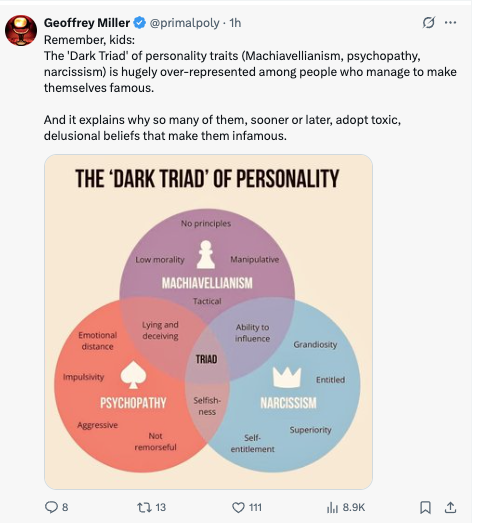
Evolutionary biologist Geoffrey Miller explains the concept:

Remember, kids:

The 'Dark Triad' of personality traits (Machiavellianism, psychopathy, narcissism) is hugely over-represented among people who manage to make themselves famous.

And it explains why so many of them, sooner or later, adopt toxic, delusional beliefs that make them infamous.
Rob Henderson adds this:
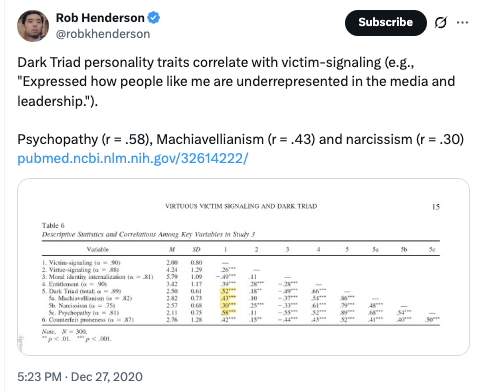
Dark Triad personality traits correlate with victim-signaling (e.g., "Expressed how people like me are underrepresented in the media and leadership.").

Psychopathy (r = .58), Machiavellianism (r = .43) and narcissism (r = .30)

https://pubmed.ncbi.nlm.nih.gov/32614222/

Psychologist Jordan Peterson:
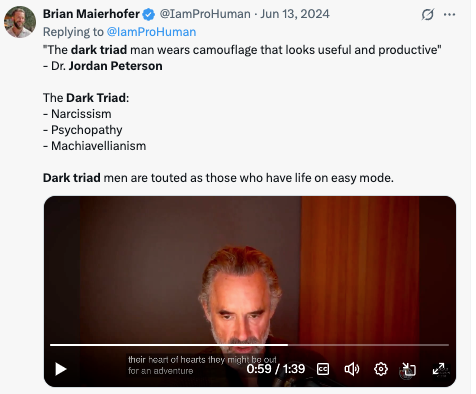
Jordan Peterson:

We're talking about this Machiavellian personality triad, the dark triad, ... Okay, so here's something really interesting. It's the bad boy paradox. They call it that. Young, naive women are attracted to those Machiavellian types, but when they get older and more experienced, they start to be able to see through that. The reason they're attracted to it, as far as I can tell, and I talked about this with bus to see if I was way off on the wrong track, is that those reckless, fearless people mimic real, fearless competence. And young women aren't good at distinguishing between the two, and so they get sucked in by the sort of psychopathic recklessness, because they think it's fearless competence. And of course, the guys who are doing that, they'll prey on that because they're trying to ape competence. But what the women are really after in their heart of hearts, they might be out for an adventure too, because there's that element of it. But they want that fearlessness that does go along with true generosity and competence and also the ability to keep, you know, real darkness away so well.

[Unknown speaker]

A lot of those people who display that kind of, what you call mimicking fearlessness macho, that's they're actually hiding the opposite. They're actually very, very riddled with insecurities. They're not, you know, and they're, they're, they kind of create this sort of bravado and this false front, and they go to an extreme to kind of project this machismo when, in fact, they're riddled with insecurities. And that's their way of dealing with it. With it.

Continue ReadingAbout the Dark Triad

About Love Blindness

Biologist Steve Stewart-Williams:

When male fruit flies are courting females and close to mating, they become so fixated on the task at hand that they often fail to spot approaching predators. The phenomenon is known as love blindness.

I can think of some intriguing hypotheticals!

I subscribe to Stewart-Williams and highly recommend it. It is titled the Nature-Nurture-Nietzsche Newsletter.

Here are two more of the tidbits he offers this week:

A large, longitudinal study found no evidence that violent videogames make people more aggressive or less empathetic. Playing violent videogames is correlated with aggression. However, rather than violent videogames making people aggressive, people who are already aggressive gravitate to violent videogames. [Link.]

According to a fascinating new paper, people tend to assume they have all the information they need to reach a conclusion or make a decision. In a preregistered experiment, participants who were given only half the available information were just as confident in their decisions as those who were given all of it. The authors dubbed this the illusion of information adequacy.

Continue ReadingAbout Love Blindness

The Modern Destruction of Romance?

Have we convinced our young adults to give up on romance? Freya India thinks so and "It’s tragic, all of this. Tragic because it’s putting us on a trajectory to miss out on what’s actually meaningful." Her evidence? See the following excerpt for some and read her entire article for a lot more:

Gen Z are dating less. Having less sex. Settling for situationships that are empty and meaningless. And I think a major part of this is that human connection comes with a high level of risk. Among young men, for example, I’d say this risk-aversion is most obvious in fear of rejection. A recent survey found that almost 45% of men aged 18 to 25 have never approached a woman in person. Another Pew Survey found that half of single men between 18 and 30 are voluntarily single, which some suggest is in part because of fear.

But I think young women are also risk-averse about relationships. We are naturally more risk-averse, for a start, and an even higher number of women are voluntarily single. But our risk-aversion plays out differently. Most obvious to me is the way we talk about relationships, the advice young women give each other, the therapy-speak and feminist clichés that I think often cloak a deep fear of hurt and vulnerability. . . . Social media is full of young women warning each other and listing out red flags and reasons why you should dump him or dodge commitment. He compliments you a lot? Love-bombing. Says I miss you too soon? Run. Approaches you in person? Predator. It’s all so cynical. It’s all about how not to catch feelings; ways not to get attached; how “you’re not gonna get hurt if you have another man waiting”! We blunt romance and passion with this constant calculation of risk, this paranoid scanning for threats, and by holding back to avoid being hurt. We encourage each other to be emotionally absent, unfazed, uncaring. We even call it empowerment! It’s not. It’s neuroticism. I think we are a generation absolutely terrified of getting hurt and doing all we can to avoid it.

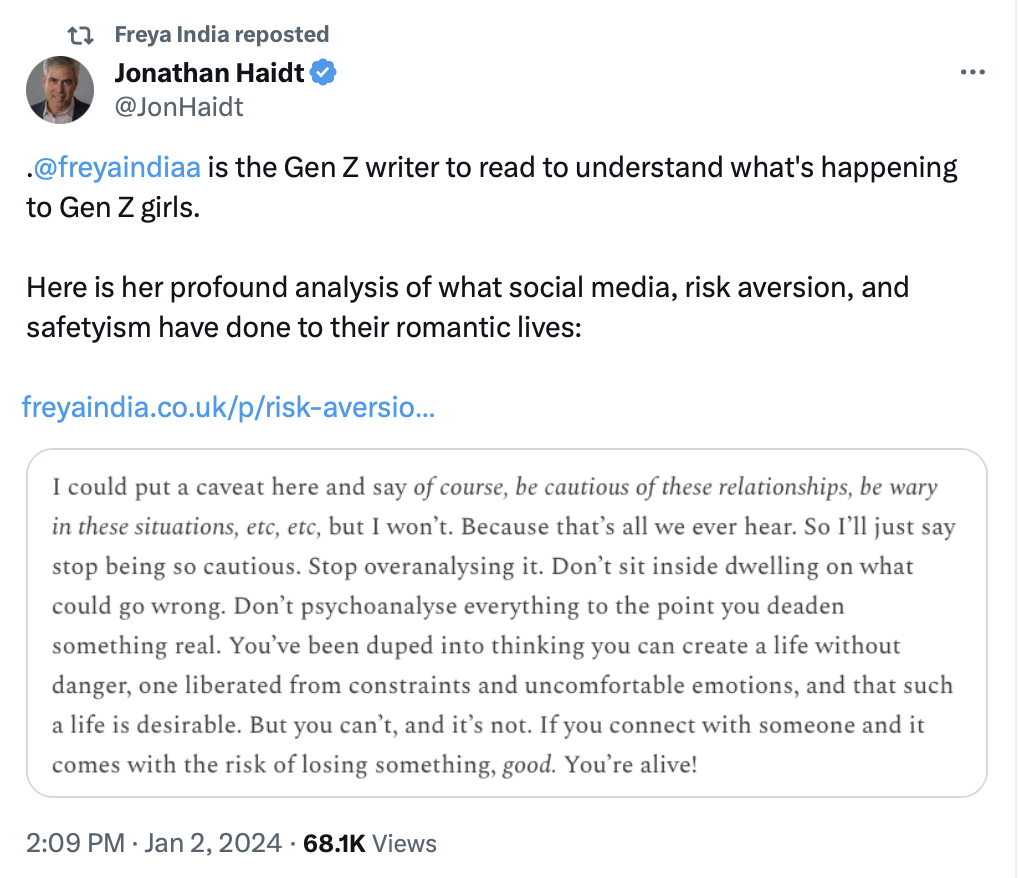
Jonathan Haidt is also impressed with India's analysis:

Continue ReadingThe Modern Destruction of Romance?