Jonathan Haidt: “We Were Fooled in the 1990s into Thinking that Democracy was Easy.”

What happened to progress in the US? It seemed like we had a plan and a good track record for progress back in the 1990s. A lot of things happened, of course. That is the topic of this discussion involving Jonathan Haidt and John Wood Jr and April Lawson. Here's how Haidt set the table for the longer discussion:

We can go back to some of the ideas in The Righteous Mind, because that's the summary of my own work as a social psychologist who studies morality. What I've always tried to do in my work is look at evolution. What is human nature. How did it evolve. [What is the] interplay of human nature with culture? And of course, everything can change over the course of just a few decades, too. We're very dynamic species.

What I'd like to put on the put on the table here first: let's really lower our expectations for humanity. Okay. Now, this sounds depressing. But let's be serious here. What kind of creatures, are we? We are primates who evolved to live in small groups that dominate territory, in competition with other groups were really, really good at coming together to fight those other groups. Part of our preparation for doing that, I believe, is the psychology of religion, sacredness, tribal rituals. We have all this really complicated stuff we do that binds us to each other. This is a human universal. Every group has rituals. I'm a big fan of the sociologist Emile Durkheim.

And so from that kind of perspective we ought to still be pre-civilization times with very high rates of murder. And somehow we escaped that. Somehow we've had this incredible ascent. This unbelievably rapid ascent, in which we've gotten wealthier, smarter, healthier. We've made extraordinary progress on women's rights, animal rights, gay rights, the concern about the environment. So let's start by appreciating our lowly origins as really violent tribal creatures, and the way that we've rocketed up from

Okay, now, in the last 10 or so, years, 10 to 20 years, we've had a little bit of a come-down. I really want to put this not just in an evolutionary perspective, but in a recent historical perspective, because this, I think, is the key to understanding what is happening to us now. It is that we were fooled in the 1990s into thinking that democracy was easy. The founding fathers were under no such illusion. They knew that democracy is prone to faction. That's what Madison wrote about, especially in Federalist 10. They knew that democracy is generally self-destructed, so they gave us all kinds of safeguards, They tried to create a system that would not be so prone, a system in which these tribal, irrational emotional creatures might actually live together. And it worked. It worked pretty well. And it worked badly at times.

But by the 1990s, we had the the mistaken view, that if we just wait for Iran, and Russia and North Korea to develop market economies, they'll get prosperous, their people will demand rights. And this was true for China too. That people will demand rights. Liberal democracies will break out everywhere. Liberal democracies are the endpoint, the end of history.

And so that's the way those of us who live through--I'm older than you guys--but the late 20th century was an incredibly dangerous and an exciting time in which there was a victor and it was liberal democracy. Okay, but like in a lot of movies where it seems like there's an early denouement and everything's great? Well, we still have a lot of stuff to go and in the 21st century, things have really come down from there. So that's the backstory.

Continue ReadingJonathan Haidt: “We Were Fooled in the 1990s into Thinking that Democracy was Easy.”

What Motivates Trump Voters?

Many people who call themselves liberal have written on FB that (and several told me in person) that they despise Trump voters and that they need not ever have a conversation with anyone who voted for Trump. Why? Many of them give this as the entire reason: "Trump voters are racist."

This reasoning is distressing to me because I (I identify as an independent) communicate with more than a few people who voted for Trump. I voted for Clinton and Biden. I acknowledge that there are some racists in the Republican party (I also believe that there are many racists among woke liberals), but to sum up that the entire motivation of every Trump voter as "racism" is over-simplistic and usually false. That's why I found this Tweet Thread by Darryl Cooper interesting. Is there any reason other than "racism" for being a MAGA voter? Cooper offers many such reasons. It's too bad many liberals refuse to take time to consider these before launching attacks on Trump voters. Glenn Greenwald offered an introduction to Cooper's thoughts. Here's an excerpt:

[W]e asked Cooper to elaborate on his influential thread, with a focus on what led him to these observations about prevailing MAGA sentiments and why he believes they are important for people to understand. As Cooper notes, he does not share all of the perceptions and beliefs he is conveying, although he shares many of them. Instead, based on the recognition that most media outlets are incapable of understanding let alone accurately describing the views of a group of people they view with little more than unmitigated contempt, condescension and scorn, he believes it is imperative that people understand the actual reality of what is motivating so many Trump voters in their views, perceptions and beliefs — regardless of whether each particular belief is accurate or not.

We also believe this understanding is vital, which is why we are happy to publish Cooper’s essay. It should go without saying that, as it true of all of our articles published on Outside Voices -- which we treat as an op-ed page -- our publishing of this article does not signify agreement with all of its claims, but only our belief that it is a viewpoint worth airing.

Here are a few excerpts to Cooper's analysis. You can read the entire thread here and here. You can listen to it here:

Trump supporters know - I think everyone knows - that Donald Trump would have been impeached and probably indicted if Robert Mueller had proven that he’d paid a foreign spy to gather damaging information on Hillary Clinton from sources connected to Russian intelligence and disseminate that information in the press. Many of Trump’s own supporters wouldn’t have objected to his removal if that had happened. Of course that is exactly what the Clinton campaign actually did, yet there were no consequences for it. Indeed, there has been almost no criticism of it.

Trump supporters had gone from worrying the collusion might be real, to suspecting it might be fake, to seeing proof that it was all a scam. Then they watched as every institution - government agencies, the press, Congressional committees, academia - blew right past it and gaslit them for another year. To this day, something like half the country still believes that Trump was caught red-handed engaging in treason with Russia, and only escaped a public hanging because of a DOJ technicality regarding the indictment of sitting presidents. Most galling, conservatives suspect that within a few decades liberals will use their command over the culture to ensure that virtually everyone believes it. This is where people whose political identities have for decades been largely defined by a naive belief in what they learned in civics class began to see the outline of a Regime that crossed not only partisan, but all institutional boundaries. They'd been taught that America didn't have Regimes, but what else was this thing they'd seen step out from the shadows to unite against their interloper president?

Cooper is not making a case that all of these things are true. His mission was to understand the mindset of MAGA advocates. It's too bad that so many people who identify as "liberal" would rather simplify MAGA voters as racist without considering any of these things. They would rather attack straw men. For those people like me who fear for our democratic project, this approach is dysfunctional and unproductive.

Continue ReadingWhat Motivates Trump Voters?

The Need for Absolute Moral Purity on Transgender Issues: The Story of Milli Hill

The story told by Milli Hill is stunning, disturbing and increasingly played out these days. Here the comment that caused her to become the object of intense hate by trans rights activists:

“Thanks. Good to see this post. I would challenge the term ‘birthing person’ in this context though, especially on international day to end violence against women. It is women who are seen as the ‘fragile sex’ etc, and obstetric violence is violence against women. Let’s not forget who the oppressed are here, and why.”

This comment was the match that lit the gasoline.

Hill recently tweeted:

Last Nov I expressed the view that obstetric violence is violence against women. It happens to women 'because they are female'. The resulting pile on was horrific. I've finally decided to tell my story and shine a light on this misogynistic bullying.

Hill is an eloquent and sensitive thinker and writer, but that didn't protect her. Despite being the target of a hate-fest, Hill is maintaining her position and her measured state of mind. I end here with this excerpt, but I highly recommend here article, "I Will Not be Silenced."

By sharing this story, I am aware I am laying it in front of you for your judgement. You may decide that my views about obstetric violence or the distinction between sex and gender are wrong. And that’s OK. It should be ok for us to hold different views and to respectfully discuss them. When we do so, it’s sometimes even possible to change people’s minds. Alternatively, we don’t change their minds, but our own clarity of thought benefits from the dialogue, and we develop and grow from the experience of sharing our views and disagreeing. We discover branches of thought we have not yet explored, we enter into grey areas, we see new perspectives. This is the kind of nuanced discussion that elevates humanity and promotes ideals such as peace, progress, growth and tolerance.

The opposite happens when we decide it is acceptable to mistreat, silence or bully people with whom we do not agree. It should never be acceptable to threaten individual’s livelihoods in the way that is currently happening to so many women. I can see that the tide is currently beginning to turn on this, as more women speak out – and this is my main motivation for speaking out. But I also hope that at some point there is a period of reflection on just how far the policing of women’s thoughts and opinions was allowed to go before anybody really noticed. To those of us in the eye of the storm, it felt completely dystopian, and this was exacerbated by the fact that the majority of people seemed to have no idea that a modern day ‘witch hunt’ was happening – or perhaps they did know, but looked the other way.

I also hope that people take time to consider why those who are being dragged to the pyre are not just women, but in most cases, lifelong left-leaning, open minded, educated and tolerant women, often with a history of supporting minority groups or working in areas concerned with justice and fairness. Either there is something in the water that has caused these usually rational and inclusive women to turn into hateful bigots overnight, or they have a point that’s worth listening to.

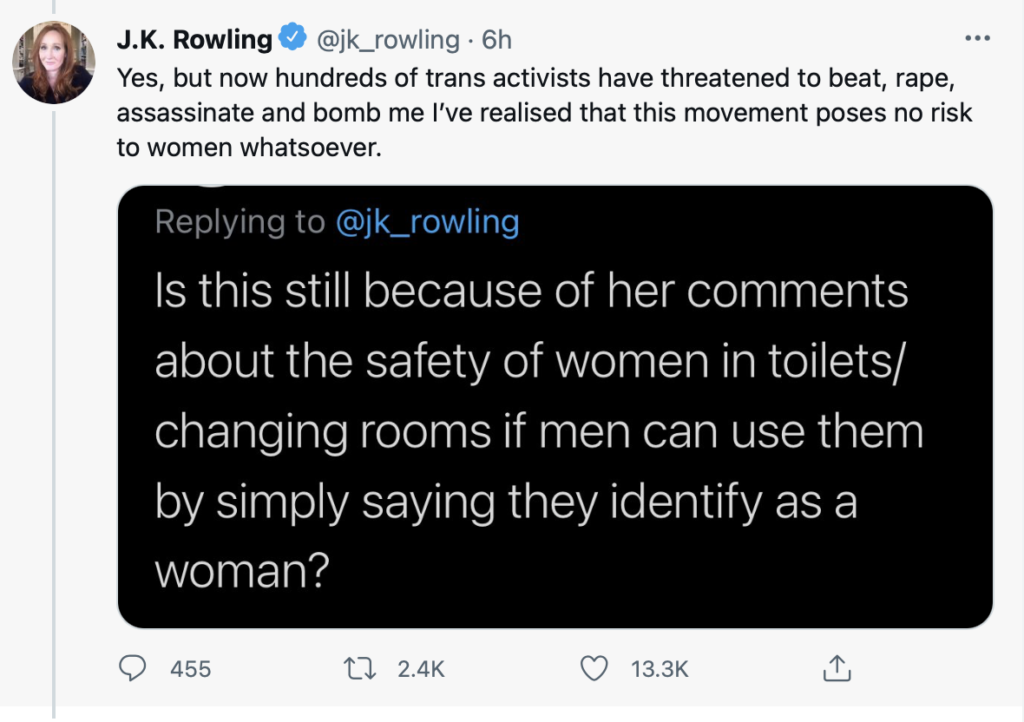
Meanwhile, J.K.Rowling stepped in to offer some words of support for Hill, somehow increasing her attractiveness as a target for venom:

Continue ReadingThe Need for Absolute Moral Purity on Transgender Issues: The Story of Milli Hill

Ed Snowden Discusses “The Most Dangerous Form of Censorship”

Ed Snowden has begun writing at Substack. He has named his column "Continuing Ed." In his first post he discusses the most dangerous form of censorship, beginning his essay with a quote by Serbian-Yugoslav writer Danilo Kiš. Kiš, who narrowly escaped the Holocaust and whose work was eventually suppressed in Yugoslavia, wrote passionately on this struggle:

Whichever way you look at it, censorship is the tangible manifestation of a pathological state, the symptom of a chronic illness which develops side by side with it: self-censorship. Invisible but present, far from the eyes of the public, buried deep down in the most secret parts of the spirit, it is far more efficient than [official] censorship. While both of them induce (or are induced?) by the same means — threats, fear, blackmail — this second ill camouflages, or at any rate does not denounce, the existence of any outside constraint. The fight against censorship is open and dangerous, therefore heroic, while the battle against self-censorship is anonymous, lonely and unwitnessed, and it makes its subject feel humiliated and ashamed of collaborating.

Snowden's essay is a commentary on this most dangerous form of censorship: self-censorship:

“Lonely and unwitnessed,” “dangerous and condemnable” — Kiš's perfect and tragic adjectives — describe how many people feel today, when confronted with the internet's many opportunities for self-presentation, and equally many opportunities for self-destruction. Under the pitiless eye of mass surveillance, which funnels the most tentative keystroke into our permanent records, we begin to surveil ourselves.

Unlike in Kiš's milieu, or in contemporary North Korea, or Saudi Arabia, the coercive apparatus doesn't have to be the secret police knocking at the door. For fear of losing a job, or of losing an admission to school, or of losing the right to live in the country of your birth, or merely of social ostracism, many of today's best minds in so-called free, democratic states have stopped trying to say what they think and feel and have fallen silent. That, or they adopt the party-line of whatever party they would like to be invited to — whatever party their livelihoods depend on.

I constantly feel that urge to self-censor, because I know that I'm pissing off people who will be vocal, many of whom I consider to be friends. I assume--perhaps presumptively--that many more will agree but will be silent). I often speak up anyway because I know that silent acquiescence by the supposed owners of this country is not a healthy want to run the country. I motivate myself to speak out by thinking of the many brave people who have spoken out against ignorance and injustice under conditions that are far more dangerous than anything I have ever faced.

A man dies when he refuses to stand up for that which is right. A man dies when he refuses to stand up for justice. A man dies when he refuses to take a stand for that which is true. - Martin Luther King, Jr.

As a general rule, people should publicly say the sorts of things that they are thinking. The American experiment requires that we collaborate with each other, and the best way is by using our words instead of throwing rocks and shooting guns. When we talk openly, we will offend others, and that is the unavoidable cost of free speech. When we bravely say the things we are thinking, we are able to function imperfectly as a coordinated whole, e pluribus unum. When a person self-censors, that person is only pretending to be part of the body politic. A wide-open national cacauphonous chattering is what bubbles up, in the aggregate into public policy. Any form of censorship thus degrades democracy and impairs social flourishing, even to the extent that idea seems like a terrible and offensive idea.

As Snowden describes, self-censorship is insidious. No one will come to your rescue because you are not making any public call for help. Further, it's easy to get used to self-censorship because there is a constant immediate cheap payback: it is extraordinarily rare that anyone will criticize you for failing to speak your mind on an important topic. Our self-censorship constitutes a payment to an intellectual protection racket. Institutions and governments won't shit on you so much when you muzzle your words and thoughts. That deal works out well enough for those who are willing to look in the mirror everyday to see someone lacking the courage of their convictions.

Continue ReadingEd Snowden Discusses “The Most Dangerous Form of Censorship”

The Straw-Manning of Christopher Rufo

Many people who only read left-leaning legacy media falsely assume that they are well-informed. They take their own select slice of information as a proxy for the full gamut of available information. Many do this because they don't want to spend an admittedly exhausting amounts of time doubling or tripling their news gathering time, much less doing the extra-hard work of processing conflicting accounts from various sources of information. Limiting our news gathering intellectually crimps us, but then we don't know what we don't know, so ignorance becomes bliss. Ignorance feels powerful and omniscient.

I'm posting these concerns because I keep hearing from people who are absolutely convinced that they know that criticism of CRT (Critical Race Theory) is a sham because they've heard about it at NYT/WaPo/NPR. These same news sources also tell us that Christoper Rufo is to be ignored because some Republicans find some of his ideas attractive. There is a much bigger world out there than left-learning legacy media. I lean left on many issues, but I keep encountering ad hominem attacks that I am a "conservative" or "Republican" because I don't pass the DNC purity test. Such simplistic and silo-driven reasoning!

I have been provoked to write this article because I noticed several people on FB citing WaPo's recent piece that starts off by straw-manning Rufo's concerns with this sentence: "Critical race theory holds that racism is systemic in the United States, not just a collection of individuals prejudices--—an idea that feels obvious to some and offensive to others." And with this single sentence, WaPo's entire article becomes a fraud. But those who choose to trust WaPo as authority wouldn't know it. If anyone wants to be truly informed, please consider Rufo's response to WaPo's article on Twitter. Of course, you don't HAVE TO read Rufo's response. But don't consider yourself well-informed unless you do.

[Added June 22, 2021]

The Washington Post walks back many steps.

Continue ReadingThe Straw-Manning of Christopher Rufo