How to be a Human Animal, Chapter 28: Morality and What to Do Next?

This is Chapter 28 of my advice to a hypothetical baby. I'm using this website to act out my time-travel fantasy of going back give myself pointers on how to avoid some of Life’s potholes. If I only knew what I now know . . . All of these chapters (soon to be 100) can be found here.

Why do people do the things they do? How can we make sense of all of this talk about what is "moral," and what is "right" and "wrong." These are an extremely difficult topics. As we already discussed, however, we need to beware systematizers who scold you to based on their mono-rules of morality. That was the main take-away from the previous chapter.

In this chapter, I’ll briefly discuss three approaches to morality that don’t rely on such simplistic rules. The first of these thinkers is Aristotle, who still has so very much to offer to us almost 2,500 years after he lived. His view of what it means to be virtuous is a holistic set of skills that requires lifelong practice. What a change of pace from the mono-rules of other philosophers. I’ll quote from Nancy Sherman’s book, Fabric of Character pp. 2 - 6:

As a whole, the Aristotelian virtues comprise just and decent ways of living as a social being. Included will be the generosity of benefactor, the bravery of citizen, the goodwill and attentiveness of friends, the temperance of a non-lascivious life. But human perfection, on this view, ranges further, to excellences whose objects are less clearly the weal and woe of others, such as a healthy sense of humor and a wit that bites without malice or anger. In the common vernacular nowadays, the excellences of character cover a gamut that is more than merely moral. Good character--literally, what pertains to ethics—is thus more robust than a notion of goodwill or benevolence, common to many moral theories. The full constellation will also include the excellence of a divine-like contemplative activity, and the best sort of happiness will find a place for the pursuit of pure leisure, whose aim and purpose has little to do with social improvement or welfare. Human perfection thus pushes outwards at both limits to include both the more earthly and the more divine.

But even when we restrict ourselves to the so-called ‘moral’ virtues (e.g. temperance, generosity, and courage), their ultimate basis is considerably broader than that of many alternative conceptions of moral virtue. Emotions as well as reason ground the moral response, and these emotions include the wide sentiments of altruism as much as particular attachments to specific others. . .  Pursuing the ends of virtue does not begin with making choices, but with recognizing the circumstances relevant to specific ends. In this sense, character is expressed in what one sees as much as what one does. Knowing how to discern the particulars, Aristotle stresses, is a mark of virtue.

It is not possible to be fully good without having practical wisdom , nor practically wise without having excellence of character  . . . Virtuous agents conceive of their well-being as including the well-being of others. It is not simply that they benefit each other, though to do so is both morally appropriate and especially fine. It is that, in addition, they design together a common good. This expands outwards to the polis and to its civic friendships and contracts inwards to the more intimate friendships of one or two. In both cases, the ends of the life become shared, and similarly the resources for promoting it. Horizons are expanded by the point of view of others, arid in the case of intimate relationships, motives are probed, assessed, and redefined.

Aristotle is talking to those of us who live in the real world, recognizing the complexity of the real world and helping us to navigate as best we can. Again, what a change from the mono-rules!  This real-world applicability and appreciation of nuance is something Aristotle has in common with the Stoics, which we discussed in Chapter 21. 

Here’s another approach, this one from modern times. For a long time, I've been almost obsessed that what we think of as moral is, in a real sense, beautiful and what we think of as immoral is ugly. Based on our reactions to situations that are "moral" and "immoral," there is no possible way that these things are not connected. Such an approach also recognizes that morality is not dictated by any static set of commandments or imperatives. Rather, both morality and art are, at least to some extent, in the eye of the beholder.

Continue ReadingHow to be a Human Animal, Chapter 28: Morality and What to Do Next?

CRT Related Censorship and Tribalism Make Inroads into the American Legal System

Detailed article by Aaron Sibarium, writing at Common Sense, the Substack of Bari Weiss.  The title to the article is "The Takeover of America's Legal System: The kids didn't grow out of it." Here are a couple excerpts:

The adversarial legal system—in which both sides of a dispute are represented vigorously by attorneys with a vested interest in winning—is at the heart of the American constitutional order. Since time immemorial, law schools have tried to prepare their students to take part in that system.

Not so much anymore. Now, the politicization and tribalism of campus life have crowded out old-fashioned expectations about justice and neutrality. The imperatives of race, gender and identity are more important to more and more law students than due process, the presumption of innocence, and all the norms and values at the foundation of what we think of as the rule of law.

One more . . .

Trial verdicts that do not jibe with the new politics are seen as signs of an inextricable hate—and an illegitimate legal order. At the Santa Clara University School of Law, administrators emailed students that the acquittal of Kyle Rittenhouse—the 17-year-old who killed two men and wounded another during a riot, in Kenosha, Wisconsin—was “further evidence of the persistent racial injustice and systemic racism within our criminal justice system.” At UC Irvine, the university’s chief diversity officer emailed students that the acquittal “conveys a chilling message: Neither Black lives nor those of their allies’ matter.” (He later apologized for having “appeared to call into question a lawful trial verdict.”)

Professors say it is harder to lecture about cases in which accused rapists are acquitted, or a police officer is found not guilty of abusing his authority. One criminal law professor at a top law school told me he’s even stopped teaching theories of punishment because of how negatively students react to retributivism—the view that punishment is justified because criminals deserve to suffer.

“I got into this job because I liked to play devil’s advocate,” said the tenured professor, who identifies as a liberal. “I can’t do that anymore. I have a family.”

Other law professors—several of whom asked me not to identify their institution, their area of expertise, or even their state of residence—were similarly terrified.

Nadine Strossen, the first woman to head the American Civil Liberties Union and a professor at New York Law School, told me: “I massively self-censor."

Continue ReadingCRT Related Censorship and Tribalism Make Inroads into the American Legal System

Matt Taibbi: Moral Panics Erase Memories

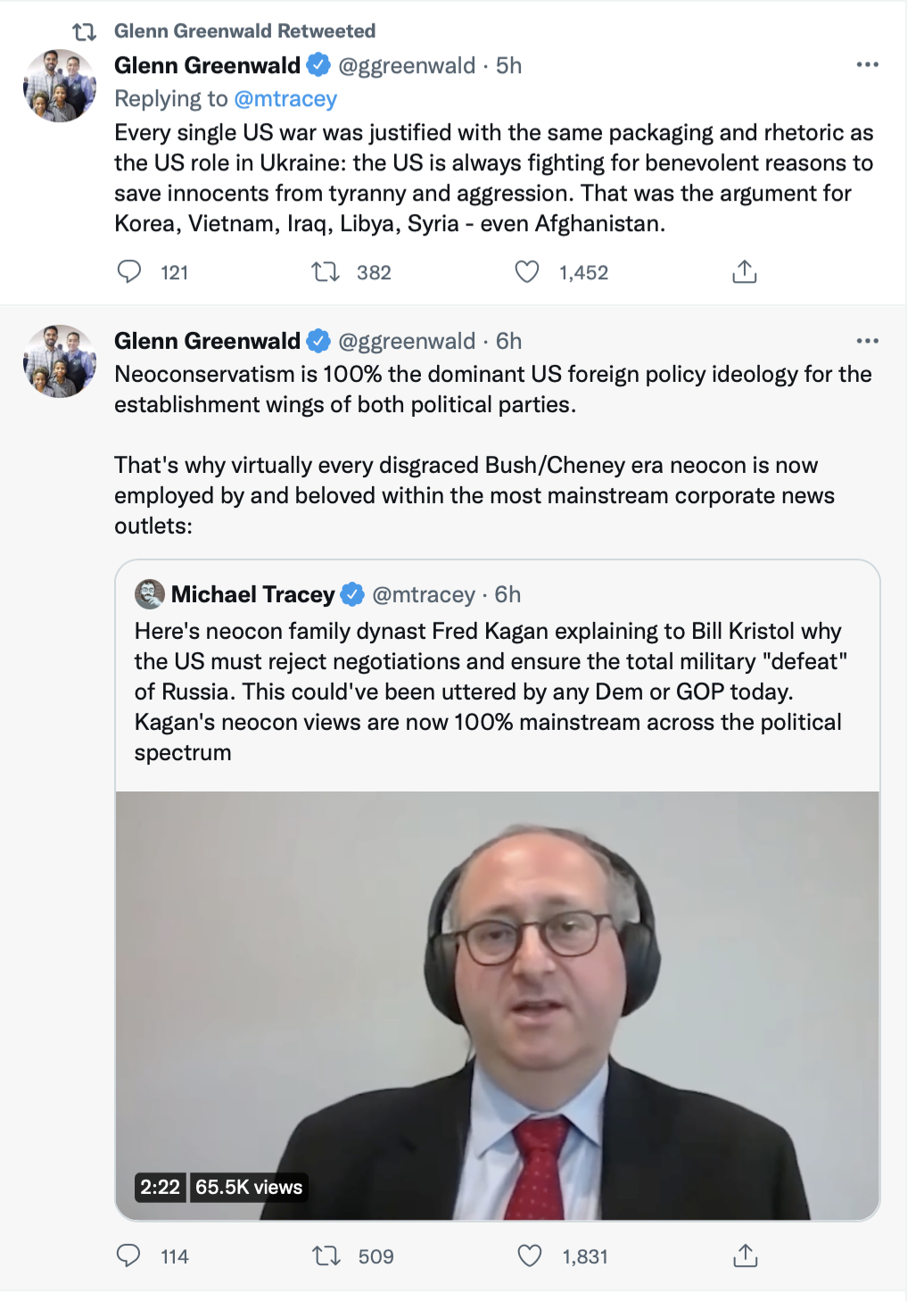
In "Orwell Was Right: From free speech to "spheres of influence" to our passion for endless war, we've become the doublethinkers 1984 predicted," Matt Taibbi points out how our hair-trigger rage makes us fickle. We are consumed with one thing after the other and we no longer have time to consider nuances or our own contradictions.I have read Taibbi's brilliant analysis three times. I can't stop worrying. Not only about the war, but about the willingness of Americans to enthusiastically embrace double-standards. And then, when they no longer work, we ignore them and embrace new double-standards.

Moral panics erase memories. It’s their primary function. 9/11 wiped the national hard drive of everything from the third degree to My Lai to Operations Phoenix and Condor to the Church Committee to the School of the Americas to countless other shameful episodes, and the lessons learned from them. The Trump-Russia scandal blotted out Snowden, made the spooks the good guys again. 2016 rehabilitated neoconservatives, now reinvented as never-Trumpers, cleaning away the shame of Iraq, Abu Ghraib, Afghanistan, etc.

The “misinformation” panic wiped out the WMD fiasco, restoring honor to credentialed press. The DNC leak erased “Collateral Murder.” After George Floyd we hated cops, after January 6th we loved them. Ukraine now is openly being sold as a blue-pill cure for everything that went wrong during the War on Terror, including the recent defeat in Afghanistan. “Realism” is in disgrace, and “leadership,” “regime change,” and the “universal appeal of freedom” are back, only this time their primary backers are the upper-class cosmopolitan Democrats who marched against the simplistic “freedom against evil” plot neoconservatives tried to sell them twenty years ago.

We’re at the end of a twenty-year cycle that has taken what was once the oppositional-skeptic portion of the American population and seen them rallied behind the people they once hated the most. This has been accomplished by keeping us in a rage that always escalates and is never watered down by contradictions, thanks to mastery of “reality control” via “an unending series of victories over your own memory.”

The relentless parade of panics listed above (just a small sample; we’ve had dozens just in the last few years) makes those victories easy, and every time we switch targets, from Russians to neo-Nazis to cops to transphobes to insurrectionists to the unvaccinated to truckers and back to Russians again, the Church of Forgetting picks up new converts.

I know plenty of people, many of them friends and many of them quite well educated, who now seem to be determining their heartfelt opinions by checking to see what way the wind blows around their social network. It has become extremely disappointing over the past couple of years. It's like their self-critical modules have somehow been flipped to the off position en masse.  For the most part, these are very smart people who have lost their ability to be curious and to make sense of the world around them on their own terms. It's like they've all been dusted with intellectual-coward dust. They no longer have time time or interest to listen to different thinking others. They listen to their own news sources, because other news sources are evil.

They have become hyper-vigilant to identity and difference. They write others off for the tiniest differences of opinion. Nothing less than moral purity will work if you want to be their friend in public. In private, it's somewhat different. In private you'll sometimes hear a different tune, a more measured perspective. I grew up Catholic. It reminds me of Catholics who chant in public that dead people can be alive again and that a virgin can have a baby. In private, they don't bring this stuff up because the chants served their purpose in public as cheap signaling so that they could bask in the social warmth of their group, not as meaningful information.

Productive political conversations are harder to find these days. I'm increasingly hearing the crowd-pleasing emotion-laden bluster leak into private conversations too.  I'm hearing this from people who had been staunch pacifists all their life, people who despised George W. Bush for the deaths he caused with his discretionary and deceitful war. From these same lifelong peace-niks, I am hearing calls to directly confront the Russian military. These are people who were terrified that when Trump did his bravado schtick regarding North Korea, a country that might have had a nuclear bomb or two and might have had a missile or two.  A couple years later, no problem! Ukraine is somehow worth it, even though we are cornering a man who they admit is a megalomanic nihilistic, arrogant hothead with thousands of nuclear bombs and thousands of missiles. Somehow, there is no need to do a cost-benefit analysis regarding Ukraine. And their getting lots of this aggressive talk from news media that leans to the political Left, media that hosts an unending stream of military generals and cheerleaders for the surveillance apparatus. Go figure.

Taibbi's article makes many excellent points. I encourage readers to sit down in a quiet place and to take it in line by line. One of Taibbi's points is that (for complex reasons I don't claim to fully understand) people are becoming much more willing to live only in the present. They are much more willing to seek out the outrage de jure.  "News" media is happy to feed them the newest outrage-of-the-day in order to sell advertisements. I suspect that the willingness to glue one's self to the outrage machine is exacerbated by increasing amounts of mortality salience in the air (Terror Management Theory), which induces people to "circle the wagons," further enabled by the polarizing influences of social media and our bifurcated "news media." We can't ignore COVID, COVID Denialism and COVID hysteria as other contributors to the current climate of mortality salience.

In times of mortality salience, people are looking for a "rock," something upon which they can rely. They are increasingly looking to acceptance by a group or a "group identity" rather than embracing consistent principles (e.g. free speech, the rule of law and Enlightenment principles). Contentment to live in the present is what animals such as dogs excel at. They have no language, thus no need to critique their former positions with their current positions.  Their world is their bowl of food and a someone to pet them on the head. For those who are willing to think fast, refusing to slow down to activate slower analytical thought, what is in front of you at this particular moment is always the only thing.  As Daniel Kahneman described, What You See Is All There Is (WYSIATI).  In recent times, I'm seeing increasing numbers of people who  are not willing to go back to check the hard work of slower, methodical and self-critical thinking. They see slower thinking as an impediment to their preference: impulsive action. Perhaps they have been trained for too many years of watching TV actions shows where heroes tend to be reactive (whereas villians seem to willing to sit down and plan out their diabolical plans).

It's easy to find your tribe these days. For most people it is left versus right wing politics, A versus B.  For increasing numbers of people (many that I personally know), their go-to reaction to danger is increasingly to seek the fast and easy safety of joining a group and parroting its talking points, despite the disastrous track record of this strategy.  For them, the alternative strategy of engaging in heterodox free speech, inviting dissent, seeking out nuances and doing cost-benefit analyses has become heretical. It takes too damned long, despite its excellent track. In fact, for many people, engaging in the free speech that they ostensibly celebrate on the Fourth of July has become treasonous. 

Back to Orwell's double-think. I struggled with this term until I translated it to double standards. There are two types of double-standards: A) my current actions versus my opponent's actions and B) my actions versus my own actions in the past.  A key point by Orwell is that people in a state of crisis become oblivious to their own double-standards. We don't have time for the exquisite thought tools, including skepticism math and the need for evidence, that we learned during the Enlightenment!  Many of the same people who clearly saw the their government lied to them about "weapons of mass destruction" and the "Gulf of Tonkin" incident have become some of the most fervent "believe the government" advocates. This, is despite decades of government lying about wars and decades of media outlets willingly amplifying the drumbeats of war.  They know that they should slow down and be less gullible, but there is not time for that because fear is in the air and you and people who disagree with you are miniature versions of Hitler who you being instructed to hate!  See this podcast where Taibbi discusses his book, Hate, Inc. with Joe Rogan.  All of this makes me wonder . . . are we really changing or is this the way we have always been? I suspect that social media is changing us, causing us to engage in more catastrophic thinking and all of the other things that cognitive behavioral therapy (CBT) is designed to prevent. Whatever the cause, increasing numbers of us seem to be wearing out cognitive dysfunctions as a fashion style, our way of showing each other that we care, even though we don't care enough to get or facts right. That pit in my stomach is trying to tell me that I have already seen (or read about) America's best moments. It appears that all of them are in the rear-view mirror now.  I hope I'm wrong, but it's getting harder and harder to convince me.

Continue ReadingMatt Taibbi: Moral Panics Erase Memories

The Problem with “Culturally Responsive Education” (CRE) and Other Variants of Neoracism

Dana Stangel-Plowe of the Foundation Against Intolerance and Racism (FAIR) explains:

In our latest video, FAIR’s Dana Stangel-Plowe discusses the issues surrounding a new academic theory called “Culturally Responsive Education.” While intended to connect students with their educational material on a deep level, Stangel-Plowe explains how this new method achieves the opposite by assuming people who superficially look like one another must also think like one another.

[T]he idea of providing kids books that feature characters who look like them feels intuitive as a way to connect them to the material; but building curriculum around students’ skin color, ancestry, or gender raises serious questions about the very purpose of education in our diverse and pluralistic nation.

By making assumptions about what will engage students based on race or immutable traits, CRE is racist. The idea that all people who share the same group identity would also share the same interests, experiences, or beliefs is reductive and demeaning to the unique human beings in that group.

Stangle-Plowe offers a more detailed analysis at FAIR's website:

Despite what some of its proponents would have us believe, CRE is much more than simply a framework for student-centered learning and a celebration of different cultures and cultural ways of knowing. CRE’s focus on “power dynamics,” “social change,” “liberation,” and “equitable outcomes” plainly reveal that critical pedagogy is baked into CRE. Critical pedagogy, popularized by Paolo Freire, is the Marxism-derived school of critical theory applied to education. Thus, it designates K-12 classrooms as the place to start a revolution to dismantle the dominant power structures—meaning our current systems of liberal democracy. Critical pedagogy is explicitly a political ideology—similar to other illiberal ideologies that focus on “liberation” and seek equality of outcomes—aiming to turn students into revolutionary activists.

With CRE becoming widespread, we must consider: Is there a better way to leverage student engagement for success across cultures? And, most importantly, how do we ensure that all students, regardless of their group identities, become “classroom insiders” without dehumanizing them or flattening them into stereotypes—and without replacing learning with activism?

It seems that we are mastering the art of slicing and dicing people culturally in much the same way that Google, Facebook and Amazon are using Billy Ball analytics on their customer bases. I see no problem categorizing people by their interests, such as knitting, pickle ball or art. The problem is with dividing people by irrelevant categories, such as the way they look or (often) the place where they were born. CRE assumes that people are "stuck" in these irrelevant categories and they they want more and more of the same. As Stangle-Plowe states, this is insulting and destructive. I'm proud to say that I am constantly learning many wonderful things from people who look different than me. I'm also proud to say that I don't obsess over what a person looks like. CLE is a well-meaning but destructive to the American Dream that we are one people who can work and play together. E pluribus unum.

Evaluating people based on superficial characteristics is inaccurate and lazy.  We need to avoid all miscategorizations, of course. Because people are extremely complex, it makes no sense to judge them on "race," sex or national origin any more than it would to determine who they are based on astrology.

Our cultural dysfunction based on insanely off-target miscategorizations needs to be cut off at the root, as suggested by Sheena Mason:

FAIR is

a nonpartisan organization dedicated to advancing civil rights and liberties for all Americans, and promoting a common culture based on fairness, understanding and humanity.

In conclusion, I am including FAIR's Principles of Peaceful Change:

FAIR Principles of Peaceful Change

Based on Dr. Martin Luther King Jr.'s Principles of Nonviolence

Exercise Moral Courage. Telling the truth is a way of life for courageous people. Peaceful change cannot happen without a commitment to the truth.

Build Bridges. We seek to win friendship and gain understanding. The result of our movement is redemption and reconciliation.

Defeat Injustice, Not People. We recognize that those who are intolerant and seek to oppress others are also human, and are not evil people. We seek to defeat evil, not people.

Don’t Take the Bait. Suffering can educate and transform. We will not retaliate when attacked, physically or otherwise. We will meet hate and anger with compassion and kindness.

Choose Love, Not Hate. We seek to resist violence of the spirit as well as the body. We believe in the power of love.

Trust in Justice. We trust that the universe is on the side of justice. The nonviolent resister has deep faith that justice will eventually win.

Continue ReadingThe Problem with “Culturally Responsive Education” (CRE) and Other Variants of Neoracism

How to Be a Human Animal, Chapter 17: Conversations Worth Having

Chapter 17: Conversations Worth Having

Greetings once again, hypothetical newborn baby!  Instead, I'm here once again to teach you another Life Lesson. I had to learn these at the School of Hard Knocks. No, I'm not claiming that you're not as able as me to learn those lessons.  I'm just trying to spare you some pain and frustration.  OK OK!  I admit that this is merely a thought experiment by which I am trying to set forth the most important things I've learned in 65 years. By the way, if you aren’t completely satisfied with these lessons, I’ll refund all of the money you paid for them ! This is Chapter 17 already.  Wow.  Aren't you tired of hearing my voice? No?  OK. Then I'll continue. If you need to review any of the past lessons, can find them all here. 

Today we’re going to talk about conversations. That term doesn’t simply mean talking with someone any more than food is defined as anything you put your mouth. Er, I can already see you drooling at you stare at my car keys. Just settle down now . . . OK, you can suck on your toes while you listen. That’s cool.

There are many types of conversations, but they fall on a continuum from simple factual exchanges on (“Is it raining?” “Yes”) to collaborations in which the parties set out to figure out a complex topic as a joint exercise by celebrating each others’ contributions.

Psychologist Scott Barry Kauffman recently Tweeted:

Imagine what discourse would be like if instead of it being conceptualized as a "match" to see who "wins", discussions were seen as mutual attempts to get at a shared truth or seen as a shared mission to get outside of ourselves and transcend our individual perspectives.

That would be a nice world, the kind I can imagine happening 24/7 at the big house where the philosophers and other "virtuous pagans" hang out just on the other side of Dante's River Acheron. You, however need to live in the world you were handed. You ended up on a Grade A planet in a Grade C era with regard to conversations.

Right now, your interactions will mostly be where some other baby grabs your toy and you cry. Here’s the problem you'll encounter when you get older: Even if you optimistically join a discussion hoping it is of the “Kauffman” variety, that doesn’t guarantee an enlightening and engaging experience. It takes two to tango and many people would rather honk at you (don’t look at ME as I say that!) than celebrate each other’s differing perspectives. Tango is the correct metaphor because, at their best, conversations are like dancing with other people. If either of you are stepping on the others’ feet, neither of you are going to have a good time.

Here's why this era is so fraught for those who want to share complex ideas with others (especially on contentious topics): We live in a time where the so-called news media makes much of its money by stirring up conflict and even hate. It’s the same thing with social media. The companies in charge of these things have decided in their corporate consciences that it's quite simple, actually: no conflict, no money. This has wrecked a pretty decent (though admittedly imperfect) conversational thing we had going on for decades.

Here’s how it so often plays out: Let’s say that you join a conversation in an open frame of mind, interested in freely sharing perspectives on an issue, but the other person is not so inclined. The other person, having been steeped in news media and social media, and now cooked to an extra-fever pitch of loneliness and rage during the pandemic, is committed to scoring points, schooling you and “winning” the discussion. I know, right? Why should there ever be a “winner” to a discussion, but that’s how many people see it these day. And they have plenty of tactic for “winning,” including these: [More . . . ]

Continue ReadingHow to Be a Human Animal, Chapter 17: Conversations Worth Having