Ukraine: Forbidden Discussions

I'm despondent that the mainstream news outlets are so intensely jingoistic, so focused on the logistics of war, so unwilling to look into the mirror. This is not surprising given the vast numbers of retired military and spy state talking heads who now work for the left leaning MSM. It's also unsurprising given that this is how war propaganda always works, illustrated brilliantly by "War Made Easy."

Here are a three snippets of conversation that I with the news media would take much more seriously:

First, this is from Freddie DeBoer's Substack:

[R]ight now, [the United States is] investing hideous amounts of treasure to maintain an order that we can’t afford and that no one really believes we can maintain. Perhaps the Ukrainians will beat back the Russians and they’ll be welcomed into NATO and we can all cheer that the good guys won. But hegemony does not last forever, and sooner or later you’re going to have to ask more adult, more useful questions than, “who’s the goodie, and who’s the baddie?” Otherwise the superpower eventually goes down the hard way.

I find myself considering this quote from a spokeswoman for the Chinese Foreign Ministry.

When the U.S. drove five waves of NATO expansion eastward all the way to Russia’s doorstep and deployed advanced offensive strategic weapons in breach of its assurances to Russia, did it ever think about the consequences of pushing a big country to the wall?

It doesn’t take sympathy for Putin to see that this is a very good question.

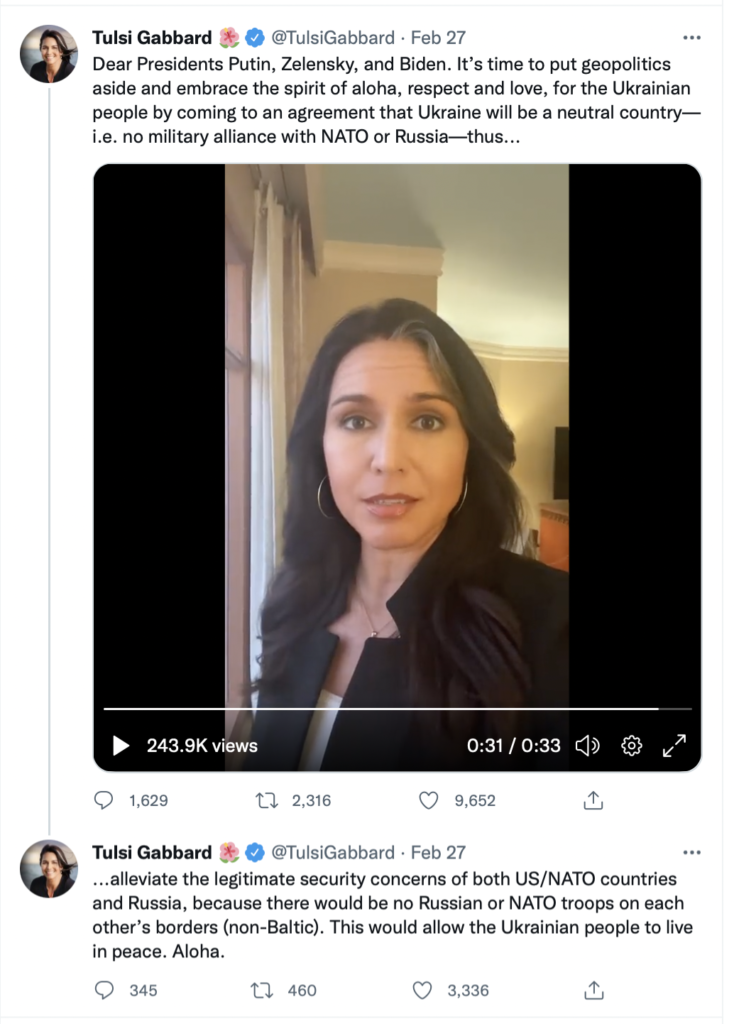
Second, Tulsi Gabbard tweeted this:

Third, Matt Taibbi reminds us that history matters:

I would like to point out that we already tried regime change in Russia. I remember, because I was there. And, thanks to a lot of lurid history that’s being scrubbed now with furious intensity, it ended with Vladimir Putin in power. Not as an accident, or as the face of a populist revolt against Western influence — that came later — but precisely because we made a long series of intentional decisions to help put him there.

Once, Putin’s KGB past, far from being seen as a negative, was viewed with relief by the American diplomatic community, which had been exhausted by the organizational incompetence of our vodka-soaked first partner, Boris Yeltsin. Putin by contrast was “a man we can do business with,” a “liberal, humane, and decent European” of “alert, controlled poise” and “well-briefed acuity,” who was open to anything, even Russia joining NATO. “I don’t see why not,” Putin said. “I would not rule out such a possibility.”

Fourth, this excerpt is from Glenn Greenwald's detailed analysis of our tribal dysfunction that mushroom when that exciting topic of war hits the tabletop:

In the weeks leading up to the Russian invasion of Ukraine, those warning of the possible dangers of U.S. involvement were assured that such concerns were baseless. The prevailing line insisted that nobody in Washington is even considering let alone advocating that the U.S. become militarily involved in a conflict with Russia. That the concern was based not on the belief that the U.S. would actively seek such a war, but rather on the oft-unintended consequences of being swamped with war propaganda and the high levels of tribalism, jingoism and emotionalism that accompany it, was ignored. It did not matter how many wars one could point to in history that began unintentionally, with unchecked, dangerous tensions spiraling out of control. Anyone warning of this obviously dangerous possibility was met with the “straw man” cliché: you are arguing against a position that literally nobody in D.C. is defending.

. . .

There is a reason I devoted the first fifteen minutes of my live video broadcast on Thursday about Ukraine not to the history that led us here and the substance of the conflict (I discussed that in the second half), but instead to the climate that arises whenever a new war erupts, instantly creating propaganda-driven, dissent-free consensus. There is no propaganda as potent or powerful as war propaganda. It seems that one must have lived through it at least once, as an engaged adult, to understand how it functions, how it manipulates and distorts, and how one can resist being consumed by it.

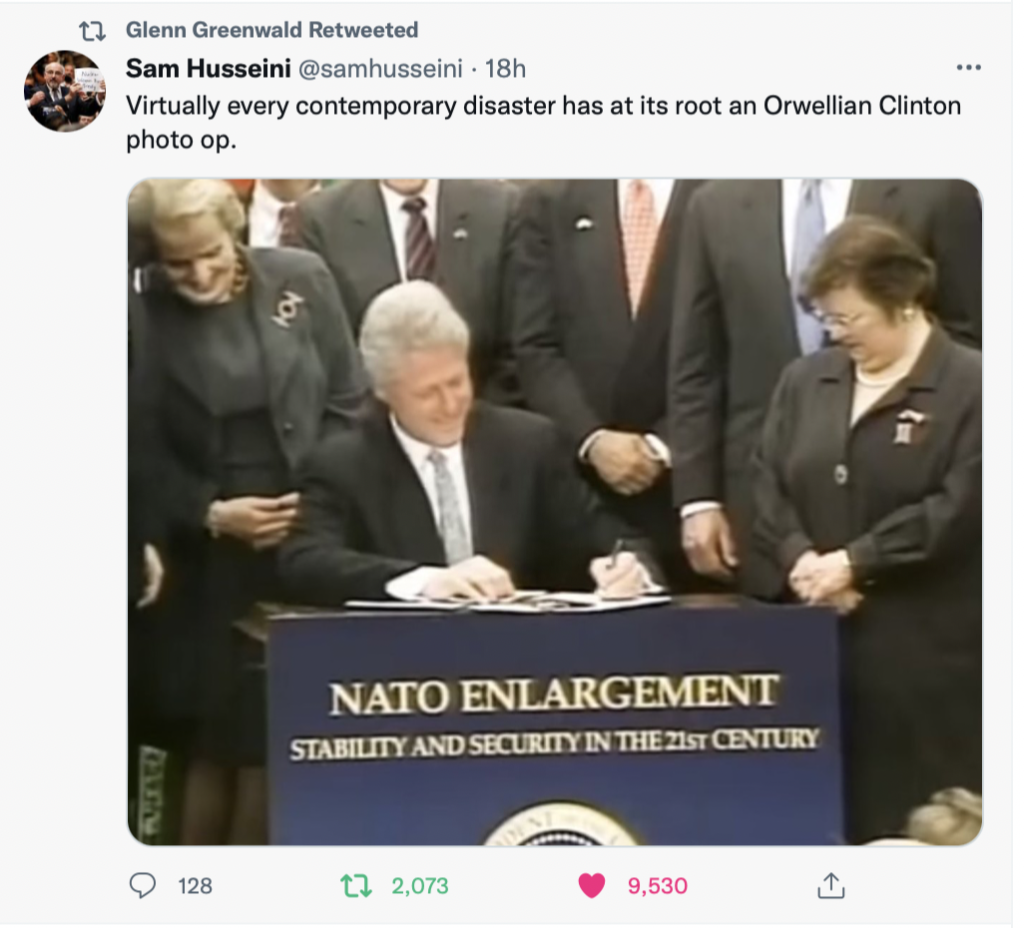
I will end with a photo:

Continue ReadingUkraine: Forbidden Discussions

The Long Tradition of Dividing People Into Good People and Bad People

Matt Taibbi, writing about Howard Zinn's People's History of the United States:

No matter how interesting a book he or she is able to write, any author who admits to looking out at the world and seeing only “victims and executioners” needs psychological help. Unfortunately, Zinn in this respect turned out to be a pioneer, presaging a generation of comic-book thinkers who understand things in binary terms, forever preoccupied with cramming people in neat categories of oppressors and oppressed.

Such mental habits are the fashion now and will definitely put you in a bind on Thanksgiving. How can I eat turkey and stuffing with a smile, when Columbus massacred the Arawaks? When the English forced the Wampanoags off their land and made many convert to Christianity? When Lincoln told Horace Greeley, “If I could save the Union without freeing any slave, I would do it”?

How? Maybe because you’re more than three years old, and don’t need fairy tales to be real in order to enjoy dinner with family and a football game?

Taibbi's article is "Thanksgiving is Awesome: In reply to the haters. Happy holiday, everyone."

On a more serious note, I read Zinn's book when I was a teenager and it was a much needed shock to my system, given that I had, to that point, been exposed to a steady stream of textbooks and teachers who argued American Exceptionalism. I agree with Taibbi that both of these approaches are simplistic.

Continue ReadingThe Long Tradition of Dividing People Into Good People and Bad People

The Political Left Needs to Start Judging More Wisely

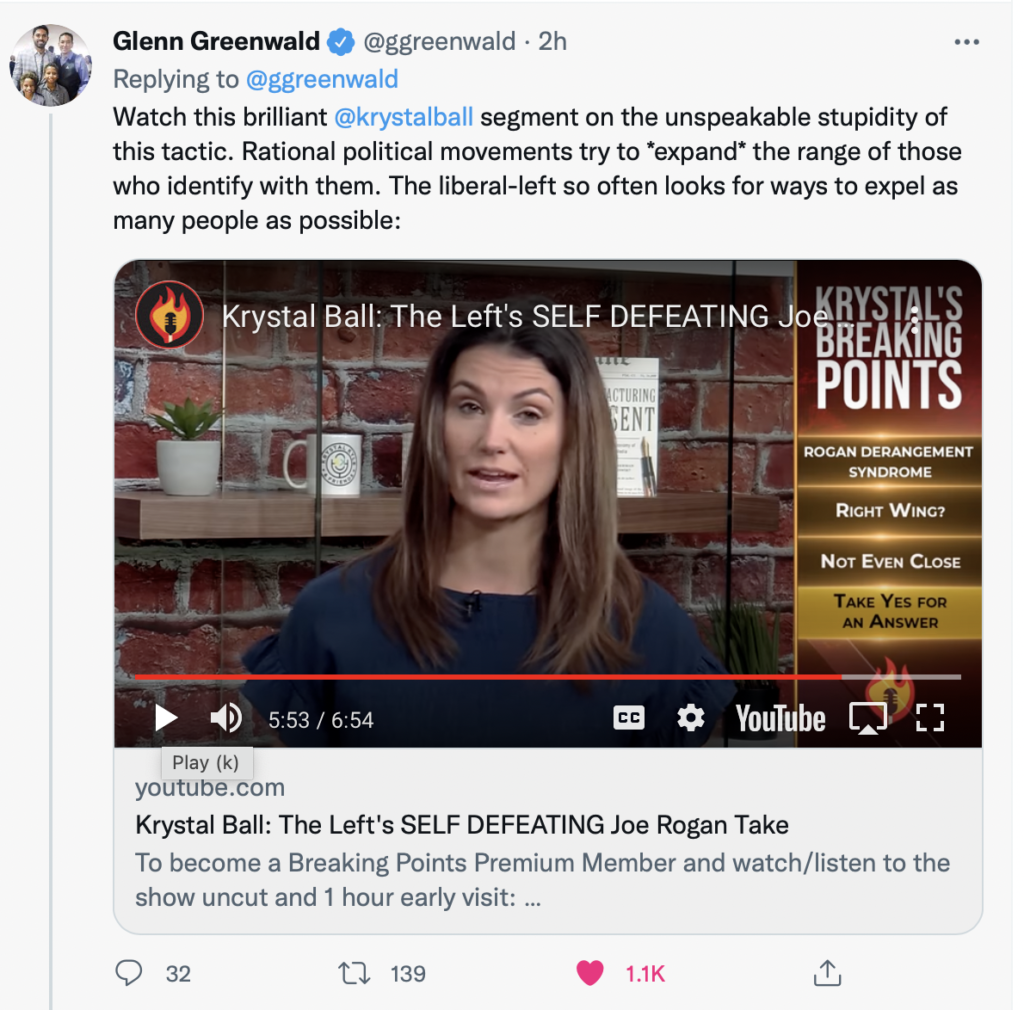
I saw this Rogan interview with Krystal and Saagar. I've watched a lot of Joe Rogan for the past two years. He leans far left on most issues he discusses, but that's not good enough for most people and news media on the political left, who seek to purification, not nuanced discussion. Many of them have no idea what to do with people like Rogan, who hold heterodox opinions. They reject the idea of human complexity and they are increasibly thinking in cartoons. That is the subject of Krystal Ball's 7-minute commentary. It was spot on. I've seen this rejection of the "impure" on FB over and over. IMO, this is ruining the political left and sending many voters over to the political right, which is morally bankrupt.

My advice to people on the political left: Quit demonizing people who are not aligned with your views. Quit writing off everyone who voted differently than you. Engage openly and respectfully with your family, neighbors and friends who think differently than you. I'm an atheist, but Jesus had it right when he gave the Sermon on the Mount: "Love your enemies." I give thanks today that we don't all think alike. And I give thanks for the wisdom of John Stuart Mill. And I give thanks for the courage and soaring inspirational thoughts of Martin Luther King: Hate cannot drive out hate and we should judge each other only by the content of our character. Let's start judging each other more wisely starting today.

Continue ReadingThe Political Left Needs to Start Judging More Wisely

The Best System for Determining What is True

I'm reading The Constitution of Knowledge by Jonathan Rauch (2021). Rauch has written an extraordinary book offering a detailed airtight case for why we need each other in order to determine what is true. We need a mediated social system in order to filter out the despots and crackpots, but who will mediate such a system? The incredible answer is no one in particular. The system powers the process, but the system cannot function in the absence of three prerequisites. The following passage sums up what we need to get the job done:

An epistemic regime—that is, a public system for adjudicating differences of belief and perception and for developing shared and warranted conclusions about truth—should provide three public goods.

First, knowledge. The system should be competent at distinguishing reality from non-reality, and at building on previous discoveries so that knowledge accumulates, thereby generating even more knowledge.

Second, freedom. The system should encourage rather than repress human autonomy, creativity, and empowerment. It should welcome and exploit human diversity, especially diversity of opinion, and it should not allow any person or faction to use force or intimidation to control what others say or believe.

Third, peace. The system should reward social conciliation, maximize the number of disagreements which are resolvable, and compartmentalize and marginalize disagreements when it cannot resolve them. It should inculcate intellectual values which abhor violence and bullying, and it should establish institutions and norms which tolerate and even embrace disagreement and doubt.

No one should expect any knowledge-producing system to be perfect, or close to it. Still, many centuries of history show that the liberal system—the reality-based community—comes closer to perfection than any other human social invention.

Next, we need two rules (p. 89):

The fallibilist rule: Ho one gets the final say. You may claim that a statement is established as knowledge only if it can be debunked, in principle, and onlyinsofar as it withstands attempts to debunk it. That is, you are entitled to claim that a statement is objectively true only insofar as it is both checkable and has stood up to checking, and not otherwise. In practice, of course, determining whether a particular statement stands up to checking is sometimes hard, and we have to argue about it. But what counts is the way the rule directs us to behave: you must assume your own and everyone else’sfallibility and you must hunt for your own and others’errors, even if you are confident you are right. Otherwise, you are not reality-based. The Constitution of Knowledge

The empirical rule: No one has personal authority. You may claim that a statement has been established as knowledge only insofar as the method used to check it gives the same result regardless of the identity of the checker, and regardless of the source of the statement. Whatever you do to check a proposition must be something that anyone can do, at least in principle, and get the same result. Also, no one proposing a hypothesis gets a free pass simply because of who she is or what group she belongs to. Who you are does not count; the rules apply to everybody and persons are interchangeable. If your method is valid only for you or your affinity group or people who believe as you do, then you are not reality-based.

Continue ReadingThe Best System for Determining What is True

“The News” Has Become Two Head-Butting Religions

Matt Taibbi explains that the modern version of "news" is religion. All honest people know this. That is why so many smart people of all political persuasions lament that there is far too much "fake news," many of them telling me that they now longer watch "the news." Taibbi's article: "The News is America's New Religion, and We're in a Religious War - When political narrative replaces faith, truth becomes heresy." Here's an excerpt:

News in America used to be fun to talk about, fun to joke about, interesting to think about. Now it’s an interminable bummer, because the press business has taken on characteristics of that other institution where talking, joking, and thinking aren’t allowed: church. We have two denominations, both as fact-averse as real churches, as is shown in polls about, say, pandemic attitudes, where Americans across the board consistently show they know less than they think.

Surveys found a third of Republicans think the asymptomatic don’t transmit Covid-19, or that the disease kills fewer people than the flu or car crashes. But Democrats also test out atrociously, with 41% thinking Covid-19 patients end up hospitalized over half the time — the real number is 1%-5% — while also wildly overestimating dangers to children, the percentage of Covid deaths under the age of 65, the efficacy of masks, and other issues.

This is the result of narrative-driven coverage that focuses huge amounts of resources on the wrongness of the rival faith. Blue audiences love stories about the deathbed recantations of red-state Covid deniers, some of which are real, some more dubious. A typical Fox story, meanwhile, might involve a woman who passed out and crashed into a telephone pole while wearing a mask alone in her car. Tales of each other’s stupidity are the new national religion, and especially among erstwhile liberals, we take them more seriously than any religion has been taken in the smart set in a long, long time.

BTW, check out the video in Taibbi's article for a reminder of how networks used to report the news.

Continue Reading“The News” Has Become Two Head-Butting Religions