Glenn Greenwald has once again gathered evidence that American citizens are intentionally being kept in the dark, even by our "news" media:
Yesterday, as I noted earlier, The Guardian reported that Davis -- despite Obama's description of him as "our diplomat in Pakistan" -- actually works for the CIA, and further noted that Pakistani officials believe he worked with Blackwater. When reporting that, The Guardian noted that many American media outlets had learned of this fact but deliberately concealed it -- because the U.S. Government told them to: "A number of US media outlets learned about Davis's CIA role but have kept it under wraps at the request of the Obama administration."
. . .
In other words, the NYT knew about Davis' work for the CIA (and Blackwater) but concealed it because the U.S. Government told it to. Now that The Guardian and other foreign papers reported it, the U.S. Government gave permission to the NYT to report this, so now that they have government license, they do so -- only after it's already been reported by other newspapers which don't take orders from the U.S. Government.
. . .
[T]here is simply no justification -- none -- for a newspaper to allow government officials to run around misleading the public, and to print those misleading statements, all while concealing information (at the Government's request) which reveal those claims to be factually dubious.
The question that has echoed in my ear for the past 10 years (or more) is, "What else don't we know?"
I am not a political analyst. Nor am I a games theorist, although I come from a family full of them. But there seems to be a pattern in the odd funding battles currently being fought by Federal House Republicans.
Defunding Planned Parenthood is a high profile battle that seems pretty silly. For 1/6 the price of a single stealth bomber, Planned Parenthood provides birth control, pap smears, breast exams, STD treatments and other health services to millions of the poor and unenfranchised for a year. No tax money has gone for abortions since the 1970's, so this service is not actually the issue.
Well, unwanted children help keep prisons full. Or become likely infantry assets (cannon fodder). They also keep the crime rate up, allowing the Fear, Uncertainty, and Doubt crowd a tighter control over individual rights.
Also, knowledge is power. Planned Parenthood works hard to try to educate young people on how to get out of the young-breeder cycle and build more fulfilling lives. If conservatives could just get this unregulated source of pure information away from the young, then church indoctrination would provide the Quiverfull of Christian soldiers at the voting booths.
Defunding Public Broadcasting is a less publicized issue. They argue that NPR and PBS may have been a necessary part of the dial back when there were three networks. But now there are hundreds! So who needs just one more paid for by taxes?
Well, in the old days, there was one non-commercial educational network on the dial: PBS. Now, with hundreds of stations to choose from, there is one non-commercial educational network on the dial: PBS. Why is this a problem to conservatives?
Well, the cities are a lost cause. With inescapable multiculturalism, a high rate of college education, and exposure to a wide variety of influences and media, cities tend toward a liberal bias. Knowledge does that. But out in the boondocks, the only fly in the otherwise completely conservative Christian ointment is the centrist ("bleeding heart liberal") influence of Public Broadcasting. If they could only get rid of that, they'd control all the channels.
Conclusion: Republican Policy is Ignorance is Bliss: Cut programs accordingly.
Last year, before I even heard of DI, I resolved to read all 15 of Isaac Asimov’s books/novels set within his Foundation universe this year. Why “before I even heard of DI”? Well, you may already know, but I won’t spoil the detective work if you don’t. (Hint: scroll down to the list about ¾ down the wiki page.) Why “this year”? I spent the summer and fall studying for an exam I had put off long enough and had little time for any outside reading.
I read I, Robot nearly 40 years ago, and The Rest of the Robots some time after that, followed by the Foundation trilogy, Foundation’s Edge when it was published in 1982, and Prelude to Foundation when it was published in 1988. I never read any of the Galactic Empire novels or the rest of the Foundation canon, and none of the “Robot novels”, which is why I decided to read them all, as Asimov laid out the timeline. I do like to re-read books, but hadn’t ever re-read any of the robot short stories, even when I added The Complete Robot to my collection in the early 1980s. As I’ve slept a bit since the first read, I forgot much, particularly how Asimov imagined people in the future might view robots.
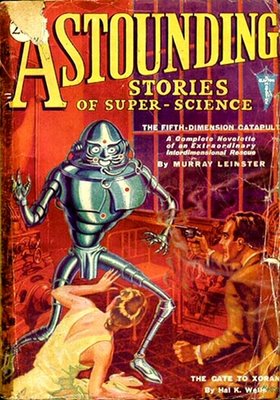
Many recognize Asimov as one of the grandmasters of robot science fiction, (any geek knows the Three Laws of Robotics; in fact Asimov is credited with coining the word “robotics”). He wrote many of his short stories in the 1940s when robots were only fiction. I promise not to go into the plots, but without spoiling anything, I want to touch on a recurrent theme throughout Asimov’s short stories (and at least his first novel…I haven’t read the others yet): a pervasive fear and distrust of robots by the people of Earth. Humankind’s adventurous element - those that colonized other planets - were not hampered so, but the mother planet’s population had an irrational Frankenstein complex (named by the author, but for reasons unknown to most of the characters being that it is an ancient story in their timelines). Afraid that the machines would take jobs, harm people (despite the three laws), be responsible for the moral decline of society, robots were accepted and appreciated by few (on Earth that is.) {note: the photo is the robot Maria from Fritz Lang's "Metropolis", now in the public domain.}Robots in the 1940s and 1950s pulp fiction and sci-fi films were generally menacing like Gort in the 1951 classic, The Day the Earth Stood Still, reinforcing that Frankenstein complex that Asimov explored. Or functional like one of the most famous robots in science fiction, Robbie in The Forbidden Planet, or “Robot” in Lost in Space who always seemed to be warning Will Robinson of "Danger!"
When writing this, I remembered Silent Running, a 1972 film with an environmental message and Huey, Dewey and Louie, small, endearing robots with simple missions, not too unlike Wall-E. Yes, robots were bad again in The Terminator, but we can probably point to 1977 as the point at which robots forever took on both a new enduring persona and a new nickname – droids. {1931 Astounding was published without copyright}
Why the sketchy history lesson (here's another, and a BBC very selective "exploration of the evolution of robots in science fiction")? It was Star Wars that inspired Dr. Cynthia Breazel, author of Designing Sociable Robots, as a ten year old girl to later develop interactive robots at MIT. Her TED Talk at December 2010’s TEDWomen shows some of the incredible work she has done, and some of the amazing findings on how humans interact.
Very interesting that people trusted the robots more than the alternative resources provided in Dr. Breazel’s experiments.
Asimov died in 1992, so he did get to see true robotics become a reality. IBM’s Watson recently demonstrated its considerable ability to understand and interact with humans and is now moving on to the Columbia University Medical Center and the University of Maryland School of Medicine to work with diagnosing and patient interaction.
Imagine the possibilities…with Watson, and Dr. Breazel’s and others’ advances in robotics, I think Asimov would be quite pleased that his fears of human robo-phobia were without … I can’t resist…Foundation.
ZeroHedge has earned a spot in my RSS feed. A diverse group of mostly pseudonymous bloggers who consistently produce excellent financial reporting, many times breaking scandals and should-be scandals before the mainstream media. They focus on the themes of intrigue in the world of high finance, corruption, politics, and the nexus where those areas intersect.
Over the past month or so, I've noticed an increasing amount of visual propaganda coming from ZeroHedge, and some of it is quite amusing. For the latest entry, they lampoon the news that Angelo Mozilo (the bankster behind the collapse of Countrywide financial) is going scott-free. Here's some background on Mozilo, from the New York Times:
The conclusion by prosecutors that Mr. Mozilo, 72, did not engage in criminal conduct while directing Countrywide will likely fuel broad concerns that few high-level executives of financial companies are being held accountable for the actions that led to the financial crisis of 2008.
I’ll admit up front that I’m shooting from the hip here. There are many aspects to what is happening in Wisconsin right now with parallels to several past instances in the country in the fight over workers’ rights, unions, and moneyed interests, but I frankly don’t have the time to research them all right now and get something up before it all comes to a head.
Isn’t it interesting, though, that we are collectively cheering what is happening in the Middle East right now and something similar is happening right here and people don’t seem to be paying attention to what’s at stake?
I grant you, it’s a stretch. But on principles, not so much. We’re talking about who has the right to speak to power and over what. The protesters in Madison aren’t having their internet access and phone service pulled and it’s doubtful the military will be called in, but on the other hand the Wisconsin state police are being asked to go get the now-labeled Wisconsin 14 and bring them back to the state capitol to vote on something that is clearly a stripping of the right of petition and assembly. So this can become very quickly a constitutional issue and that’s scary, because right now the Supreme Court has been decidedly against workers’ rights.
Governor Scott is at least being clear. I’ll give him credit, he’s not ducking questions about what he’s trying to do. Wisconsin, like many states, has a budget crisis. He’s already gotten concessions from the unions, a lot of money. The unions have not balked at doing their civic duty in terms of agreeing to pay cuts, freezes on raises, and some concessions on benefits to help the state meet its budgetary responsibilities. But he’s going further and asking that all these unions be stripped of their collective bargaining abilities in order to make sure they never again demand something from the state that the legislature or the governor believes they don’t deserve. In other words, Governor Scott doesn’t ever want to have to sit down and ask them for concessions ever again—he wants to be able to just take what he wants.
[More . . . ]
Hello, I invite you to subscribe to Dangerous Intersection by entering your email below. You will have the option to receive emails notifying you of new posts once per week or more often.