
Not open government

I decided to see how hard it would be to determine what information Homeland Security has gathered about me. I went to the Homeland Security Website and wrote an email to Homeland Security (foia@dhs.gov). Here is my email request:

January 23, 2011 Catherine M. Papoi Deputy Chief FOIA Officer Director, Disclosure & FOIA The Privacy Office 245 Murray Drive, S.W. STOP-0550 Washington, DC 20528-0550 FOIA REQUEST Dear FOIA Officer: Pursuant to the federal Freedom of Information Act, 5 U.S.C. § 552, I request access to and copies of All records dated on or after January 1, 2006 concerning "Erich Vincent Vieth" in your possession. I would like to receive the information in electronic format. (CD-ROM.) I agree to pay reasonable duplication fees for the processing of this request in an amount not to exceed $150. However, please notify me prior to your incurring any expenses in excess of that amount. If my request is denied in whole or part, I ask that you justify all deletions by reference to specific exemptions of the act. I will also expect you to release all segregable portions of otherwise exempt material. I, of course, reserve the right to appeal your decision to withhold any information or to deny a waiver of fees. As I am making this request as an author and this information is of timely value, I would appreciate your communicating with me by telephone, rather than by mail, if you have questions regarding this request. I look forward to your reply within 20 business days, as the statute requires.[caption id="attachment_16372" align="alignright" width="300" caption="Image by Ssuaphoto at dreamstime (with permission)"][/caption] Thank you for your assistance. Sincerely, Erich Vieth

Now all I needed to do was sit back and wait for the federal government to disclose to me all of my emails that they've been reading and all of my phone calls that they've been listening to. We'll, actually, instead of getting information, I got a major league dose of bureaucratese. Here's the paper letter I received instead of real information. I've interspersed comments below in red and in brackets: [More . . . ]

Continue ReadingNot open government

The Day the Routers Died

This cute song is about a serious issue.

The Web is technically part of the Internet, descended from Arpanet. Way back when the addressing protocol was established, they figured that 4 bytes were sufficient. After all, there were about 10,000 computers in the world, and 4 bytes is over 4 billion addresses. It was the standard. But as personal computers emerged, and then the web grew, it soon became clear that this legacy would be a problem. So in the 1990's, they set up a new standard, IPv6. But there are already more websites than available addresses. This is done by clumsily sub-networking most websites. But even with this, we are running out of addresses. So, why don't Internet providers simply switch? Much like why we are still using the clumsy QWERTY keyboard standard, designed to patch around a technical problem that was fixed over 100 years ago. The routers are used to the old standard, and are expensive to change. Part of the pain is that the new protocol is completely different, so a router has to handle both and be able to translate between. But change they must. As of this month (February 3, 2011), every old IPv4 address has been assigned. There are no more. And networks that have not yet upgraded to the 1998 IPv6 standard will not be able to see new websites. Thus the old routers must die. Most of us are protected in a subnet, as on a home or office network re-routed from a T1, cable, or DSL connection. But your computer still needs to be able to handle the new addresses to let you see external sites that are no longer using the older protocol.

Continue ReadingThe Day the Routers Died

Logic: Cold and Fuzzy

A recent post on the Good Math blog called "Fuzzy Logic vs Probability" reminded me of a coping skill that I take for granted, yet most people probably don't know about. The post linked above is about the essential difference between probabilities and values in fuzzy logic. Fuzzy logic is a sort of analog approach to Boolean logic. Boole constructed a rigid logical framework containing only two values: True and False. In Fuzzy logic, every statement has a rating of how true it is, from 0 to 100%. Decisions can therefore be made when there is not any binary certainty about the input parameters. The result is a degree (or percentage) of how true is the resulting compound statement. But how can this be a coping skill? Let's say a spouse asks if you want to go out for dinner. If you absolutely refuse, or eagerly must, then the answer can be Boolean (Yes or No). But that No might just lead to an argument. A grudging Yes may breed resentment. What if you are tired, but hungry, and not feeling sociable, nor like more driving, but also would like some entree that you are not likely to get at home, yet thinking about the money? You can go either way. One might call it 40% "want to go out". By myself, under half is a "No". But here is the spouse, and the spouse has also had a hard day with different characteristics, and leans toward going out (as indicated by the issuing of the question). She might counter my 40% with a more urgent 80%. This 80% indicates a willingness to stay home, if I really want to. But the average (logical union) of our two values is 60%. So we go out, each understanding how strongly the other one feels about it. If there is a near tie, we cast another ballot. As with a flipping coin in the air, one often has second thoughts about which way we want it to land. It does take a little practice to use percentages in gauging each others desires. But it really saves on arguments.

Continue ReadingLogic: Cold and Fuzzy

Left Behind by Snowmageddon

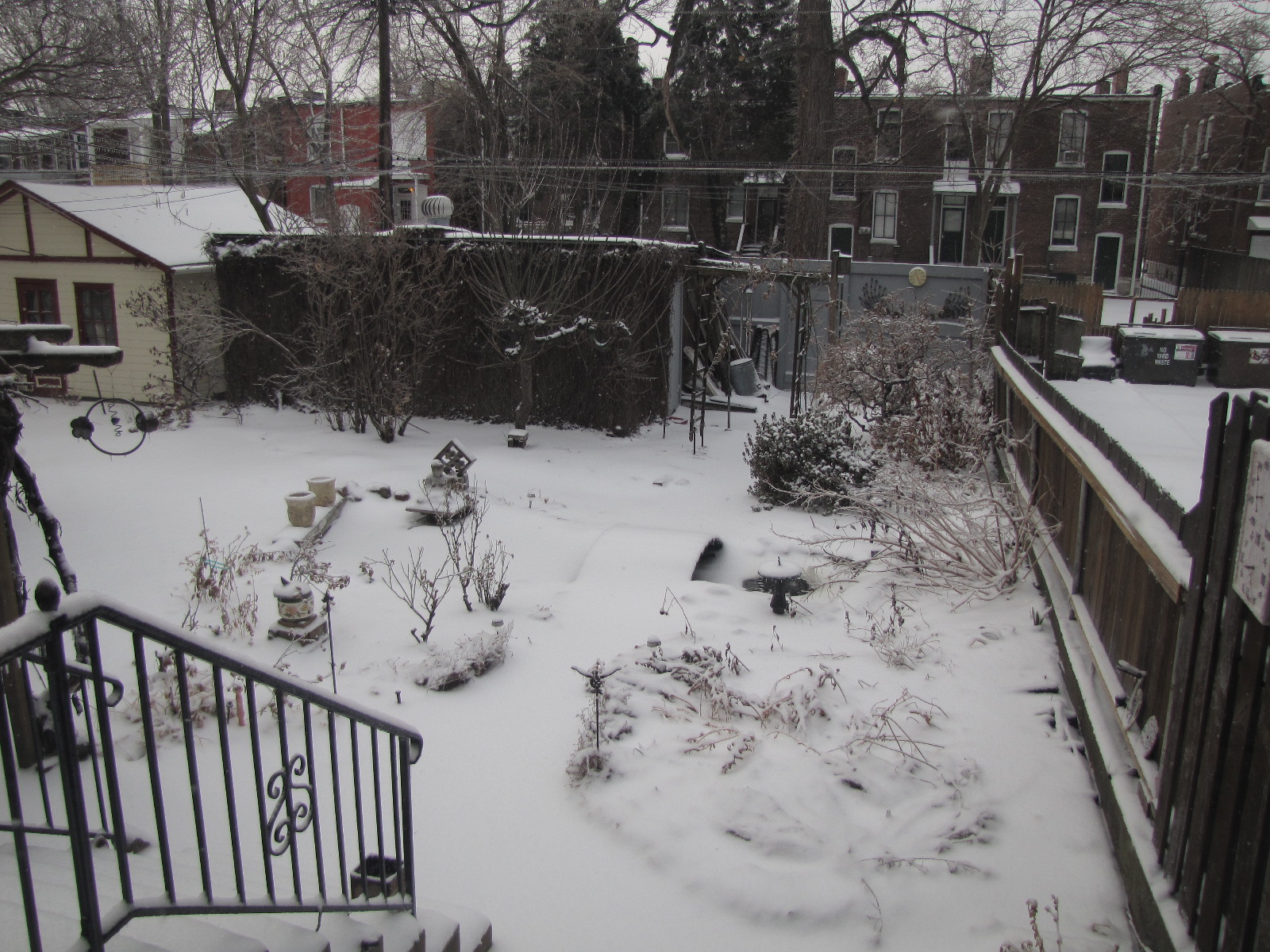
There was recently a big winter storm across the Central and North Eastern U.S. In my local town, it had the potential of exceeding the record one-day snowfall set 29 years ago. All the local news stations talked about the major storm approaching. Thunder snow, a rare occurrence here, was predicted. Stores were stripped of snow shovels, salt, water softener (salt), milk and bread.The governor called in the National Guard, and all the utility and road crews were on high alert. When the freezing rain started on Monday, the media warned people to stay home for the next day or two as the storm passed over. I grew excited. The little kid in me was hoping for a big snow. But our town was right on the freezing line. Just south of us, there is rain. North of us, snow. The band from rain through freezing rain, sleet, snow, up to full blizzard is only a hundred miles wide. As Tuesday dawned, we had a glaze of ice, and sleet was falling. I woke early and spent a couple of hours learning how to hack my new super-zoom camera to force it to take a time lapse picture series. I hoped to make a nice video of the yard disappearing under a foot or more of snow. So I set up my camera and started it early in the morning, when there was still just a glaze of ice on the path and plants. The day wore on. At noon I it was still just sleeting. I changed the batteries in the camera. By sunset, there was just a couple of inches of sleet. It was fun to walk on top of what looks like snow. But the yard is still visible. Had the freeze line been a couple of dozen miles farther south, that thin layer of sleet would have been about a foot of snow. What a gyp! So I let the camera run overnight, in hopes that we'd get some snow on the few inches of ice. But as Wednesday dawned, Groundhog Day, there was only a little more snow. Sure, the roads are all iced over, and icicles hang from everything. But this is a far cry from what the hue and cry of the media had us expecting. Granted, the next county over (and half the state) is snowed in. Interstate 70 is closed between the Saint Louis metro area and Kansas. And the temperature will drop below zero (-18°C) tonight. But how did we get Left Behind from the transcendental fairyland, a heaven of deep snow? Obviously we hadn't prayed hard enough to the God of the clean white snowy world above to deliver us from mundane weather. Or we didn't believe sincerely enough in the snowy salvation offered by his half-breed son, Jack Frost. Maybe some around us are heretical worshipers of the Daily Commute, and counteracted our prayers. So we beseech those who were called up to the snowy realm to share with us their good fortune. Show us unworthy shovelers of sleet what the True Light of real snow is like. Maybe it's not too late.
Continue ReadingLeft Behind by Snowmageddon

The Hellhound and HeLa: Recent American Historical Writing At Its Best

The last really good history I read was "Hellhound On His Trail, " which follows James Earl Ray's path from his childhood in Alton, Illinois through a violent intersection with the life of Dr. Martin Luther King, Jr., and continues to follow Ray's trajectory with his quizzical recantations of his "life's purpose." With the same cool hand, Sides sketches the strengths and inadequacies of Dr. King's inner circle and paints larger atmospheric strokes with newspaper headlines on the increasing violence in response to desegregation and the influence of war in Vietnam on national sentiment about federal involvement in heretofore state affairs. By themselves, vignettes about Ray's lackluster career as a petty criminal, his stunted attempts at artistic grandeur and addiction to prostitutes would simply depress the reader. Here, the intentional failures and manipulations of Hoover's FBI and first-hand accounts of Ray's behavior appear like birds descending on a tragic town, flickering across the broader canvas creating momentum and dread. Awful as the true subject of this thriller may be, I found myself disappointed to reach the end.

Continue ReadingThe Hellhound and HeLa: Recent American Historical Writing At Its Best