Government and Corporate Actors Are Coordinating to Regulate AI to Keep us “Safe”
The government is claiming that they need to regulate AI to keep us "safe." Once again, they claim that they need to protect us from, at bottom, words and ideas. Where have we heard this before?
We can be certain that they want to censor us because they always want to censor us, regardless of who is in power, because censorship gives them control over us. They won't admit that they are trying to "censor" us. No censor admits that he or she is engaging in censorship, but that is exactly what they are aiming to do. Sayer Ji connects the dots for us:
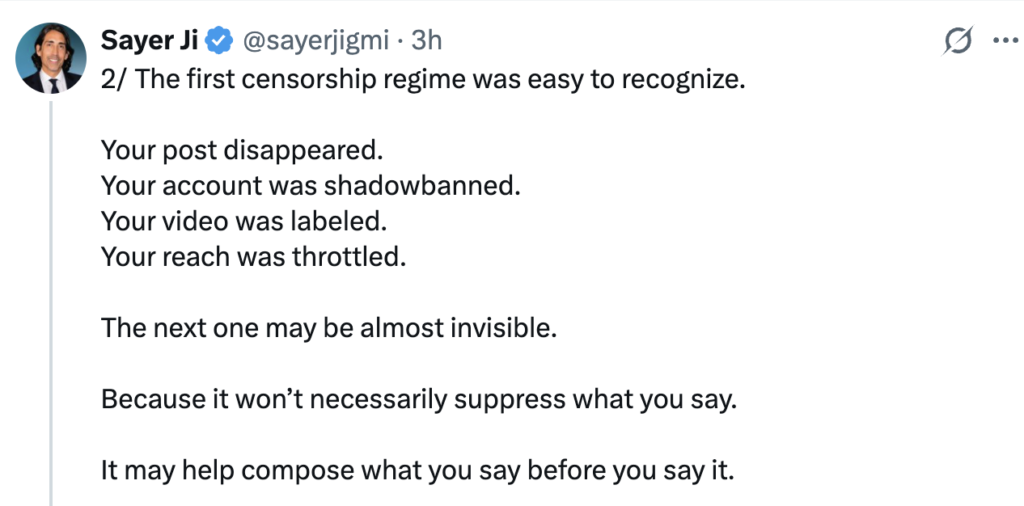
Si's post is actually a long thread of posts (and this article). Here are his first four posts:
The world is being flooded with warnings that AI could destroy humanity.What is Si reacting to? An undeniable and coordinated psyop on the same scale as the COVID psyop. We are currently being bombarded from what appears to be many directions, but it is actually a focused attempt to rip control from ordinary people and hand it to a select group of elites (including the government and some of the biggest sellers of AI), who want all of the vast power that AI already has, and more. Working with the government, none of them will ever be satisfied, because the People cannot ever be trusted with self-governance.But the panic itself is creating something just as consequential:
A justification for controlling the systems that will increasingly shape what billions of people can know, say, and even think.
The first censorship regime was easy to recognize.
Your post disappeared. Your account was shadowbanned. Your video was labeled. Your reach was throttled.
The next one may be almost invisible. Because it won’t necessarily suppress what you say. It may help compose what you say before you say it. Think about what has changed. Search once gave you competing links. Now AI gives you one synthesized answer. Autocomplete once finished a word.
Now AI drafts your email, summarizes your meeting, answers your child’s questions, edits your argument and increasingly speaks for you.
That is a fundamentally different kind of power. Call this emerging layer speech infrastructure.
AI is becoming the mediation layer between:
you and information
you and your audience
you and your doctor
you and your government
you and eventually even other human beings. Control that layer and you don’t need to censor millions of individual posts.