Today’s Predominant Political Category Error

If only I could conjure up a sprawling, complex, monied and politically-interconnected system of prophylactic gaslighting in order to protect me from any criticism at all for my own egregious misconduct. I don't have those resources.

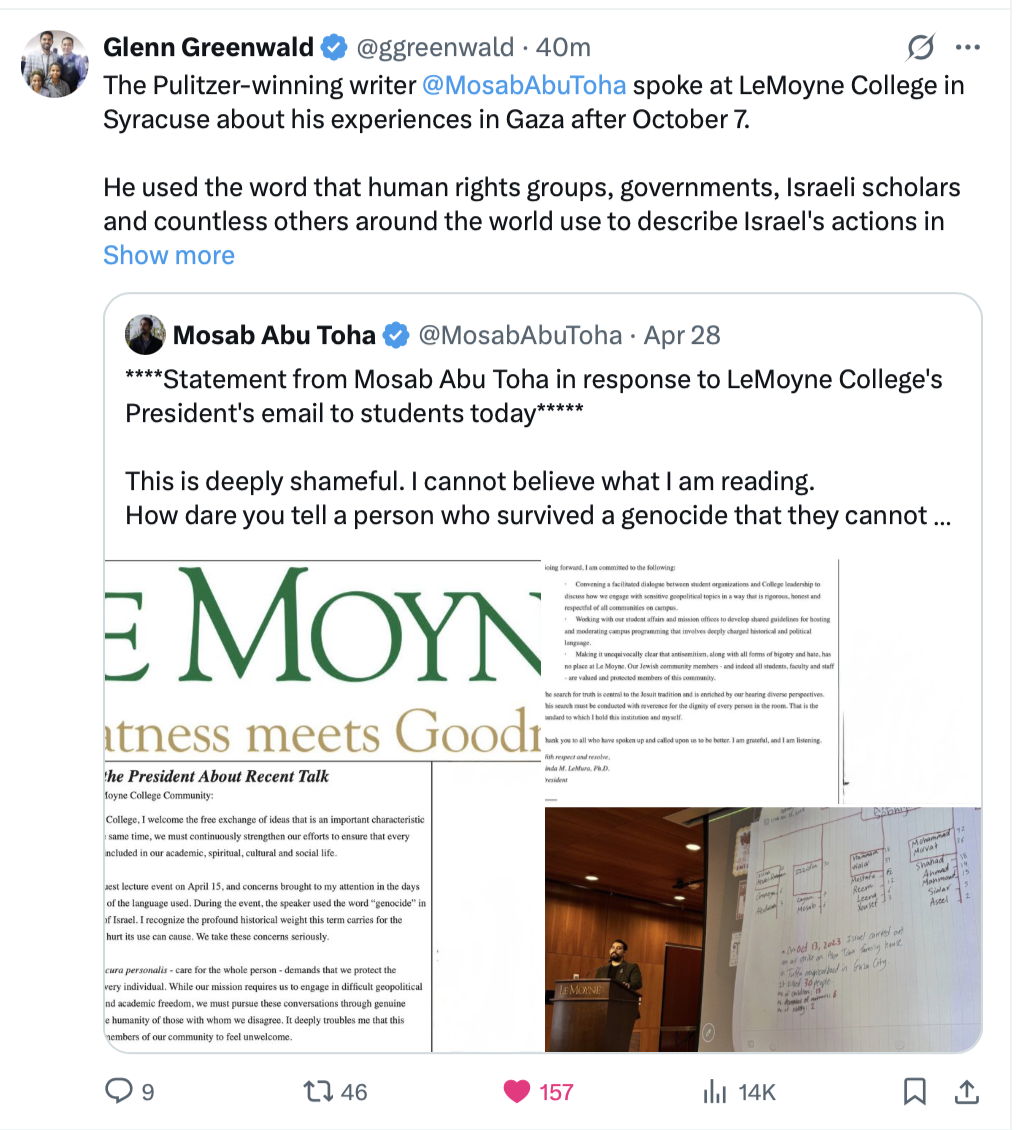
I would need a very powerful social and economic system, indeed, to sell "logic" as idiotic as this: Whenever you criticize me for despicable things I actually did, you are criticizing my puppy, the Apple tree in my backyard and my second grade music teacher. That sad state of affair is where we currently are, as Glenn Greenwald describes.

Truly, it would take an immensely powerful political/economic force to sell that level of bullshit on a nationwide basis. It would take the kind of overwhelming power capable purchasing CBS and TikTok, as well as purchasing hundreds of members of Congress through AIPAC. With that kind of power and money and reach, we now see that one could even incentivize (or frighten) a college president to implore to her college students that 2 + 2 = 5.

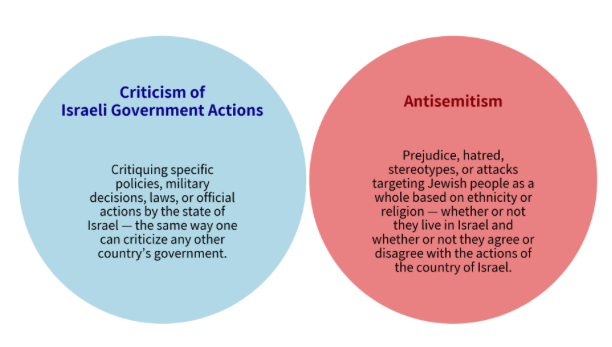
What we are seeing in these modern times is that sufficient money and power can dispense with the simple logic and clear meaning of this Venn diagram:

Continue ReadingToday’s Predominant Political Category Error

The Branding Problem of Free Speech on Campus

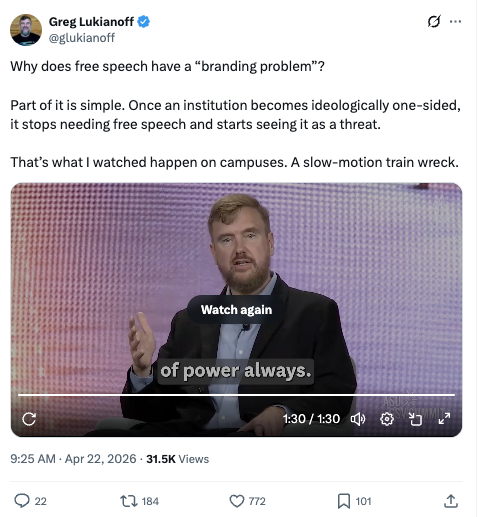
Q: "I'm really curious to hear from you why you think free speech has the branding issue that you know it tends to have, and why for young people, there's this perception that you know is warped. "

Greg Lukianoff: "This is probably a rough thing to say in a group full of educators, but I do think that a lot of the quote, unquote, branding issue with freedom of speech came out of K through PhD. When I was working at the ACLU back in 1999 I could see something happening, what I called the slow motion train wreck on college campuses in particular. We qualified for public assistance when I was a kid, and then I ended up at a place like Stanford Law School. And this was definitely a very weird experience for me, and it was the first time I really ran into kids who were pretty mediocre, a little ambivalent about freedom of speech. Working Class liberals were very pro freedom of speech. I thought that's what made a liberal, a liberal. But it was only when I started meeting more upper class people who came from, you know, the 1% and tended to go to the fanciest schools, that I started really running into this very anti liberal kind of idea, and that's a very typical dynamic that essentially, once your politics become a super majority of an institution--you want free speech when you're the minority, because free speech protects minority opinions. You don't need it to protect the majority. The popular vote protects the majority power. And in higher ed, there was this intentional, clear shift that free speech started being problematized partially because the people in charge of higher ed kind of thought, well, if I'm the one deciding what will get you punished and what won't, I can be trusted with that. And that's the temptation of power always."

Continue ReadingThe Branding Problem of Free Speech on Campus

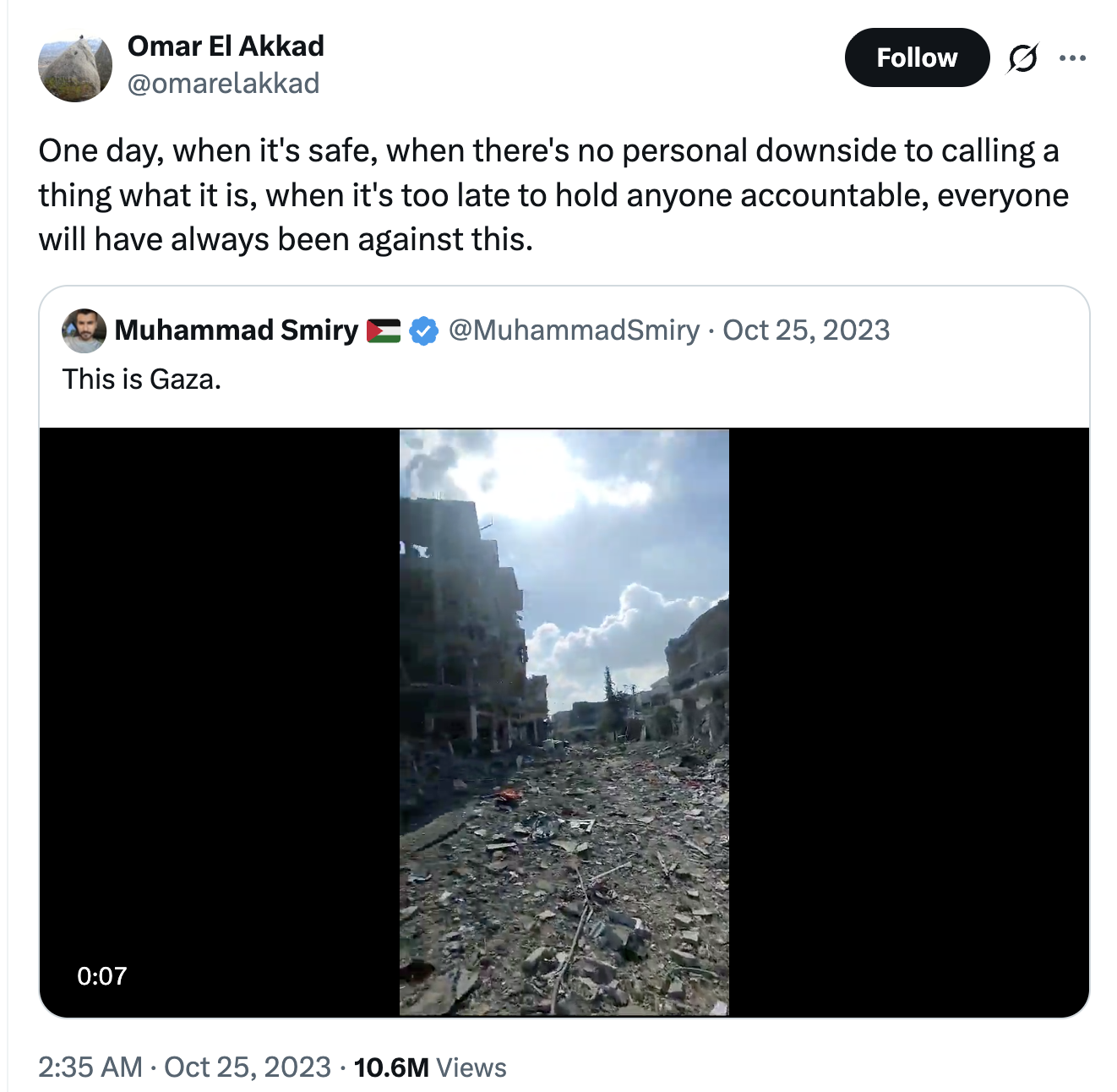
Hide the Photos of the Maimed and the Dead, so the War Looks Sterile, Glorious and Successful.

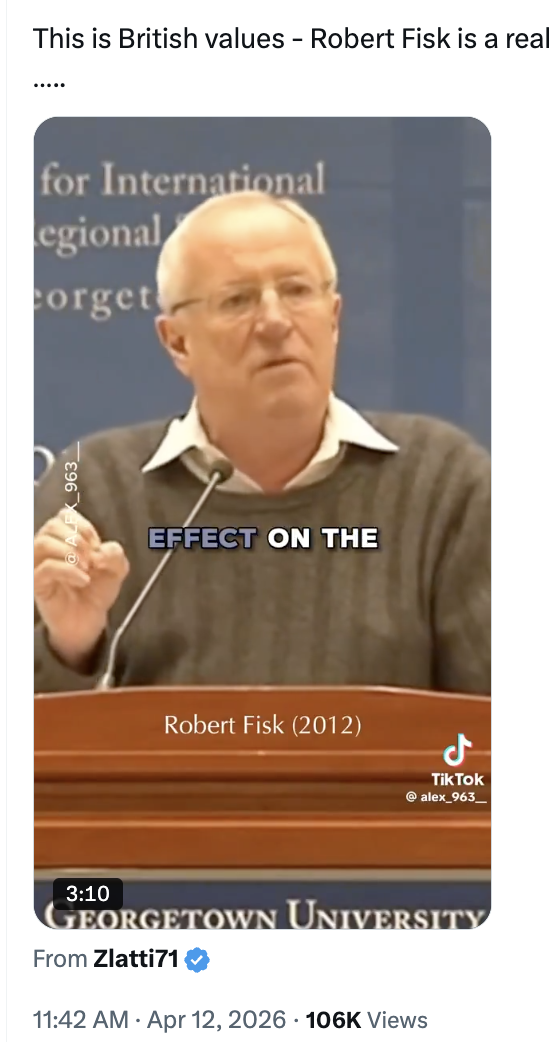
They hide the dead to help the "fight for freedom." Most corporate news organizations have been cheerleaders for the wars waged by the party in power.  They curate the experience for you to spare you the trouble of thinking.  Think of Afghanistan. And see here.  Raw photography would end almost every war, so that's why you are not permitted to see the photos, especially photos of up-close suffering, maiming of civilians and death, in the corporate media. Not in Iraq, Afghanistan, Gaza, Syria, Lebanon, Iran or anywhere else that the US fights for "freedom." Robert Fisk, Robert Fisk (1946–2020) was a highly regarded British journalist and author:

I always remember when Madeleine Albright announced that Israel was under siege. For a brief moment, I asked myself, if there were Palestinian tanks in Haifa. How do we reach a stage where we so distort reality that we actually have a lethal effect on the conflict itself? The worst example of this, I'm sorry to say, is television, the way in which, unless an Iraqi is obliging enough in a war to die romantically beside the road in silhouette with all his arms still attached, you do not see the dead for viewers of television, not in the Arab world, I might add that in the West we do not see the dead, and thus our leaders, all of whom at the moment have ZERO experience of real war--the journalists do, but not our leaders in the West--they are able to present, to the public, war as a bloodless sand pit. War as something primarily to do with victory and defeat rather than death, which is exactly what is about on a large scale. War represents the total failure of the human spirit.

And I had a perfect example of this in 2003 I was in Baghdad. I was trying to get down to Basra. I got halfway, and then I was so frightened I could hardly write. And were so many bombs dropping from my own Air Force, among others, that I turned back to Baghdad. But Al Jazeera were in Basra, and they got back the same day to Baghdad with their video film, and I sat with them in their little tent. You probably realized that in a war, many of the big agencies pool their material, especially the television companies. So it was being sent through the satellite to Reuters in London, whose job was to edit the film. So of course, this was film of a civilian hospital. There were some soldiers brought in wounded and dead, but most of the pictures were of dead and wounded, women and children. They had been killed and wounded by British artillery fire in Basra. The British were besieging Basra while the Americans took the highway to claim Baghdad. And what was particularly revealing was, as they showed the film, I listened to the remarks coming back from London. You know, there were terrible scenes. It was one of a child holding its intestines and a woman with part of her hand missing. And there were screams and cries and lots of blood on the film. And the voice from London said, "You know, we can't really show this. You can't show this to people at tea time." And by this moment, I had my notebook out for The Independent, my newspaper. THIS was going to be tonight's story. So [Al Jazeera] said, "Please, please. Please, we risked our life for this. Just let us put out a little bit more of the film. Maybe you can use it." And of course, there were more pictures of blood and wounded children and dead children. And then the voice came back and said, "This is obscene. We can't put obscene pictures like this on Western television." They pleaded again by now, of course. My pen was skidding over the pages. These were great quotes, because this is what was wrong. And then the voice came back for the third and final time. "We can't show these pictures because we must respect the dead." Now you get the point. We didn't respect them when they were alive. We didn't respect them when we blew them to bits. But when they're dead, by God, we have to respect them.

Continue ReadingHide the Photos of the Maimed and the Dead, so the War Looks Sterile, Glorious and Successful.