
How We Got Here: Conclusion

In an earlier post on this topic I made the claim that the thing which changed everything in this country was the rise of capitalism as the dominant economic model. It’s time to make good on that claim. Firstly, we need to understand, once and for all, just what Capitalism is and how it is misunderstood in these sorts of discussions. Capitalism is an umbrella term used to describe a variety of practices under one general heading, practices like mercantilism, industrialization, and interest-based lending. But to be precise, all these different practices overlap but are not themselves capitalism. Capitalism is the strategic use of money to determine the value of money and thereby transfer latent wealth from one sector of an economy to another. This simple distinction does much to explain the animosity throughout the 19th Century toward any kind of centralized bank, including the Jacksonian war on the United States Bank, and Jeffersonian suspicion of corporate power. It is nothing less than the ability of a small group to determine the value of local currency and the buying power of a community, all through the manipulation of currency exchange markets (like Wall Street), regardless of intrinsic values of manufactures and production. But we have so conflated this with all other aspects of our much-vaunted “free” enterprise system that to criticize capitalism is seen as an attack on the American Way of Life. It is not. Although many Left attacks on it become hopelessly mired in broad attacks on wealth, it is not so much an attack on wealth per se—that is, wealth based on the prosperity of a community—but wealth derived at the expense of the community. Which is what we are seeing take place today. Which has taken place often in our history. The difficulty is, this has been one of the most successful economic systems ever for creating prosperity, especially for the individual who understands it and works it, and, if properly regulated, has been the foundation of American achievement, at least materially. So any critique can be made to seem like a critique of America itself. This fact has been useful to plutocrats defending their practices against attempts to rein in and control abuses. The coupling of what in extremes are parasitic practices of economic pillage with grass roots patriotism has been the most difficult combination to deal with in our history. In its contemporary guise, it couches itself in an argument that socially responsible community-based efforts to address economic and resource inequality are Socialist and therefore fundamentally un-American. This is historically inaccurate and strategically manipulative, but the bounds between the anti-federalist sentiments that began even before the revolution and became quasi-religious among certain groups in the aftermath of the Civil War are many and strange and need teasing apart to understand. [More . . . ]
Continue ReadingHow We Got Here: Conclusion

The political left chokes–allows Bradley Manning to be tortured

There are a few news media figure who are taking principled stands regarding the the horrific way that the United States government is treating Bradley Manning, who has not been convicted of any crime. Glen Greenwald is one of the few with scruples. Other principled voices can be read at Alternet, including Lynn Parramore, who (rightfully) suggests that we'd be outraged if we viewed a fictitious movie of someone being treated as badly as Manning, but since it's happening in real life we don't give a shit. Jane Hamsher of Firedoglake has admirably covered the story. Andrew Sullivan has weighed in. Barack Obama has fully earned the title of America's Second Modern Torture President. This is not hyperbole. Bradley Manning is being tortured by the United States. We are enthusiastically treating Manning the way we treated the (mostly innocent) prisoners at Gitmo. We are doing to Manning what we criticize when other countries do it. Dylan Ratigan of MSNBC has also presented the story with energy. The torture is bad enough, but the silence by mainstream Democrats is infuriating. We're running a great country, aren't we? No need to speak out about Wall Street corruption, massive problems with health care "reform," the right to assassinate U.S. citizens, government spying on its own citizens, and not blatant torture.

Visit msnbc.com for breaking news, world news, and news about the economy

Continue ReadingThe political left chokes–allows Bradley Manning to be tortured

Why Sensationalize an Already Sensational Event?

Scientific American reports, Radiation leaking from Japan's quake-hit nuclear plant as part of the devastation in Japan from the record setting earthquake. Sure, four out of five nuclear facilities immediately shut down safely. But of one unit at the fifth, they say

The blast raised fears of a meltdown at the facility north of Tokyo as officials scrambled to contain what could be the worst nuclear disaster since the Chernobyl explosion in 1986 that shocked the world.

Uh, yeah. Actually, this looks more like the Three Mile Island "disaster" to me. Chernobyl used a reactor technology that was considered too unstable outside of the Manhattan project or the U.S.S.R. that involved a big pile of carbon graphite to regulate the reaction. Graphite burns. Chernobyl burned. Chernobyl also exploded wide open. People stood miles away touristically looking directly into the reactor core, and then dying from the gamma ray exposure. The G.E. reactors in Japan are water filled steel containers. They don't burn.They didn't burst. The reactor was idled within hours. The quake broke the outer concrete containment structure (but not the inner steel one) and also interrupted all three safety backup systems. So the reactor overheated before they got it under control, and they had to vent some probably radioactive steam to prevent the inner containment from also rupturing. I say "probably radioactive" because the cooling water certainly contains tritium (Hydrogen-3) and traces of other isotopes. But so far there are no reports of measurable radiation beyond the reactor premises. I'm sure there will be. Personally, I take this as a sign that we really need to move beyond the 1970's style Cold War reactors to the 1990's style ones now being specified in Europe. These are designed to fail safe even if all the active safety systems fail. Sure, they cost a little more to build. But they are pretty much proof against flood, earthquake, and bomb attacks short of nuclear warheads releasing radiation. I have also advocated building next generation fast neutron reactors that can use depleted uranium, thorium, and most current generation reactors waste as fuel. A past post of mine: Whatever Became of Thorium? These reactors are also inherently safer, because they are using less volatile fuel. This should be an opportunity to discuss the future safer implementation of this inevitable successor to coal power, rather than to propagate, "Gee whiz, isn't noocular power dangerous?"

Continue ReadingWhy Sensationalize an Already Sensational Event?

How bad is the Gulf? How bad is American media?

Secretary of State Hillary Clinton has endorsed Arab news organization Al Jazeera as offering "real news", superior to ersatz U.S. news which is full of commercials, talking-heads and soundbites that are "not particularly informative to us." Perhaps that explains a part of the reason why U.S. audiences are largely unaware of the continuing ecological disaster in the Gulf of Mexico in the aftermath of BP's Deepwater Horizon blowout last year. Al Jazeera, on the other hand, brings us this story of sickness and death on the Gulf Coast.

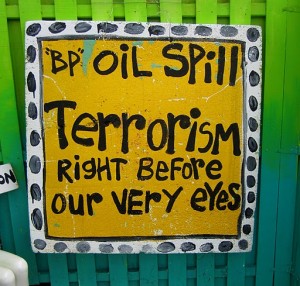
[caption id="attachment_16980" align="alignright" width="300" caption="Eco-terrorism in Gulf of Mexico. Image via Leoma Lovegrove (creative commons)"][/caption] "I have critically high levels of chemicals in my body," 33-year-old Steven Aguinaga of Hazlehurst, Mississippi told Al Jazeera. "Yesterday I went to see another doctor to get my blood test results and the nurse said she didn't know how I even got there." Aguinaga and his close friend Merrick Vallian went swimming at Fort Walton Beach, Florida, in July 2010. "I swam underwater, then found I had orange slick stuff all over me," Aguinaga said. "At that time I had no knowledge of what dispersants were, but within a few hours, we were drained of energy and not feeling good. I've been extremely sick ever since."
[More . . . ]

Continue ReadingHow bad is the Gulf? How bad is American media?

NPR needs help to find the culprit who killed the WPEA

The Whistleblower Protection Enhancement Act (WPEA) passed the Senate unanimously last December. It was tweaked and passed unanimously in the House, then sent back to the Senate for a final vote - where someone blocked it by the an anonymous hold, killing it on December 22. On January 7th, NPR’s On the Media, with the Government Accountability Project, set out to find out who. Now they are down to three: Sen. Jeff Sessions (R-AL), Sen. Jon Kyl (R-AZ) and Sen. Jim Risch (R-ID), all of whom have declined to deny placing the hold. WNYC and the GAP still need help to blow the whistle on who killed the WPEA. They need residents of Alabama, Arizona and Idaho to call their respective Senators and ask for confirmation or denial of responsibility for the hold, and more pointedly, ask “why they believe the public does not have a right to hold them accountable for something as basic as killing a bill.” They suggest asking the following questions “as a way to guide the conversation”:

1) Did you place the anonymous hold on the Whistleblower Protection Enhancement Act? 2) What is the Senator's policy regarding inquiries from constituents about his use of the anonymous hold? 3) When is the Senator’s “hold” the public’s business, about which the public has the right to know? 4) What determines when use of the “hold” is a “personal, private matter” that is not the public’s business? 5) Why would the Senator be publicly supportive of the bill but work to defeat it in private? 6) All but three Senators have confirmed that they did NOT use the hold to kill S. 372, the Whistleblower Protection Enhancement Act. Assuming that the senator who placed the hold is eventually identified - as they frequently are - and it is your senator, is he prepared to deal with the fallout that comes from ignoring constituent questions?
These are good questions to ask about any anonymous hold on Senate bills, not just this one. You can read about what the Act would have done here, and if you have any information, email blowthewhistle@wnyc.org. WNYC is collecting and posting the responses.

Continue ReadingNPR needs help to find the culprit who killed the WPEA