I live in St. Louis, where major league baseball is taken seriously. After I was invited to attend the opening day game as part of a business function this year, and I attended as an amateur 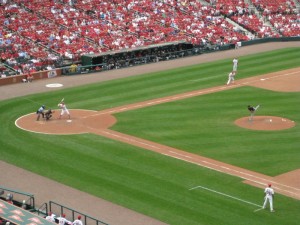 anthropologist, not as a baseball fan.
A bit of background: About 15 years ago I was an avid sports fan. I followed all of the St. Louis professional teams. I watched some games on television, attended occasional games and read the sports page almost every day. For reasons I don't really understand, I decided to stop being a sport fan. I was frustrated that I didn't have enough time to get to attend my alleged priorities, which included trying to become a writer and trying to achieve a deeper understanding of cognitive science. What could I do to make room for those things in my schedule?
Well . . . I was spending about 10 hours per week being a sports fan. If I went cold turkey, I'd have about 500 hours more per week to do other
anthropologist, not as a baseball fan.
A bit of background: About 15 years ago I was an avid sports fan. I followed all of the St. Louis professional teams. I watched some games on television, attended occasional games and read the sports page almost every day. For reasons I don't really understand, I decided to stop being a sport fan. I was frustrated that I didn't have enough time to get to attend my alleged priorities, which included trying to become a writer and trying to achieve a deeper understanding of cognitive science. What could I do to make room for those things in my schedule?
Well . . . I was spending about 10 hours per week being a sports fan. If I went cold turkey, I'd have about 500 hours more per week to do other  things. That's the equivalent of 12 weeks of vacation. So I did go cold turkey (interrupted only to follow the St. Louis Rams for a few years while they were Superbowl winners and contenders). For the most part, I've successfully cultivated a high level of apathy for professional sports. I don't feel any compulsion to spend any money on tickets or to ever to read the sports page. I really don't care whether the team won last night. My experiment was a success. A bonus is that I now have a privileged perch from which to appreciate the extraordinary lengths to which sports fans spend their money and invest their time in order to root for their teams.
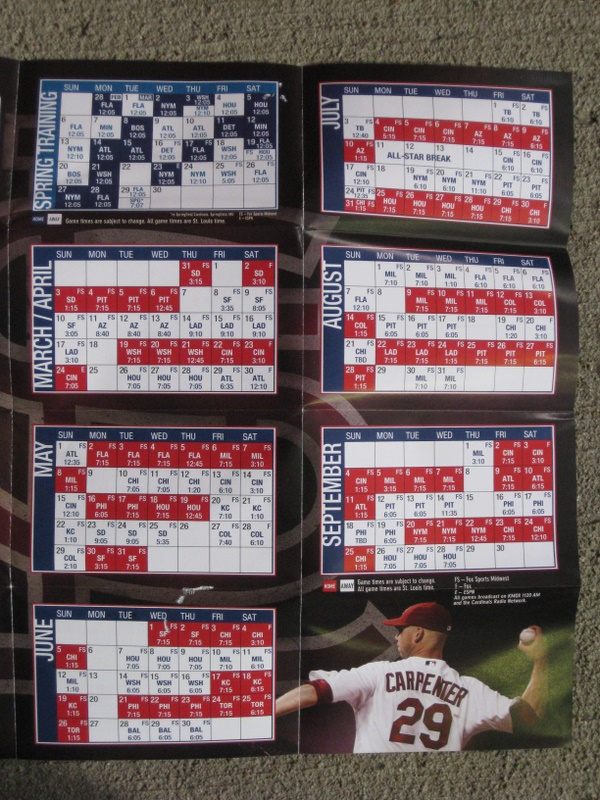
  In St. Louis, rooting for the Cardinals is far more than entertainment. It's much like a religion. Check out the schedule above (you can click on any of the images for an enlarged view). It is the official list of 162 holy days of 2011. I know many people who plan their schedules around the baseball calendar.
Being knowledgeable about the local sports teams is also the preferred ice-breaker at many business gatherings: "So, do you think LaRussa left the starting pitcher in for too many innings last night?" Sorry, but I don't know. Sometimes I admit, "I gave up sports." Inevitably jaws drop. I don't dare follow up by blunting saying, "I wanted to live more in the real world.
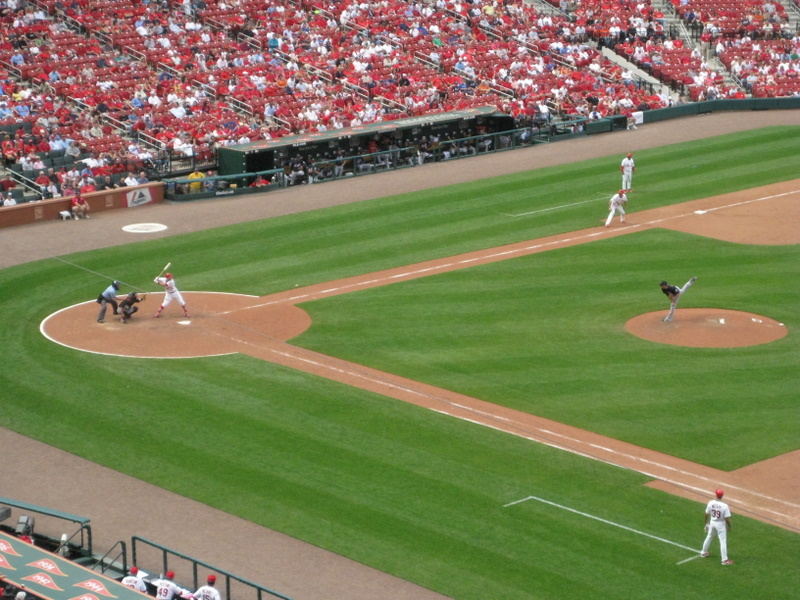
Therefore, a few days ago I attended the St. Louis Cardinal's opening day game as a member of an out-group. I was much worse than a luke-warm fan. You see, if you offered most sports fans 12 extra weeks of vacation, they'd spend it watching more sports and thinking more about sports. It wouldn't occur to
In St. Louis, rooting for the Cardinals is far more than entertainment. It's much like a religion. Check out the schedule above (you can click on any of the images for an enlarged view). It is the official list of 162 holy days of 2011. I know many people who plan their schedules around the baseball calendar.
Being knowledgeable about the local sports teams is also the preferred ice-breaker at many business gatherings: "So, do you think LaRussa left the starting pitcher in for too many innings last night?" Sorry, but I don't know. Sometimes I admit, "I gave up sports." Inevitably jaws drop. I don't dare follow up by blunting saying, "I wanted to live more in the real world.
Therefore, a few days ago I attended the St. Louis Cardinal's opening day game as a member of an out-group. I was much worse than a luke-warm fan. You see, if you offered most sports fans 12 extra weeks of vacation, they'd spend it watching more sports and thinking more about sports. It wouldn't occur to  them that they should go cold turkey and pursue anything else. What else is there of equal of greater importance?
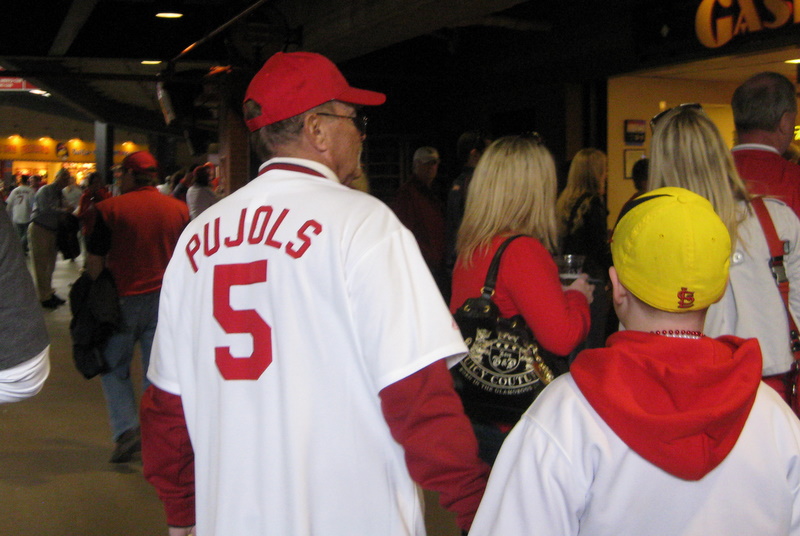
In this religion of St. Louis Baseball, Albert Pujols is the Savior. Incredible amounts of ink have been spilled over whether this man will sign a new contract with St. Louis. People relate to Albert; apparently, they think that they are Albert. If you attend a St. Louis Cardinal Baseball game, you will see many hundreds of people wearing Pujols jerseys, and most of them are adults. What are they thinking? Are they thinking "I'm like Pujols because I am wearing his jersey"? Are they thinking "I want people to think I'm a bit like Albert Pujols when I wear his Jersey"?
them that they should go cold turkey and pursue anything else. What else is there of equal of greater importance?
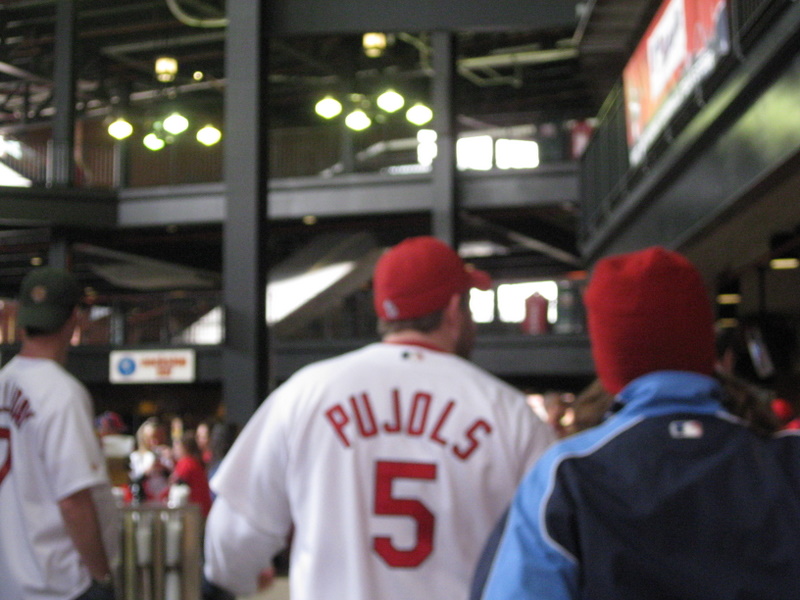
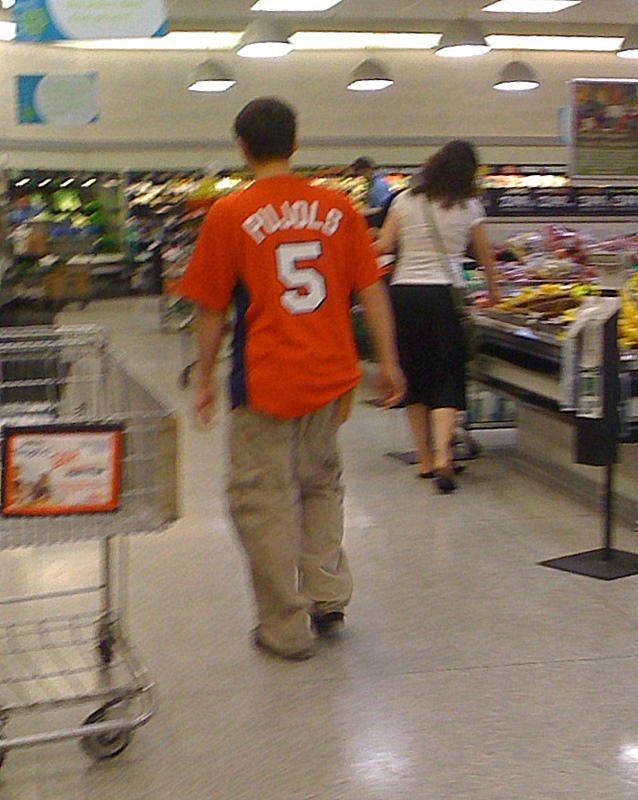
In this religion of St. Louis Baseball, Albert Pujols is the Savior. Incredible amounts of ink have been spilled over whether this man will sign a new contract with St. Louis. People relate to Albert; apparently, they think that they are Albert. If you attend a St. Louis Cardinal Baseball game, you will see many hundreds of people wearing Pujols jerseys, and most of them are adults. What are they thinking? Are they thinking "I'm like Pujols because I am wearing his jersey"? Are they thinking "I want people to think I'm a bit like Albert Pujols when I wear his Jersey"?  Are they thinking that they somehow get credit for Pujols' accomplishments because they are wearing his jersey? Even after leaving the stadium, you will see Pujols jerseys all over town (I spotted the one to the right at a grocery store after the game). Playing into the role of "Savior," Albert has an interest in a local Christian radio station.
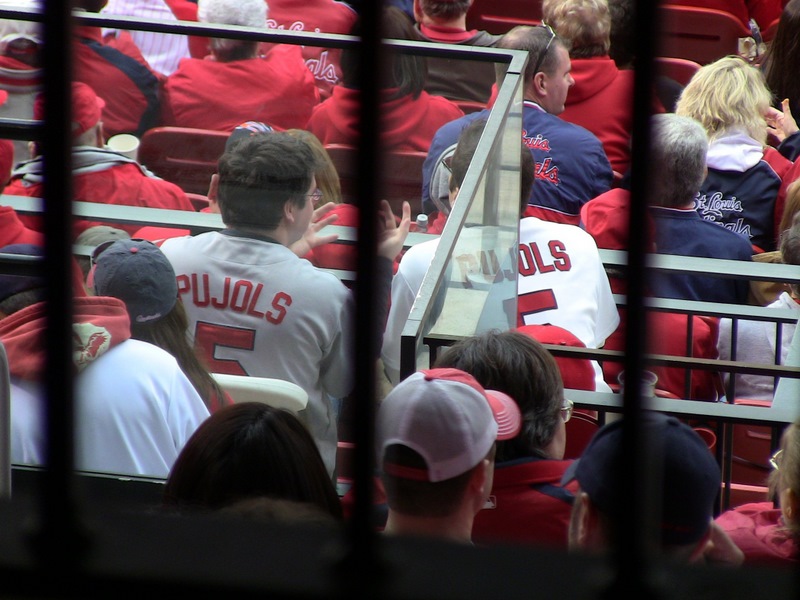
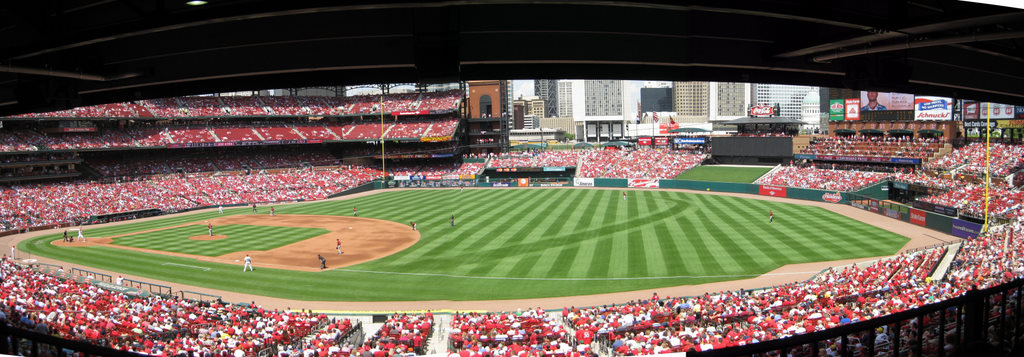
 [And do check out the image to the left, where I caught Pujols having a chat with Pujols.] The physical church is Busch Stadium, of course. I see people staring at it even in the dead of winter. People have been known to get married at Busch Stadium (there was a wedding in the snow last week). You would have been amazed to hear how the team "needed" a new stadium a few years ago. When something is considered "sacred" there is no rational bargaining. The owners said we need it, so we go the new stadium.
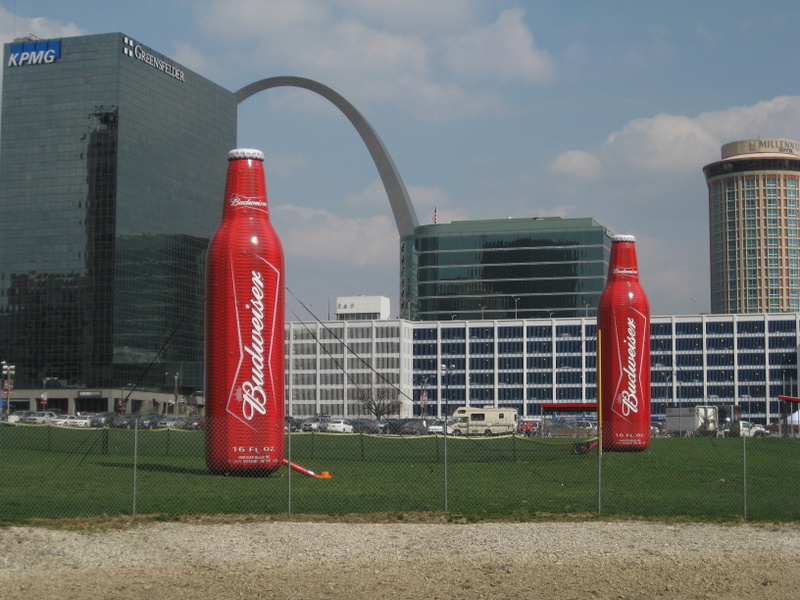
There are sacred food items in the religion of baseball. I do believe that nachos serve as the bread of the religion of baseball, and the "wine" is obviously beer. At opening day, I was greeting with twin 30-foot bottles of beer.
[And do check out the image to the left, where I caught Pujols having a chat with Pujols.] The physical church is Busch Stadium, of course. I see people staring at it even in the dead of winter. People have been known to get married at Busch Stadium (there was a wedding in the snow last week). You would have been amazed to hear how the team "needed" a new stadium a few years ago. When something is considered "sacred" there is no rational bargaining. The owners said we need it, so we go the new stadium.
There are sacred food items in the religion of baseball. I do believe that nachos serve as the bread of the religion of baseball, and the "wine" is obviously beer. At opening day, I was greeting with twin 30-foot bottles of beer.  But it can't be a religion because the fans are really attending those games because they are serious about baseball, right? Well I'm not so certain of that. If you had to guess what people do the most of at ball games, it would either be eat and drink, or socialize. The food stands are ubiquitous, and I would estimate that far more than half of the people attending aren't concentrating on the game much at all. How else can
  you explain that thousands of people are leaving a close game in the 7th or 8th inning? They paid $50/seat and they aren't going to watch every pitch?
It seems as though most people go to the ball game to bask in the crowd, and to display their loyalty. When you are surrounded by 50,000 people, regardless of what is going on, it does seem important. And that is very much how it is in most churches.
you explain that thousands of people are leaving a close game in the 7th or 8th inning? They paid $50/seat and they aren't going to watch every pitch?
It seems as though most people go to the ball game to bask in the crowd, and to display their loyalty. When you are surrounded by 50,000 people, regardless of what is going on, it does seem important. And that is very much how it is in most churches.


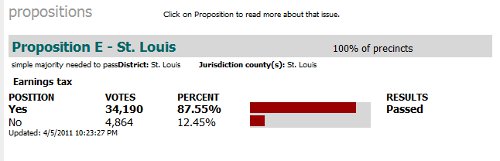 Passed by 7 to 1. Yay! We get to keep paying 1% of our income to support city services.