Rachel Maddow’s Own Attorneys Argued that She Shouldn’t be Taken Seriously

Glenn Greenwald Tweets"

MSNBC's lawyers argued - and a court agreed - that Maddow can't be sued for defamation, even when she accuses an outlet of being "literally paid Russian propaganda," because nobody takes her seriously. No liberal outlet will mention this even as they *constantly* say it about Fox

Follow the thread for details and yet another example about how there are two news teams out there. I think of them as two separate types of "News Filters."
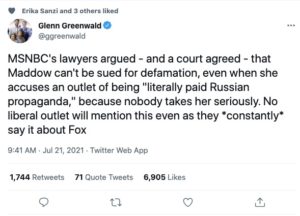
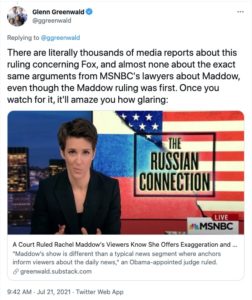
Greenwald comments that the left leaning media team constantly thrashes a comparable case with a comparable argument made on behalf of Tucker Carlson, but when it comes to Maddow's own case, it's crickets:

[T]hose most guilty of being unreliable liars and propagandists are those in the media and even Maddow's own MSNBC colleagues who repeatedly cite this court ruling to delegitimize Carlson without ever mentioning that Maddow’s lawyers successfully used the same arguments in her defense.

Here is an excerpt from the Court's Opinion adopting the arguments of Maddow's own attorney and dismissing the case against Maddow:

Here, Maddow had inserted her own colorful commentary into and throughout the segment, laughing, expressing her dismay (i.e., saying “I mean, what?”) and calling the segment a “sparkly story” and one we must “take in stride.” For her to exaggerate the facts and call OAN Russian propaganda was consistent with her tone up to that point, and the Court finds a reasonable viewer would not take the statement as factual given this context. The context of Maddow’s statement shows reasonable viewers would consider the contested statement to be her opinion. A reasonable viewer would not actually think OAN is paid Russian propaganda, instead, he or she would follow the facts of the Daily Beast article; that OAN and Sputnik share a reporter and both pay this reporter to write articles. Anything beyond this is Maddow’s opinion or her exaggeration of the facts. In sum, when the total context surrounding Maddow’s comment is considered, the Court finds that the context weighs towards a finding that the statement constitutes opinion and rhetorical hyperbole protected under the First Amendment.

.    .    .

By protecting speakers whose statements cannot reasonably be interpreted as allegations of fact, courts “provide[ ] assurance that public debate will not suffer for lack of ‘imaginative expression’ or the ‘rhetorical hyperbole’ which has traditionally added much to the discourse of our Nation.” Milkovich, 497 U.S. at 20 (quoting Hustler Mag., Inc. v. Falwell, 485 U.S. 46, 53–55 (1988)). That is the case here.
Continue ReadingRachel Maddow’s Own Attorneys Argued that She Shouldn’t be Taken Seriously

Ben Franklin: It’s “a Republic, if you can keep it.”

On September 17, 1787, as delegates left the Constitutional Convention in Independence Hall, Benjamin Franklin was asked what kind of government do we have?

"A Republic," he replied, "if you can keep it."

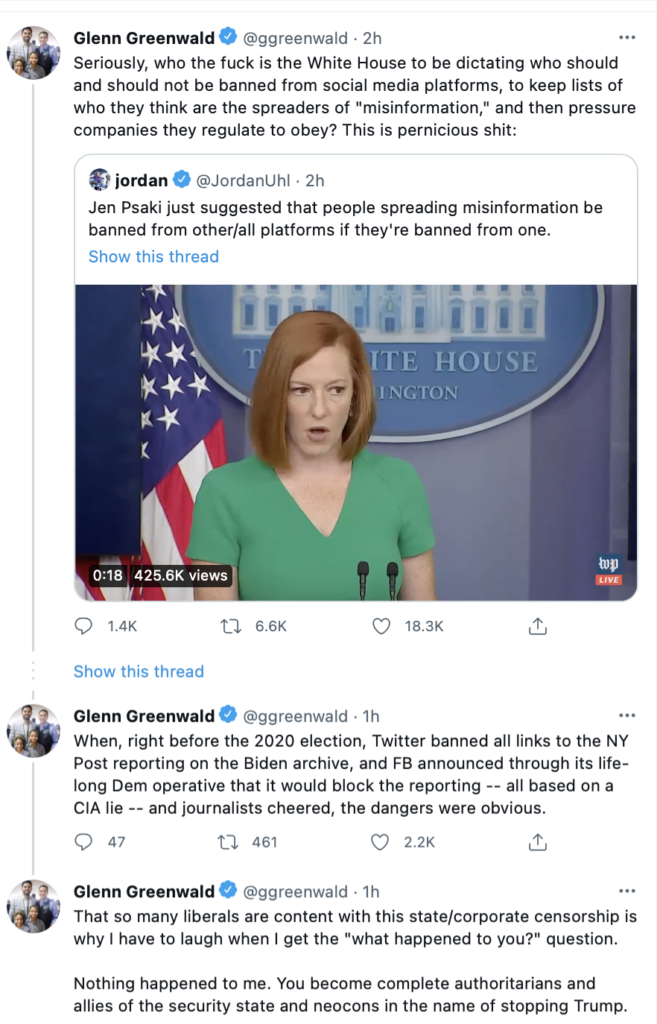
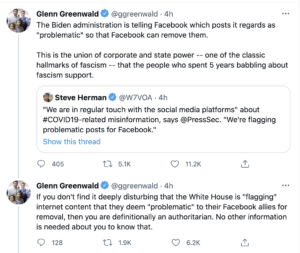
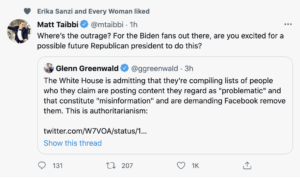
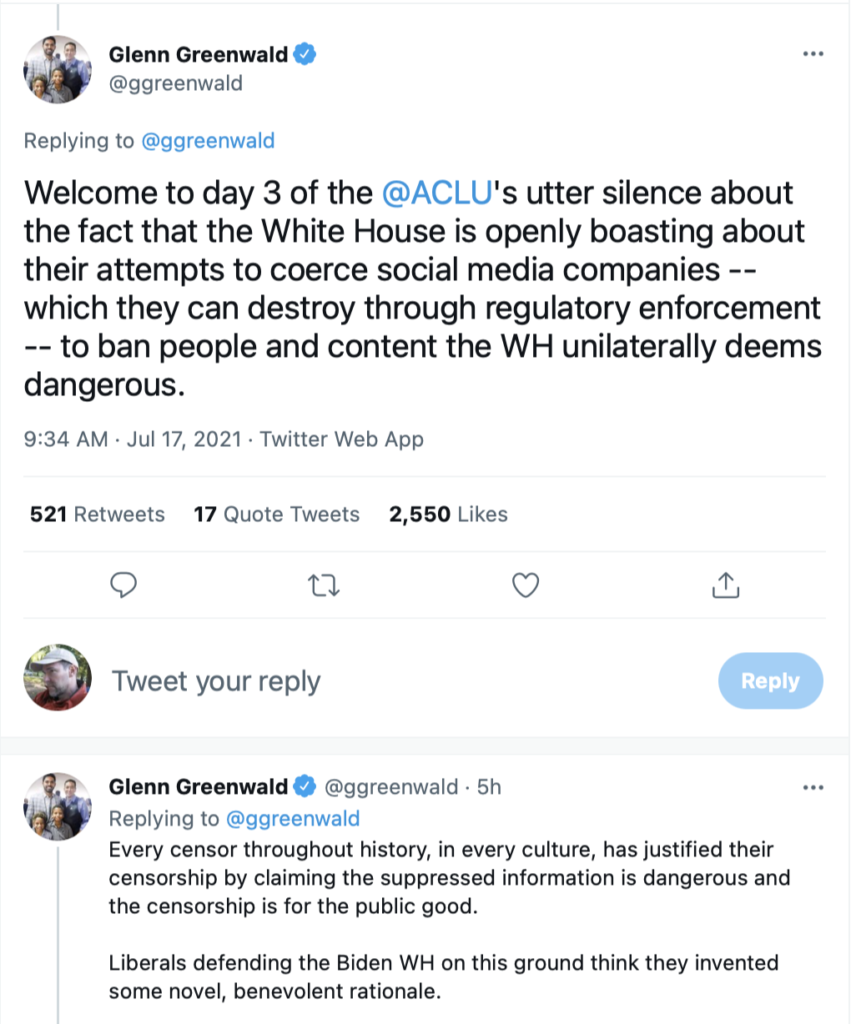
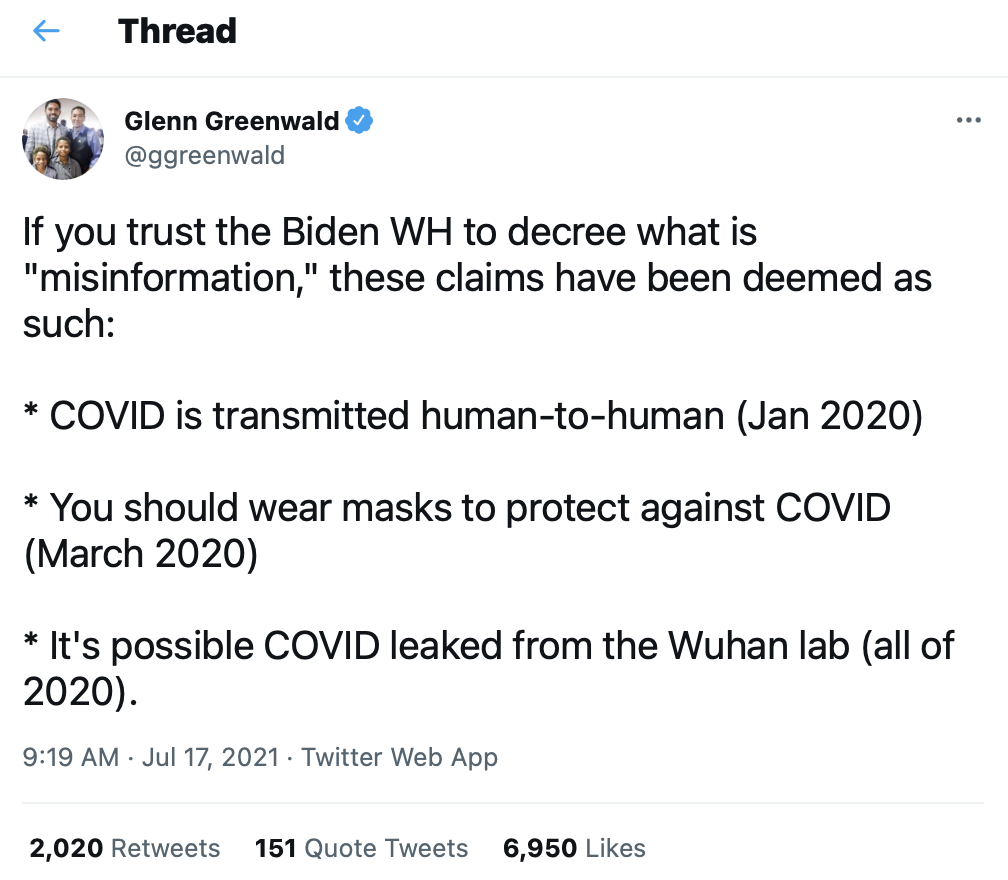
I am stunned at the willingness of many on the political left to ignore the First Amendment out of convenience when it comes to their favorite issues. As I predicted several days ago, the ACLU has been silent. Many of us who used to fear government censorship are publicly warming up to that idea.  In recent days, Glenn Greenwald has commented repeatedly. For example:

Those who remember the recent past the federal government be able to declare and enforce its version of the "truth" re COVID.  Here's a few examples:

There is apparently something in the water that is causing Americans to become obtuse, unable to understand their own history, their own government and nuance. Many people who hear my opinions of these topics accuse me of liking it when malevolent and stupid people kill other people by spreading lies about COVID.  They think I like it when harmful false ideas are spread through social media. Many of them are proud Americans who wave flags and celebrate the Fourth of July, but they don't understand the function and power of the First Amendment and free speech (the latter of which is a broader issue). It's as though they don't understand that many truths are complex, making them unendingly imperfect and tentative. It's as though they don't understand that by allowing the marketplace of ideas to run its course, we will be in the best position to understand what is going on around us on every topic and every issue. It's as though they want to completely trust a government that excels in spewing out lies, year after year, administration after administration.

Is it too much to ask that Americans understand their own Constitution before willingly shredding parts of it?

Continue ReadingBen Franklin: It’s “a Republic, if you can keep it.”

The United States is Dictating to Facebook What We Can Say to Each Other

The U.S. government is providing a handy new service for us. We no longer need to worry about what to say and think! It is well-established, however, that the First Amendment prohibits the government from forcing private companies to censor.

I would like to think that the ACLU will file suit tomorrow to crush this obvious violation of the First Amendment, but I have no confidence that that will happen. And beware: Censorship is a potent narcotic that is difficult for governments to quit. Republicans are undoubtedly licking their chops now, waiting for their chance.

Continue ReadingThe United States is Dictating to Facebook What We Can Say to Each Other

Ed Snowden Talks Shop with Daniel Ellsberg

Ed Snowden invited Daniel Ellsberg to have a conversation. These two men who are heroes to me (and to each other), discuss the importance of whistle-blowers, free speech and the war powers of the United States. Ellsberg points out (at min 8) that he did not disclose the Pentagon Papers because the government was lying or because the Vietnam war wasn't winnable. Almost everyone knew these things at that time. He did it because the war was "wrong" and it was "getting bigger," at a time where Nixon knew that he might be drawing the Chinese into the war and he was considering the use of nuclear weapons.

At minute 12, Ed Snowden explains that he acted not because he was against spying (though he was against spying), but because the government was acting outside of the knowledge and control of the People. The government was reinterpreting the Constitution outside of the knowledge of the People (and outside of the knowledge of most members of Congress) in a "secret rubber-stamp court." The People were no longer "partner" with the government, but "subjects" of the government. Snowden continued, from Bush to Obama to Trump, "the government is becoming less accountable to the People, and the people are becoming more accountable to the government."

Continue ReadingEd Snowden Talks Shop with Daniel Ellsberg