Why We Need to Re-Teach the Importance of Free Speech to Each Generation

Jonathan Rauch, author of The Constitution of Knowledge, discussing free speech with Andrew Sullivan:

Books like mine, I hope, and work like yours [Sullivan's], will sound the alarm and show the way out, show that our arguments are strong, that pluralism is really the only path to a peaceful, productive and knowledgeable society. What the purists have to argue is only eternal warfare, in which arguments are not resolved. And the casualties are either physical human bodies, or ostracism, or ignorance, or chilling.

Even if we don't win that argument right now, I keep pointing out to people: Remember the notions of free speech and free thought and all the rigors of science? These things are profoundly counterintuitive. The idea that speech is blasphemous, heretical, wrongheaded, offensive--add your adjectives--that speech is like that? That ideas like that should not only be allowed, but affirmatively protected, is the strangest and weirdest, and probably the craziest social idea that was ever invented. And it's only rescued by the fact that it's also the most successful social idea that was ever invented by a country mile. I would argue that it put an end to the creed wars. It gave us knowledge. It gave us finally some peace. And the result of that counter-intuitiveness is that you and I and our children, metaphorically, and our grandchildren and their grandchildren, will have to get up every morning and defend these ideas from scratch against a new generation that, for whatever new reason, emotional safety-ism or critical race theory or something else, that they don't get it. And we just have to be cheerful about that because, historically speaking, we've done incredibly well for about two and a half centuries. This is a template in the history of the human species.

Continue ReadingWhy We Need to Re-Teach the Importance of Free Speech to Each Generation

Carl Sagan’s 1997 Prediction

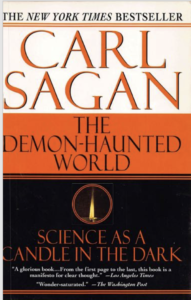
In 1997, Carl Sagan wrote the following in "The Demon Haunted World":

Science is more than a body of knowledge; it is a way of thinking. I have a foreboding of an America in my children’s or grandchildren's time—when the United States is a service and information economy; when nearly all the key manufacturing industries have slipped away to other countries; when awesome technological powers are in the hands of a very few, and no one representing the public interest can even grasp the issues; when the people have lost the ability to set their own agendas or knowledgeably question those in authority; when, clutching our crystals and nervously consulting our horoscopes, our critical faculties in decline, unable to distinguish between what feels good and what’s true, we slide, almost without noticing, back into superstition and darkness.

The dumbing down of America is most evident in the slow decay of substantive content in the enormously influential media, the 30-second sound bites (now down to 10 seconds or less), lowest common denominator programming, credulous presentations on pseudoscience and superstition, but especially a kind of celebration of ignorance. As I write, the number-one videocassette rental in America is the movie Dumb and Dumber. “Beavis and Butthead” remain popular (and influential) with young TV viewers. The plain lesson is that study and learning—not just of science, but of anything—are avoidable, even undesirable.

We’ve arranged a global civilization in which most crucial elements—transportation, communications, and all other industries; agriculture, medicine, education, entertainment, protecting the environment; and even the key democratic institution of voting—profoundly depend on science and technology. We have also arranged things so that almost no one understands science and technology. This is a prescription for disaster. We might get away with it for a while, but sooner or later this combustible mixture of ignorance and power is going to blow up in our faces.

Continue ReadingCarl Sagan’s 1997 Prediction

Andrew Sullivan Explains What has Changed on the Political Left

Andrew Sullivan is perplexed and deeply concerned. I'm talking about same Andrew Sullivan who was far ahead of the curve on gay marriage. He supported Barack Obama. He has leaned left on many issues. To call him a conservative (or a liberal) cannot be done without a huge asterisk. I've followed Sullivan for years and I value his heterodox viewpoints. I share his concern with what is happening to America's political left. Here's an excerpt from his article, "What Happened To You? The radicalization of the American elite against liberalism."

“What happened to you?”

It’s a question I get a lot on Twitter. “When did you become so far right?” “Why have you become a white supremacist, transphobic, misogynistic eugenicist?” Or, of course: “See! I told you who he really was! Just take the hood off, Sully!” It’s trolling, mainly. And it’s a weapon for some in the elite to wield against others in the kind of emotional blackmail spiral that was first pioneered on elite college campuses. But it’s worth answering, a year after I was booted from New York Magazine for my unacceptable politics. Because it seems to me that the dynamic should really be the other way round.

The real question is: what happened to you?

. . .

Look how far the left’s war on liberalism has gone.

Due process? If you’re a male on campus, gone. Privacy? Stripped away — by anonymous rape accusations, exposure of private emails, violence against people’s private homes, screaming at folks in restaurants, sordid exposés of sexual encounters, eagerly published by woke mags. Non-violence? Exceptions are available if you want to “punch a fascist.” Free speech? Only if you don’t mind being fired and ostracized as a righteous consequence. Free association? You’ve got to be kidding. Religious freedom? Illegitimate bigotry. Equality? Only group equity counts now, and individuals of the wrong identity can and must be discriminated against. Color-blindness? Another word for racism. Mercy? Not for oppressors. Intent? Irrelevant. Objectivity? A racist lie. Science? A manifestation of white supremacy. Biological sex? Replaced by socially constructed gender so that women have penises and men have periods. The rule of law? Not for migrants or looters. Borders? Racist. Viewpoint diversity? A form of violence against the oppressed.

Continue ReadingAndrew Sullivan Explains What has Changed on the Political Left

What the Opponents of “Critical Race Theory” are Most Concerned About. What Teachers Should be Teaching Instead of CRT.

What are people (I'm included) concerned about when we talk about "critical race theory" being taught in the classroom, especially K-12? What should we be teaching instead of "CRT"? Greg Lukianoff of FIRE nails it:

What these bills are trying to address doesn’t map directly to the academic definition of critical race theory, which is, in short, an academic school of thought pioneered by Derrick Bell, Kimberlé Crenshaw, Mari Matsuda, and Richard Delgado (among others) that holds that social problems, structures, and art should be examined for their racial elements and impact on race, even when they are race-neutral on their face.

As a result, a lot of arguments dismiss the bills by claiming “they don’t teach critical race theory in K-12!”, pointing to the fact that Bell’s work is on few, if any, K-12 syllabi. But that is a refutation of a point no one is actually making.

Like it or not, the acronym “CRT” as commonly used in 2021 doesn’t refer to the foundational texts and authors in the academic movement. It’s a shorthand for certain ideas that have filtered (in reductive forms or not) from CRT thinkers into the mainstream, including in bestselling books like “White Fragility” and “How to Be an Antiracist” — ideas like how relationships between individual white and nonwhite people are those of the oppressor and oppressed, that all white people are consciously or unconsciously racist, that ostensibly raceblind concepts like “meritocracy” are the result of white supremacy, among others.

. . .

What opponents of “CRT” are getting at is a philosophy that comes directly in conflict with small-L liberalism — and I am among the many Americans who believe the ideals of small-L liberalism are worth defending. What critics of CRT fear is the rise and widespread adoption of a philosophy that relies on genetic essentialism, overgeneralization, guilt by association, what we call in Coddling “The Great Untruth of Us versus Them,” shame and guilt tactics, and deindividuation. This is a formula for reinforcing group difference, undermining the hope of future social cohesion, and returning to the kind of tribal politics of the country in which my father grew up: Yugoslavia.

What should we be doing instead of preaching K-12? Lukianoff has some ideas on that topic too. His article is titled: "The Empowering of the American Mind: We need to fix K-12 education. These 10 principles are a path for reform.". Here are some excerpts from Lukianoff's article:

Principle 1: No compelled speech, thought, or belief.

Principle 2: Respect for individuality, dissent, and the sanctity of conscience.

Principle 3: Foster the broadest possible curiosity, critical thinking skills, and discomfort with certainty.

Principle 4: Demonstrate epistemic humility at all levels of teaching and policymaking.

Principle 5: Foster independence, not moral dependency.

Principle 6: Do not teach children to think in cognitive distortions, e.g.:

Emotional reasoning

Catastrophizing

Overgeneralizing

Dichotomous thinking

Mind-reading

Labeling

Negative filtering

Discounting positives

Blaming

Principle 7: Do not teach the “Three Great Untruths.”

As a society, we are teaching a generation three manifestly bad overarching “untruths”—ideas that contradict both ancient wisdom and modern psychology:

The Untruth of Fragility: What doesn’t kill you makes you weaker.

The Untruth of Emotional Reasoning: Always trust your feelings.

The Untruth of Us Versus Them: Life is a battle between good and evil people.

Principle 8: Take student mental health more seriously.

This brings me to the most frustrating thing I’ve seen since publishing the original “Coddling” article. We know anxiety, depression, self-harm, and suicide are up among young people, and up dramatically. In light of this fact, it is cruel to nevertheless advocate political philosophies that assume:

The majority of students are both oppressors and oppressed due to the color of their skin, gender, sexuality, socioeconomic status, and/or national origin, and that therefore not only is life rigged against such students, they are also active participants in harming other students;

Words, arguments, and images can be so harmful that students must be shielded from many of them in order to prevent serious psychological harm;

Some students are in a war against oppression, where they don’t have friends but rather “allies”—which implies a conditional, utilitarian arrangement, not a deep and personal bond;

Students must always be on the lookout for slights, as these always mean something much more pernicious than a simple faux pas; and

A single bad joke, dumb comment, or unwise tweet at any moment could, and even should, derail future academic or professional careers.

Principle 9: Don’t reduce complex students to limiting labels.

Sorting students into politically useful categories that involve assigning them character attributes or destinies based on immutable traits circumscribes their potential and hampers their growth. Self-determination is foundational to the American promise and central to our unique national identity. Students must be permitted to decide for themselves how much, or how little, emphasis they wish to place on their race, ethnicity, religion, gender, social class, or economic background.

Principle 10: If it’s broke, fix it.

Be willing to form new institutions that empower students and educate them with the principles of a free, diverse, and pluralistic society. Is this a formula for peace and quiet? No. But free societies aren’t supposed to be particularly quiet. As Justice Robert Jackson gravely warned in 1943, attempts to coerce unanimity of opinion have only resulted in “the unanimity of the graveyard.”

Continue ReadingWhat the Opponents of “Critical Race Theory” are Most Concerned About. What Teachers Should be Teaching Instead of CRT.

Greg Lukianoff’s Analysis of “Critical Race Theory” in the Classroom

Attorney Greg Lukianoff of FIRE (Foundation For Individual Rights in Education) has written a detailed legal analysis regarding a disturbing and divisive method of "teaching race" in the classroom (which many have referred to as "Critical Race Theory") (and see here and here).  This trend in the classroom is divisive because many teachers think it's a good idea to categorize there students as "colors" and to divide them into these "colors," sometimes physically.  It disturbing because the main job as a teacher is to teach students how to think, not what to think. The title of his article is "13 important points in the campus & K-12 ‘critical race theory’ debate." Below, I've included an excerpt from Point 8 of Lukianoff's 13 points:

Each side’s distorted impression of the goals of the other side, and of what’s actually in the bills, has been an unfortunate side effect of the media coverage. Those listening to left-leaning outlets and pundits could be forgiven for thinking that the bills outright ban discussion of slavery. Those listening to right-leaning outlets and pundits could be forgiven for having no idea of the breadth and vagueness of a lot of the clauses in these bills, and the chilling effect they may create with teachers making good faith attempts to comply. The media coverage of these bills has been largely lacking in deep-dives into the actual text of the bills, instead relying on broad characterizations of their intent and the motivations behind those introducing them.

As I’ve already gone into many of the good points made by the critics of these bills, I would like to pay some attention to the valid concerns that the bills were meant to address. With the exception of the vague kinds of clauses mentioned above, most of what these bills prohibit are speech or patterns of behavior by teachers that even many of the critics of these bills would find problematic, and arguably would already run afoul of laws prohibiting racial discrimination and harassment. For example, North Carolina’s HB 324, mentioned above, prohibits public K-12 schools from “promoting” the following concepts:

(1) One race or sex is inherently superior to another race or sex.

(2) An individual, solely by virtue of his or her race or sex, is inherently racist, sexist, or oppressive, whether consciously or unconsciously.

(3) An individual should be discriminated against or receive adverse treatment solely or partly because of his or her race or sex.

(4) An individual’s moral character is necessarily determined by his or her race or sex.

(5) An individual, solely by virtue of his or her race or sex, bears responsibility for actions committed in the past by other members of the same race or sex.

(6) Any individual, solely by virtue of his or her race or sex, should feel discomfort, guilt, anguish, or any other form of psychological distress. […]

These bills are a reaction to legitimately concerning documented cases of K-12 students being singled out due to their race and made to participate in exercises that are, arguably, racially discriminatory. I was disturbed to read some of the examples in my co-author — and FIRE colleague — Bonnie Snyder’s forthcoming book Undoctrinate: How Politicized Classrooms Harm Kids and Ruin Our Schools—And What We Can Do About It, such as:

A biracial high school student in Las Vegas was allegedly singled out in class for his appearance and called derogatory names by his teacher. In a lawsuit, the student’s family alleges he was labelled an oppressor, told denying that status was “internalized privilege,” and told he needed to “unlearn” the Judeo-Christian principles imparted by his mother. When he refused to complete certain “identity confession” assignments, the lawsuit claims, the school gave him a failing grade. He has had to attend counseling.

Third grade students in California were forced to analyze their racial and other “identities,” rank themselves according to their supposed “power and privilege,” and were informed that those in the “dominant” culture categories created and continue to maintain this culture to uphold power.

Parents in North Carolina allege that middle school students were forced to stand up in class and apologize to other students for their “privilege.”

Buffalo public schools teach students that all white people perpetuate systemic racism and are guilty of implicit racial bias.

Elementary children at the Fieldston School in Manhattan were sorted by race for mandatory classroom exercises.

A head teacher in Manhattan was caught on tape acknowledging that the curriculum at his school teaches white students that they’re inherently “evil” and saying, “we’re demonizing white people for being born.”

While there is some debate to be had over how widespread the phenomenon is, some students are being made to feel, in class, that their mere existence is problematic and requires an apology or explanation. These bills, wise or not, are intended to address this problem. If your argument against these bills is that they’re much ado about nothing, or a solution in search of a problem, I think you should look deeper and think more critically about what proponents of these laws are worried about.

Continue ReadingGreg Lukianoff’s Analysis of “Critical Race Theory” in the Classroom