
Two Worlds
When I first heard about the irresolvable blue dress versus brown dress dispute, I assumed it was an outlier. I didn't realize that it was the template for every social issue going forward.
We now have a world where many of us see decades of commendable racial progress based on MLK's urge that we treat each other based on content of character, not color of skin. On the other side are many other people who consider themselves to be "white" who claim to have experienced an epiphany over the past year. They see themselves as drenched in guilt because they have been blindly perpetuating the mentality of slave-holders. Is there any possible way to bridge this gap?
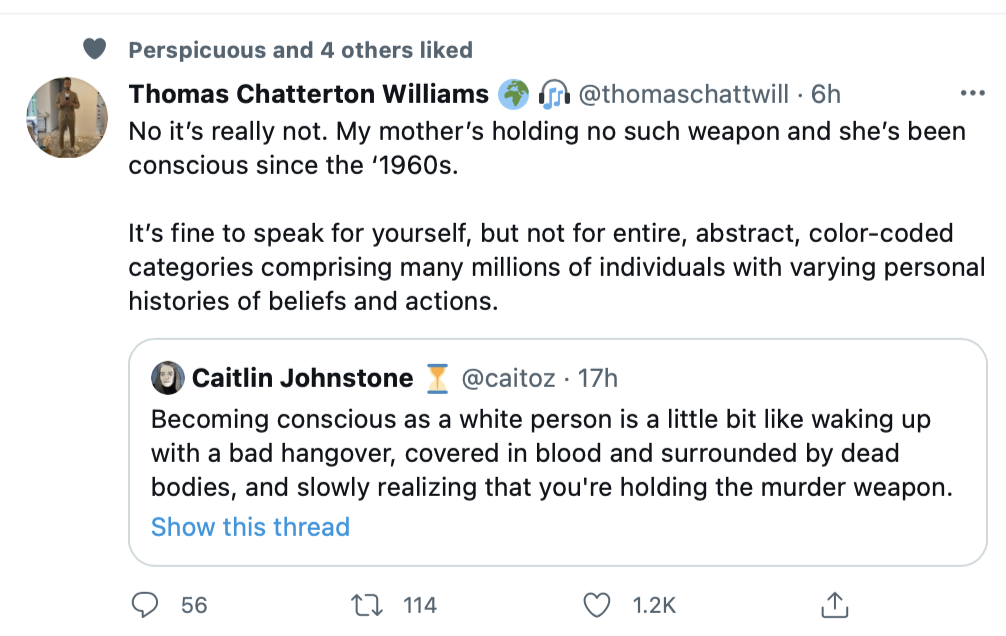
I believe that Thomas Chatterton Williams has nailed it: Speak only for yourself based only on your own life, your own choices and your own experience. If you've been a lifelong closet racist, such as Robin DiAngelo, then, yes, it's time to come clean. I suspect there are more than a few such people But don't pretend that you can speak for anyone else. Don't pretend that it has been impossible to treat everyone else as individuals.Don't pretend that it is a rare thing. Don't pretend that everyone else inevitably sees people as "colors" and treats them in stereotypical ways. If you recently had a revelation that you are a racist, go fix yourself and quit projecting your dysfunctional mindset onto everyone else. As part of your healing process, you might want to read Thomas Chatterton Williams' excellent book: Self-Portrait in Black and White: Family, Fatherhood, and Rethinking Race.
Wide Open Classroom Discussion
A professor at Duke has convinced his students to open up classroom discussions. The project could not happen in the absence of trust. An excerpt from the WSJ:
To get students to stop self-censoring, a few agreed-on classroom principles are necessary. On the first day, I tell students that no one will be canceled, meaning no social or professional penalties for students resulting from things they say inside the class. If you believe in policing your fellow students, I say, you’re in the wrong room. I insist that goodwill should always be assumed, and that all opinions can be voiced, provided they are offered in the spirit of humility and charity. I give students a chance to talk about the fact that they can no longer talk. I let them share their anxieties about being socially or professionally penalized for dissenting. What students discover is that they are not alone in their misgivings.
Having now run the experiment with 300 undergraduates, I no longer wonder what would happen if students felt safe enough to come out of their shells. They flourish. In one class, my students had a serious but respectful discussion of critical race theory. Some thought it harmfully implied that blacks can’t get ahead on their own. Others pushed back.
My students had an honest conversation about race, but only because they had earned each other’s trust by making themselves vulnerable. On a different day, they spoke up for all positions on abortion. When a liberal student mentioned this to a friend outside class, she was met with disbelief.
Transgender Nomenclature
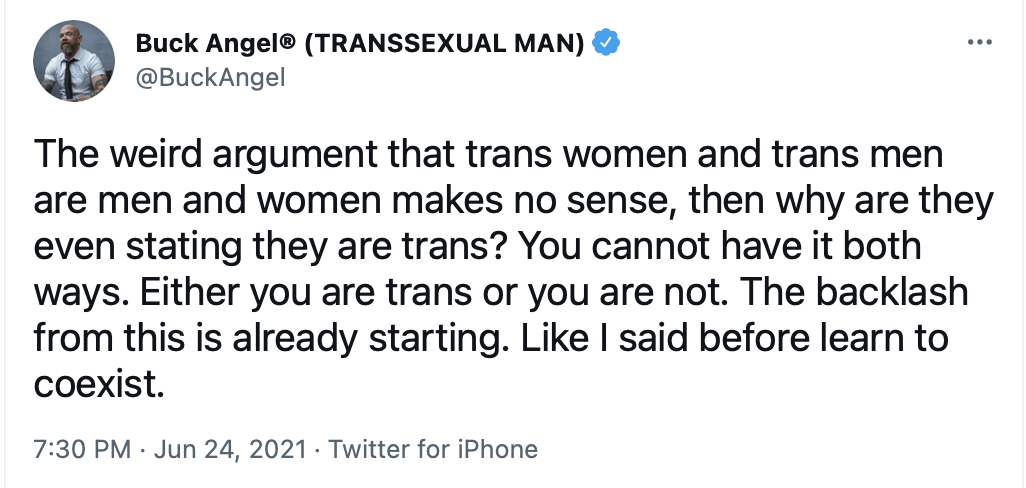
Trans men are not the same as men. Trans women are not the same as women. Men were not born as women, whereas trans men were. These are not mean spirited things to say. They are facts. Trans men were born as women and they present as men. If they want me to refer to them as men, I happily will. No problem. But that doesn't change the fact that trans men are not exactly the same as natural born men. Buck Angel, a trans man, explains:
Ed Snowden Discusses “The Most Dangerous Form of Censorship”
Ed Snowden has begun writing at Substack. He has named his column "Continuing Ed." In his first post he discusses the most dangerous form of censorship, beginning his essay with a quote by Serbian-Yugoslav writer Danilo Kiš. Kiš, who narrowly escaped the Holocaust and whose work was eventually suppressed in Yugoslavia, wrote passionately on this struggle:
Whichever way you look at it, censorship is the tangible manifestation of a pathological state, the symptom of a chronic illness which develops side by side with it: self-censorship. Invisible but present, far from the eyes of the public, buried deep down in the most secret parts of the spirit, it is far more efficient than [official] censorship. While both of them induce (or are induced?) by the same means — threats, fear, blackmail — this second ill camouflages, or at any rate does not denounce, the existence of any outside constraint. The fight against censorship is open and dangerous, therefore heroic, while the battle against self-censorship is anonymous, lonely and unwitnessed, and it makes its subject feel humiliated and ashamed of collaborating.
Snowden's essay is a commentary on this most dangerous form of censorship: self-censorship:
“Lonely and unwitnessed,” “dangerous and condemnable” — Kiš's perfect and tragic adjectives — describe how many people feel today, when confronted with the internet's many opportunities for self-presentation, and equally many opportunities for self-destruction. Under the pitiless eye of mass surveillance, which funnels the most tentative keystroke into our permanent records, we begin to surveil ourselves.Unlike in Kiš's milieu, or in contemporary North Korea, or Saudi Arabia, the coercive apparatus doesn't have to be the secret police knocking at the door. For fear of losing a job, or of losing an admission to school, or of losing the right to live in the country of your birth, or merely of social ostracism, many of today's best minds in so-called free, democratic states have stopped trying to say what they think and feel and have fallen silent. That, or they adopt the party-line of whatever party they would like to be invited to — whatever party their livelihoods depend on.
I constantly feel that urge to self-censor, because I know that I'm pissing off people who will be vocal, many of whom I consider to be friends. I assume--perhaps presumptively--that many more will agree but will be silent). I often speak up anyway because I know that silent acquiescence by the supposed owners of this country is not a healthy want to run the country. I motivate myself to speak out by thinking of the many brave people who have spoken out against ignorance and injustice under conditions that are far more dangerous than anything I have ever faced.
A man dies when he refuses to stand up for that which is right. A man dies when he refuses to stand up for justice. A man dies when he refuses to take a stand for that which is true. - Martin Luther King, Jr.
As a general rule, people should publicly say the sorts of things that they are thinking. The American experiment requires that we collaborate with each other, and the best way is by using our words instead of throwing rocks and shooting guns. When we talk openly, we will offend others, and that is the unavoidable cost of free speech. When we bravely say the things we are thinking, we are able to function imperfectly as a coordinated whole, e pluribus unum. When a person self-censors, that person is only pretending to be part of the body politic. A wide-open national cacauphonous chattering is what bubbles up, in the aggregate into public policy. Any form of censorship thus degrades democracy and impairs social flourishing, even to the extent that idea seems like a terrible and offensive idea.
As Snowden describes, self-censorship is insidious. No one will come to your rescue because you are not making any public call for help. Further, it's easy to get used to self-censorship because there is a constant immediate cheap payback: it is extraordinarily rare that anyone will criticize you for failing to speak your mind on an important topic. Our self-censorship constitutes a payment to an intellectual protection racket. Institutions and governments won't shit on you so much when you muzzle your words and thoughts. That deal works out well enough for those who are willing to look in the mirror everyday to see someone lacking the courage of their convictions.
- Go to the previous page
- 1
- …
- 185
- 186
- 187
- 188
- 189
- 190
- 191
- …
- 530
- Go to the next page