rss

Tag: "race"

0
Tour de Lafayette bicycle race photos

Tour de Lafayette bicycle race photos

Watching bicycists racing is awesome. The Tour de Lafayette bicycle race was held tonight, about two miles away from my house. My wife and two daughters (9 and 11) rode our lighted bikes through the dark to watch parts two img_93341races. We brought our little consumer grade camera with us (the Canon SD1100SI) to see if we could squeeze a good photo out of fast bicycles racing through the still night. There was lighting at each of the corners of the 1 mile square course, so we parked ourselves under one of those lights. Most of our photos were total blurs, even when we tried panning with the bikes as they blew by us from left to right. I did manage the photo on the right, though.
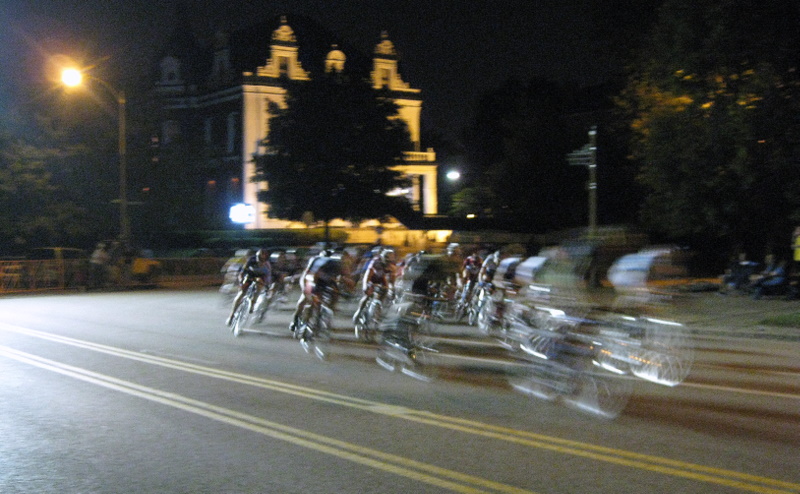
The winning photo of the night, however, belonged to my 11-year old daughter JuJu, who at first thought she had let the pack get too far in front when she snapped her photo (below). It’s a neat effect: speed, darkness and well-tuned athletes. You’ll have to imagine the cool night air and the gracious encouragement of the spectators.

Image by JuJu Vieth

Click on these photos for larger versions.

1

We can’t talk

We can’t talk. Or, rather, we can only talk in canned narratives, as Glenn C. Loury writes in the NYT:

[T]his convenient story line is reflected in an all-too-familiar narrative: “Here we are, 45 years after the Civil Rights Act of 1964, with a black man in the White House. And yet, it is still the case that a distinguished Harvard professor, standing on his own front step, can be treated like a common criminal simply because he’s black. Obviously it is way too soon to declare that we have entered a post-racial era … .”

As far as I am concerned, the ubiquity of this narrative shows that we are incapable of talking straight with one another about race. And this much-publicized incident is emblematic of precisely nothing at all. Rather, the Gates arrest is a made-for-cable-TV tempest in a teapot.

Therefore, as many people use the Gates incident to teach lessons about race, the reality is that objective people are left to wonder whether the case was about race at all.

2

Richard Nisbett: Intelligence mostly varies due to the environment, not genes

The dominant hereditarian view of intelligence holds that intelligence is mostly fixed by the genes. Richard Nisbett has dismantled the evidence on which the hereditarian theory is based. In his new book, Intelligence and How to Get It, Nesbitt argues that the twin studies on which the hereditarian view is based are deeply flawed. The main problem is that the adoptive homes in which those separated twins often find themselves are uniformly enriched learning environments. Nisbett’s book was reviewed by Jim Holt of the NYT Book Review:

Nisbett bridles at the hereditarian claim that I.Q. is 75 to 85 percent heritable; the real figure, he thinks, is less than 50 percent. Estimates come from comparing the I.Q.’s of blood relatives — identical twins, fraternal twins, siblings — growing up in different adoptive families. But there is a snare here. As Nisbett observes, “adoptive families, like Tolstoy’s happy families, are all alike.” Not only are they more affluent than average, they also tend to give children lots of cognitive stimulation. Thus data from them yield erroneously high estimates of I.Q. heritability. (Think: if we all grew up in exactly the same environment, I.Q. differences would appear to be 100 percent genetic.) This underscores an important point: there is no fixed value for heritability. The notion makes sense only relative to a population. Heritability of I.Q. is higher for upper-class families than for lower-class families, because lower-class families provide a wider range of cognitive environments, from terrible to pretty good.

What does Nisbett’s book have to say about race and intelligence? That the differences among the “races” are not genetic. Evidence in point: The “racial” IQ gap has been shrinking. “Over the last 30 years, the measured I.Q. difference between black and white 12-year-olds has dropped from 15 points to 9.5 points.”

3

Intelligence versus attractiveness; is there a correlation?

Intriguing post by points out research that purports to show that intelligence correlates positively with attractiveness.

This research does dispel the notion that very attractive woman are less intelligent than average-looking woman; according to this research, very attractive woman are in the most intelligent group. I’m mulling over these findings; I don’t quite know what to think of this yet. I do know that I’m highly suspicious of any sort of simplistic IQ-based characterization of “intelligence” (I recently made that point here).

0
Diminishing races, growing family

Diminishing races, growing family

In the January 22, and 2009 edition of Nature (available only to subscribers online), Aravinda Chakravarti explains that our simplistic notions of “population” and “race” will need to be revised as we enter the age of “personal genomics.” Chakravarti teaches at the Johns Hopkins University School of Medicine.

Traditionally, we’ve used geological records to trace our family histories. We are now approaching a time where we will be able to use DNA databases. Whereas our traditional human records take us back several hundred years, our genomes will allow us to explore our ancestry for hundreds of thousands of years. Chakravarti argues that we will be entering unknown territory riddled with surprises and stretching the meaning of the word “family.”

How close knit is our human “family”?

All living humans are related via a set of common ancestors who lived in Africa about 200,000 years ago. Other studies have since shown that the world beyond Africa was settled even more recently. From 100,000 years ago, descendants of our African forebears spread out to populate other continents . . . the striking implication of this is that all living humans are mosaics with ancestry from the many parts of the globe through which our ancestors trekked. In other words, each of us has around 6.7 billion relatives.

Chakravarti points out that our genealogy-based record-keeping is often riddled with error. It fails to indicate our interrelatedness to each and every other human being, for example. Further, evidence shows that at least one out of 20 people do not know the identity of their genetic father. Thanks to the falling cost of examining entire human genomes (Chakravarti indicates that it has fallen 1000- fold or more), we now have abilities we could only have dreamed of a few decades ago.

Personal genomics might well destroy our simplistic notion of “race.” Human populations are not intact groups. There is no such thing as genetically characterized racial categories. We are all “multiracial, related to each other only to a greater or lesser extent.” Detailed surveys are making it clear that there is no such thing as a discrete racial group. Rather, it is clear that there is a “continuity in variation across the globe, not abrupt transitions between population-specific sequence patterns.” Personal genomics would allow us to focus on individual human beings, instead of artificially constructed “racial” populations.

Genome-wide studies … could result in the individual identity and kinship coming to define populations rather than the other way around. We could test once and for all whether genetic race is a credible concept. This would be tremendously exciting. It is bound to stir up our deeply held notions of who we are, where we came from, our history and thus our politics. .. . it may be time for science to reshape the views of society. By dismantling our notions of race and population, we may better appreciate our common shared and recent history and perhaps more importantly our shared future.

I recently posted on the topic of whether science should study race and intelligence. I think this would be a worthy topic of science (just as is every other potential field of study), but I warned that our current definition of “race” is horribly muddled. We need to get clear on this term, if that is even possible. I found Chakravarti’s article to be a refreshing reminder that there might not even be a worthy scientific definition of “race.” In fact, it might well be that, once we look carefully at the evidence, we will find that there are actually 6.7 billion “races” out there. Or is it more accurate to conclude that there is only one human race?

2
Color-coded history

Color-coded history

Consider this description of a significant and tragic event in American history:

[Occurring in May and July 1917, this event] was an outbreak of labor and racially motivated violence against blacks that caused an estimated 100 deaths and extensive property damage in [an American industrial city]. It was the worst incident of labor-related violence in 20th century American history, and one of the worst race riots in U.S. history. It gained national attention. The local Chamber of Commerce called for the resignation of the Police Chief. At the end of the month, ten thousand people marched in silent protest in New York City over the riots, which contributed to the radicalization of many.

[paraphrased from Wikipedia]

Do you know anything about the event described above? The above passage describes the East St. Louis race riot that occurred on Monday, July 2, 1917. I learned about this riot for the first time tonight when I had the opportunity to hear a talk by Harper Barnes, a St. Louis journalist who has recently written a book called Never Been a Time: The 1917 Race Riot That Sparked the Civil Rights Movement.

[caption id="attachment_5419" align="alignright" width="150" caption="Harper Barnes - Photo by Erich Vieth"]Harper Barnes - Photo by Erich Vieth[/caption]

In 1914, the first world war was heating up and so were the heavy industries. East St. Louis, Illinois, located right across the Mississippi River from St. Louis, Missouri, was the home of large aluminum and steel plants.

To backtrack, through the 1910s, one-half million blacks who had resided in the rural South moved up to northern cities. Employers made use of these blacks as strikebreakers. The blacks certainly wouldn’t have felt much loyalty toward the unions, because the white unions banned black workers.

13
Should science study race and IQ?

Should science study race and IQ?

Should science study race and IQ? A recent article in Nature (”Should scientists study race and IQ“) says yes, as long as the research is done carefully and kept free of outside influence and premature application by social scientists and politicians. Science did not give rise to bigotry. After all, scientific studies of race and IQ began in relatively modern times, only after long centuries of “pernicious folk-theories of racial and gender inferiority predated scientific studies.” The authors believe that first-rate scientific research will, in the end, dispel much of the racial bigotry that still exists.

Some scientists hold more ‘acceptable’ views, ourselves included. We think racial and gender differences in IQ are not innate but instead reflect environmental challenges. Although we endorse this view, plenty of scholars remain unpersuaded. Whereas our ‘politically correct’ work garners us praise, speaking invitations and book contracts, challengers are demeaned, ostracized and occasionally threatened with tenure revocation.

Acts of censure edge close to Lysenkoism. They also do a disservice to science. When dissenters’ positions are prevented exposure in high-impact journals and excluded from conferences, the dominant side goes unchallenged, and eventually its rationale is forgotten, forestalling the evolution of crucial ideas.

I am sympathetic to the need to for scientists to carefully examine everything, no exceptions. I’m concerned, though, that we need to look extra-closely at the concept of “race,” which I consider to be virtually useless in daily matters. Nor should we allow the simplistic concept of “IQ” to serve as a variable, given much more expansive ways to measure intelligence (see, for example this post on Howard Gardner’s work). For more on the dangers of misusing “IQ,” see Steven J. Gould’s 1996 book, “The Mismeasure of Man.”

In sum, we should do good science and I believe that good science would suffocate bigotry. The article points out several examples of this. Good science should be done on only after kicking out the clumsy, pernicious concepts of “race” and “IQ,” reframing the debate as the relationship between fine-grained genotypic variation and competence in each of the many ways in which humans display competence. Because genotypic variation within “races” is at least as wide as genotypic variation among “races,” a meaningful scientific exploration would not amount to a simplistic survey of how people with different colors of skin do on standardized intelligence tests. That would not be good science. Good science will always take into account the convoluted ever-changing environment, and that is not easy to do when we are dealing with basic concepts that are vague.

I’m not convinced that we are prepared to begin the necessary research on this general topic, because too many of us, including many well-trained scientists, have not done their ontological homework (consider the incoherent and clumsy stumblings of DNA co-discoverer James Watson, described in the article). Are “race” and “IQ” useful constructs with which to do this sort of research? Time will tell if we are intelligent enough to sharpen our constructs before running off to demonstrate our “truths.”

1

The language of science is always so amazingly precise . . . except when it isn’t

The language of science is always so amazingly precise . . . except when it isn’t. Consider, for example, the word “life.” Scientists have long struggled to determine exactly what qualifies as “life.” For instance, are viruses “alive?”

In the October 23, 2008 edition of Nature (available only to subscribers online), an article titled “Disputed Definitions” considers other often-used disputed terms. The article is divided into sections written by specialists from the relevant disciplines. The subtitle of the article is “Nature goes in search of the terms that get scientists most worked up.” Consider how often you encounter the following disputed terms.

Consider “paradigm shift,” made popular by Thomas Kuhn in his often-cited 1962 book, The Structure of Scientific Revolutions. Kuhn argued against the then-popular view that science marched incrementally toward the truth. Sometimes, “normal science” doesn’t explain all of the phenomenon, straining a prevailing scientific theory. If the strain of accommodating evidence is great enough “eventually some new science comes along and overturns the previous consensus. Voila, a ‘paradigm shift.’” The often-used term “paradigm shift” is used in at least two ways, however. In its broad sense it encompasses the “entire constellation of beliefs, values, techniques and so on shared by the members of a given community.” In the narrow sense, it refers to “concrete puzzle-solutions.”

Another often-debated (and currently fashionable) term is “epigenetic.”

1

Obama discusses the family dog, and much more

It’s interesting what kind of man we have elected President.   He is so knowledgeable about so many things, even the topic of dog allergies.  And he is so incredibly comfortable talking about race.  Consider this comment from today’s press conference:

We have two criteria that need to be reconciled,” said Obama. “One is that Malia [...]

1

Why isn’t Barack Obama way ahead in the polls?

Why isn’t Senator Barack Obama way ahead of John McCain in the polls?  Why is this race so tight?  Bob Cesca has an idea:
Hmm. I can’t imagine why that is. It’s not like Senator Obama’s patriotism and character is being assassinated for three hours every morning on cable news — six hours if we include [...]

8

Is there an innate human desire to use the vague word “innate”?

As I mentioned in an earlier post, I recently had the opportunity to attend some of the sessions of the “Future Directions in Genetic Studies” workshop at Washington University in St. Louis. One of the talks was by Paul Griffiths, a Philosophy professor from Sydney, Australia, who discussed “The Distinction between Innate and Acquired [...]

7

A College Class Lists the Races

I’ve stewed on this one for a while. I couldn’t decide whether it made for an interesting post or a snide, judgmental complaint. I think it will ultimately fall somewhere in between.
Last fall, I took an introductory Anthropology course at my large public university of choice. The class fulfilled a general science requirement, so [...]

11

Obama on the meaning of “We the People”

Barack Obama has challenged Americans to rise above trite cartoonish conceptions of race.
[youtube]http://www.youtube.com/watch?v=pWe7wTVbLUU[/youtube]
The full text of Obama’s thought-provoking and impassioned speech can be read here.
Are Americans ready for a candidate who dares to challenge them? Are they ready for a candidate who speaks comfortably of the complexities of race as he has previously [...]
