Reminder: Biden White House Censorship of Facebook
For those who claim there was no censorship by the Biden WH. I could give dozens of examples. Here is Mark Zuckerberg discussing Biden WH censorship of Facebook: "It was brutal."
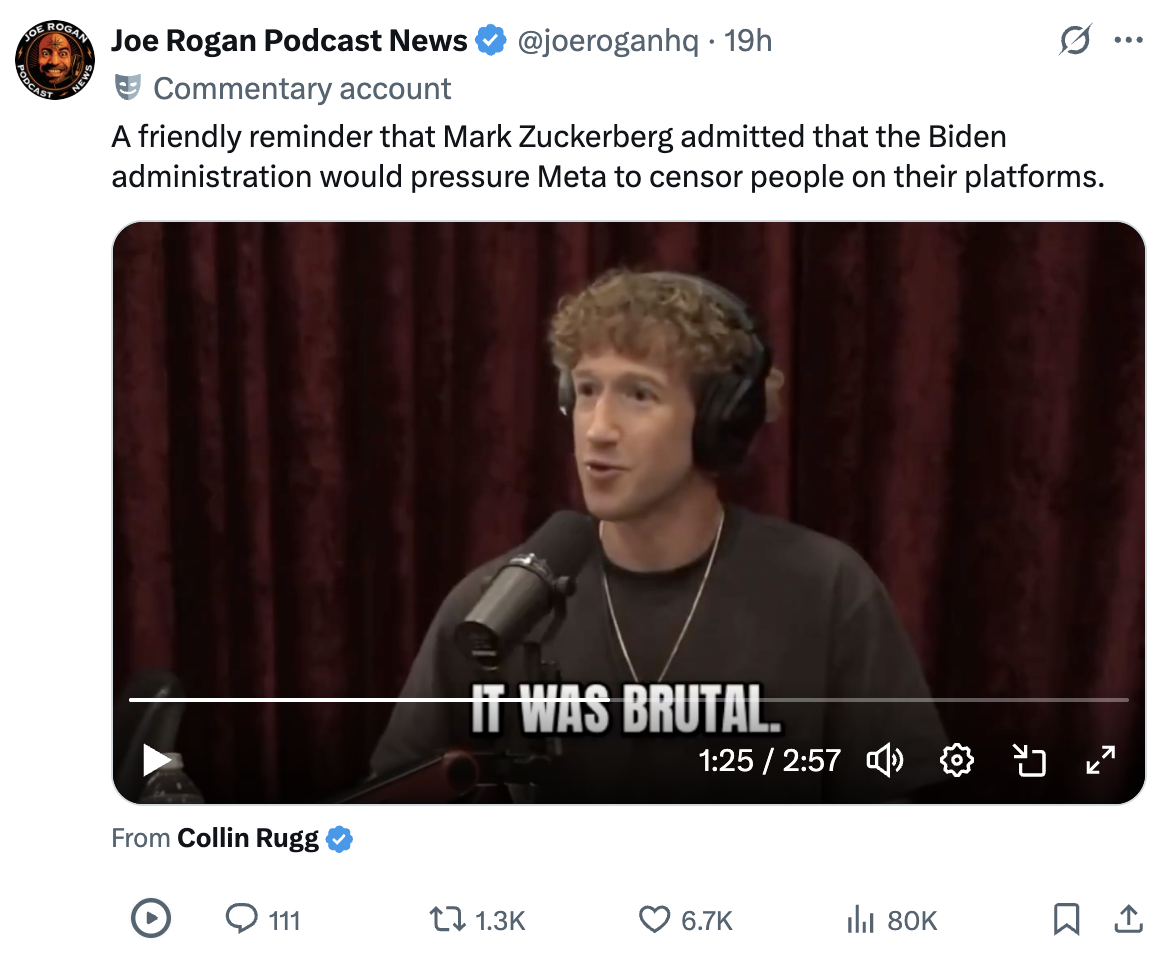

For those who claim there was no censorship by the Biden WH. I could give dozens of examples. Here is Mark Zuckerberg discussing Biden WH censorship of Facebook: "It was brutal."
Glenn Greenwald: "Meet Aaron Berman: who spent his entire adult life working at the CIA, only to leave to become a top Facebook official responsible for censoring political speech.Among other things, Aaron was the key Facebook official who censored Brazil's debates before its 2022 election."
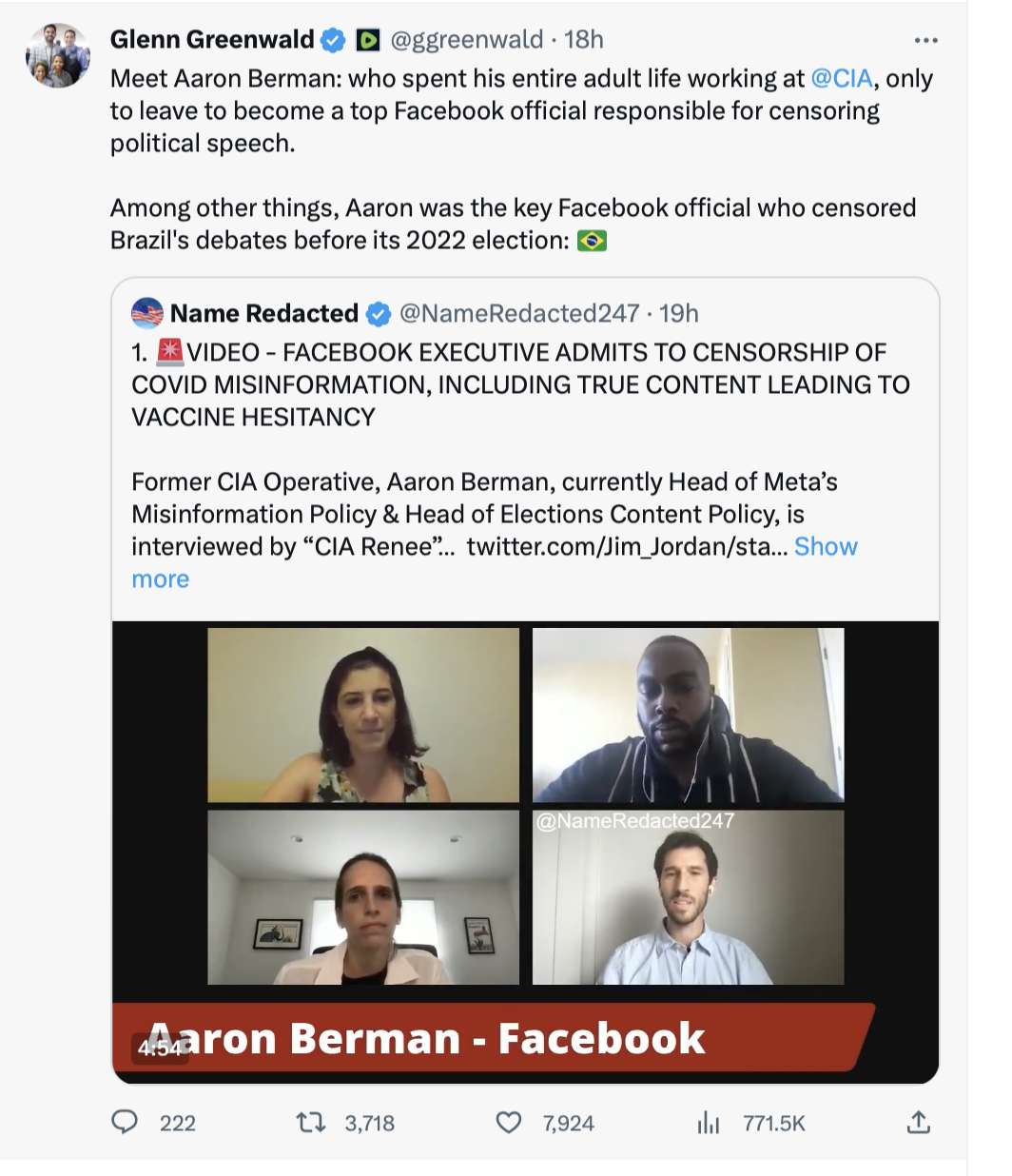
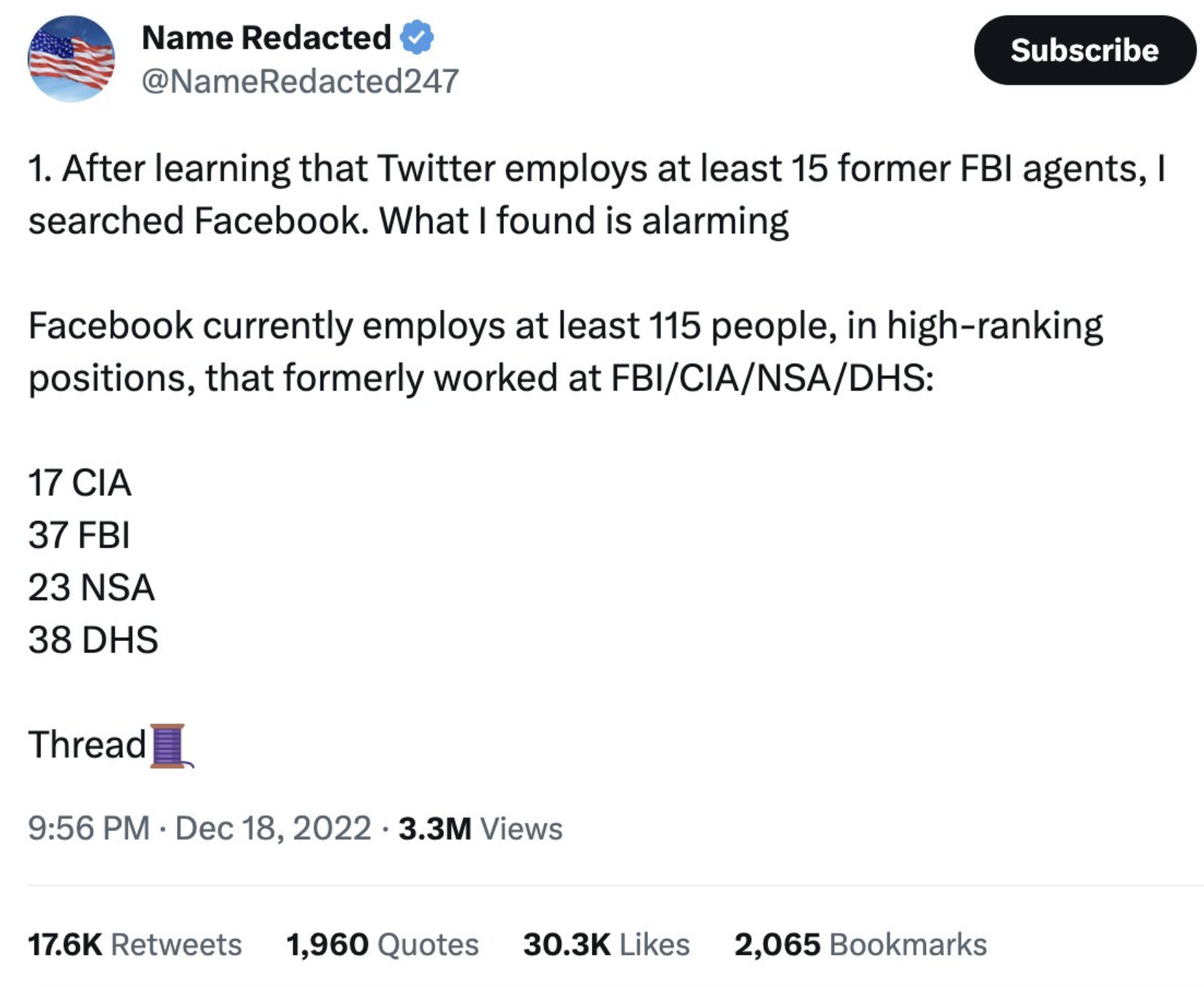
And speaking of ex-spies now at social media, you'll find CIA, FBI, NSA and DHS ex-employees. And there is a saying that one you work at the CIA, you never stop working at the CIA, no matter where you end up:
I'm working on some longer articles for Dangerous Intersection at the moment, though I'm not publishing at DI as often as I did several years ago. However, I have lots of plans to address quite a few exciting topics here. This will be the location for extended commentary and my own substantive articles. In the meantime, I've been posting many links to worthy articles over at my Facebook page. I'm publishing some of those materials only at Facebook, not here at DI. If you are interested in tapping into those very short articles and links, simply send me a Friend Request at Facebook.
In years past, I used to rest assured that I was in good shape, physically, economically and socially. That was before computers gave me the ability to know exactly how I'm doing. It used to be easier to pretend that one was in good health. Nowadays, hundreds of websites let you know about all of the diseases that threaten you, complete with many symptoms that undoubtedly match some of your symptoms. Of course there have always been books and magazines with medical information, but never before could you so easily pinpoint so many symptoms with a free Google search or a quick visit to the symptom-checker at Wrongdiagnosis.com. Economically, we used to put our money into some sort of mutual fund or other investment, and we considered that we were "married" to the account. Computers now give us the ability to track our financial health second by second. Computer-programmed trading also creates crazy jumps and plunges in the market. Ignorance was bliss, and many advisers argue that you should go back to finding a reasonable place to put your money, then ignoring it for long periods of time. Then there is one's social health. It used to be that I could assume that I had an indefinite (large) number of people with whom I had a friendship. That was before Outlook came along to tell me exactly who I did (and did not) know well enough to have a phone number or an email address. In Outlook, you'll get the exact number. Ooops. My social circle is not nearly as big as I'd like to believe. Perhaps you are thinking that Outlook is not the right place to look, and that one ought to look, instead, to Facebook. Thanks to the precision statistics offered by Facebook, we can see that the typical Facebook user has 190 friends. That's it? But what if I get in a bind or I get sick, and I need the help of a "friend." It seems like you could run through 190 "friends" all too quickly. It ultimately presents the same problem as Outlook. It gives you a finite number, and many of them are not really good friends, anyway, as much as I enjoy sharing information with them. A new article in The Atlantic, "Is Facebook Making Us Lonely," by Stephen Marche, should make us even more suspicious of the Facebook phenomenon (the article is in the May 2012 edition, not yet online). We learn (p. 66) that neurotics and lonely individuals spend greater amounts of time on Facebook per day than non-lonely people. He also writes that Facebook has become a place to pretend that one's life is better than it is, and that "believing that others have strong social networks can lead to feelings of depression." He also cites to research showing that "surrogates can never make up completely for the absence of the real thing . . . actual people in the flesh." He concludes that the idea that a website "could deliver a more friendly, inter-connected world is bogus." Further research shows that "the greater the proportion of face-to-face interactions, the less lonely you are . . . [and] The greater the proportion of online interactions, the lonelier you are." He adds that Facebook is not always a bad thing. Like many things, it is a tool that can be used or misused. "It's like a car. you can drive it to pick up your friends. Or you can drive alone." Then again, Facebook puts us into the business of competing with our "friends." "Facebook imprisons us in the business of self-presenting, and this, [according to author Jaron Lanier], is the site's crucial and fatally unacceptable downside." Facebook gratifies "the narcissistic individual's need to engage in self-promoting behavior." So think about this next time you smugly react to your "friend" count. Marche's article is far more nuanced than the above summary, and he would admit that there are many ways to use Facebook. I, for instance, use it to share article, including many articles from this website. I can't help but notice, though, that many people post on Facebook 8 times per day, and they would seem to fall into his description of those having a "narcissistic personality disorder." When you add up your Facebook "friends," then, to see how rich you are with "friends," you might want to set those narcissistic friends aside before counting. So this is life by the numbers, at least if you include this final number, which I take as a challenge, rather than a depressing fact (or use this alternate method of calculating your approximate number of remaining days). In sum, it appears that you will be happier (or at least you will think you are happier) if you get away from the computer and, instead, spend time with a good friend, face-to-face, talking about something other than your health, your investments, and you cyber social circle.
How does a person end up with 700,000 "Friends" on Facebook? Here's how.