rss

Tag: "Economy"

0

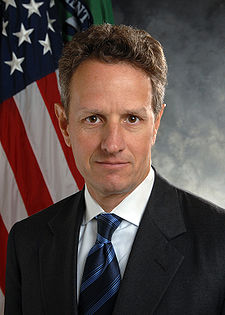
Dylan Ratigan asks why Tim Geithner still has a job

In a succinct and powerful video, Dylan Ratigan wonders why Tim Geithner still is our Treasury Secretary. Senator Maria Cantwell, who makes an appearance on this video, wonders this too, calling Geithner’s job performance “appalling.” I agree. It’s time for Obama to start fresh while we are not in crisis mode. He can do this without starting a panic by saying something like, “We thank Mr. Geithner for his service getting us through this crisis.” But then, by all means, throw the bum out and let’s pick an honest outsider (not another Goldman Sachs alum) to lead the way. Am I being harsh when I say “bum”? Nope . . . I’m being restrained. Geithner should be taking the time to use the mass media to teach common people what went wrong, how we can avoid it happening again, and explaining exactly where our public tax dollars have gone. Because he refuses to do any of this, and he refuses to be an powerful advocate for taxpayers, he should step aside. It is clear that he doesn’t understand who he is supposed to represent.

If I were to speak more bluntly, I would say that Tim Geithner is committing a fraud on the U.S. public. Here are the words of Robert Johnson, former economist at the Senate Banking Committee and the Senate Budget Committee

[Geithner] speaks as though they’re doing very comprehensive reform. Unfortunately, in the United States, one of the reasons we had the bubble and the crisis was because we have a broken political system, where campaign money, lobbying influence of the financial sector is enormous, and it created bad regulations, bad laws. I’m going back into the Reagan period, Bush the senior, particularly the Clinton era. We’ve made a mess, and now we come back from a crisis where the population knows darn well what a mess we’ve made. But the problem is, at this point, the people in power, the moneyed interests are still in power. And a large portion of these reforms are either cosmetic or designed by the industry and quite ineffective. . .

Ground Zero, the San Andreas Fault of our financial system, where it blew up last time, was in the intersection between “too big to fail” firms and over-the-counter derivatives and that these derivatives need to be put on exchanges, because they’re too complex, and when they’re combined with the “too big to fail” firms, which have a 95 percent market share in OTC derivatives, five banks, that it can create a situation, like we were talking about moments ago, where Citibank could not be restructured. The spider web of positions in derivatives is so complex and so entangled that it deters policy officials from being able to put them through restructuring, because they’re afraid of what kind of spin-offs and consequences will happen. I spoke about the credit default swap market and the illusion of safety that those credit default swap contracts created when they’re unregulated, because everybody thought AIG was going to be able to pay the bill, but they weren’t, and then the taxpayer got to provide that capital.

It’s also time for Cantwell and her Senate colleagues to quit blaming Treasury for failing to lead the way. Congress has the power to make laws; it should should pass the necessary laws to close the “loopholes” she finds so appalling.

12
The unspoken reality of “Peak Oil”

The unspoken reality of “Peak Oil”

THE world will have to find four Saudi Arabias by 2030 if it wants to maintain its oil dependency, the International Energy Agency says.

The reality of peak oil is fast approaching, and more must be done to develop and encourage the use of alternatives including solar and nuclear, the agency’s chief economist has warned.

“My main motto never changes, the era of low oil prices is over,” Dr Fatih Birol said.

That’s the verdict reported today in The Australian. I thought I’d check to see what other sources had to say about Birol’s assertion, but I cannot find a single U.S.- based source reporting it, other than blogs that are dedicated to peak-oil issues. This is rapidly becoming a crisis, and almost nobody is discussing it in America. Not just here, of course– study groups in Britain have been trying to get their government to begin planning for the reality of peak oil for years, and now they are saying it’s simply too late. (see this also).

10

William Black’s five fatal flaws of finance

William Black is a white-collar criminologist who has written a compelling account of how the bloated parasitic financial sector is ruining America in his recent post at Huffpo. These are Black’s five “fatal flaws” of finance:

1. The financial sector harms the real economy. Even when not in crisis, the financial sector harms the real economy. First, it is vastly too large.

2. The financial sector produces recurrent, intensifying economic crises here and abroad.

3. The financial sector’s predation is so extraordinary that it now drives the upper one percent of our nation’s income distribution and has driven much of the increase in our grotesque income inequality.

4. The financial sector’s predation and its leading role in committing and aiding and abetting accounting control fraud combine to: A) Corrupt financial elites and professionals, and B) Spur a rise in Social Darwinism in an attempt to justify the elites’ power and wealth.

5. The CEOs of the largest financial firms are so powerful that they pose a critical risk to the financial sector, the real economy, and our democracy.

The Solution: Fix the real economy, if you can find it. “The real economy came off the rails at least three decades ago for the great majority of Americans.”

I was highly impressed with William Black after seeing him interviewed by Bill Moyers. And now, after reading this detailed by accessible analysis, I’m even more impressed. We can’t begin to fix the economy unless we begin to implement basic principles we can actually understand. Fixing the real economy and making sure that finance is merely the servant of the real economy are clearly steps one and two, for each of the reasons listed by Black.

2
Regulation as a prerequisite to meaningful cooperation

Regulation as a prerequisite to meaningful cooperation

While I was reading up on free market fundamentalism, and I happened across an intriguing article by biologist David Sloan Wilson. As I started reading this article, I was wondering this: Even assuming that a “free market” works wonders in small societies, can societies be scaled up in size guided only by the free market, without formal regulations? D.S. Wilson argues that this is the wrong question. All societies are regulated. The only question is how they are regulated.

D.S. Wilson notes that humans are incredibly cooperative, especially in “small face-to-face groups.” In fact, we regulate each other’s conduct so easily in small groups that “we don’t even notice it.” This gives us the illusion that there is no regulation keeping things in check. All well-functioning groups, large and small, human and non-human, are highly regulated, however. Small groups often seem to work well without formal regulation, but free market fundamentalists (and others) confuse this lack of formal regulation for the total lack of regulation.

This self-organizing ability to function as cooperative groups is “so perfectly natural” because it evolved by a long process of natural selection, in humans no less than bees. By the same token, functioning as large cooperative groups is not natural. Large human groups scarcely existed until the advent of agriculture a mere 10 thousand years ago. This means that new cultural constructions are required that interface with our genetically evolved psychology for human society to function adaptively at a large scale.

Wilson’s approach makes intuitive sense. Throughout the Pleistocene (from about 2 MYA until 10,000 years ago), people lived in small groups. They lacked written language and written laws. They used unwritten techniques (presumably customs, habits, ostracism and various other informal methods of social control and punishment) to coordinate community efforts and punish cheaters. These informal methods worked well enough and long enough that we can now sit here and ponder how well they worked. But just because those ancient forms of regulations weren’t written down doesn’t mean they didn’t exist. And it doesn’t mean that ancient societies weren’t tightly regulated. Just as human households are highly regulated without formal rules, so are small societies. So are non-human societies:

These social preferences go beyond our own species. Cooperation and cheating are behavioral options for all social species, even bacteria, and cooperation survives only to the extent that it is protected against cheating. The eternal conflict between cooperation and cheating even takes place within our own bodies, in the form of genes and cell lineages that manage to game the system at the expense of the organism upon which they depend. We call them diseases, but they are really the failure of a vast system of regulations that enable us to function as organisms as well as we do . . .

What about the eusocial insects, such as ants, wasps and bees? Wilson would argue that a well-functioning hive doesn’t simply happen, and it certainly isn’t driven by something as simplistic as the “self-interest” of individual bees:

[B]ee behavior cannot be reduced to a single principle of self-interest, any more than human behavior. There are solid citizens and cheaters even among the bees, and the cheaters are held at bay only by a regulatory system called “policing” by the biologists who study them.

According to D.S. Wilson, you’ll find regulation (informal or formal) everywhere you find a well-functioning society of living organisms. Further, a human society based merely on individual selfishness can’t self-regulate because we can no longer depend on selfishness to be well-tuned or consistent thanks to Daniel Kahneman’s brilliant destruction of rational choice theory.

Regulation runs a continuum from informal to formal. It is not like regulation itself just showed up for the first time in modern human societies. D.S. Wilson argues that in all large-scale societies, “regulation is required or cooperation will disappear, like water draining from a bathtub.” Without some form of regulation, all societies become rudderless and unproductive. Therefore, there must always be some form of regulation. The question to decide is “What kind of regulation?”

Let there be no more talk of unfettered competition as a moral virtue. Cooperative social life requires regulation. Regulation comes naturally for small human groups but must be engineered for large human groups. Some forms of regulation will work well and others will work poorly. We can argue at length about smart vs. dumb regulation but the concept of no regulation should be forever laid to rest . . . We also need to change the metaphors that guide behavior in everyday life to avoid the disastrous consequences of our current metaphor-guided behaviors. That is why the metaphor of the invisible hand should be declared dead.

I would agree that the “invisible hand” is shorthand for the informal regulations that have been since prehistoric times to facilitate social coordination of small primitive societies. Rather than declaring the “invisible hand” to be dead, though, it might be more accurate to suggest that the “invisible hand” lives on in modern societies, quietly and substantially supplementing our formal regulations. Seen in this way, the “invisible hand,” used in the complete absence of consciously planned social regulations and laws, is not a method for creating or maintaining a complex functioning modern society. Rather, it is the path back to the Pleistocene.

0

Financial crisis: NOT fixed

Have we “fixed” the problem that lead to the financial collapse of the U.S.? Not at all, according this article in Bloomberg.

Joseph Stiglitz, the Nobel Prize- winning economist, said the U.S. has failed to fix the underlying problems of its banking system after the credit crunch and the collapse of Lehman Brothers Holdings Inc.

“In the U.S. and many other countries, the too-big-to-fail banks have become even bigger,” Stiglitz said in an interview today in Paris. “The problems are worse than they were in 2007 before the crisis.”

18
A big suburban shopping mall is dying, yet I’m not shedding any tears

A big suburban shopping mall is dying, yet I’m not shedding any tears

Today I took my two daughters to a movie. The theater was located in a large suburban shopping mall in Southwest St. Louis County, “Crestwood Plaza.” I had not been to this mall for several years, and I was shocked at what I saw. Approximately 40% of the stores have been shuttered and the entire place was like a ghost town. A lonely security guard told me that the stores have been rapidly failing over the past two years. That comports with my recollection. Two years ago, this mall was a packed and thriving shopping area located in a solidly middle-class community. Crestwood Plaza is not an isolated story; shopping malls are failing all across America.

[I've posted a gallery of today's images many of these shuttered stores along with this post. If you don't see that gallery, click the title to this post to go to the permalink, where you will see those thumbnails.]

I sometimes get snarkish when someone tells me they’re going to a shopping mall. I sometimes ask the Intrepid shopper to do me a favor and buy something practical for me, “Could you please buy me a hammer.” I usually get the same reaction, a puzzled look accompanied by a response “They don’t sell practical things like hammers at shopping malls.” Now I’m not denying that malls sell clothes or that we need clothes. Most mall clothes are for far more than staying warm or covering up. They are much more often than not, for impressing others.

For that reason, I’m not shedding tears for the shattering of dozens of mall stores at Crestwood Plaza or anywhere else. The failure of most of the stores means that we won’t be buying things we don’t actually need. Because Hallmark no longer sells its commercial greeting cards, we might be “forced” to create and send our own personalized cards and letters to each other. Now that Libby Lu gone, our pre-teen daughters can get back to being children rather than obsessing about their sex appeal. In my mind, many of these store closings are mostly good things, although I am saddened by the thought that so many people have lost their jobs due to these shutdowns. See these terrific videos by Josh Golin of CCFC regarding the dangers of turning our children into rampant consumers.

Another silver lining is that the mall owners have been forced to do something different with their space in order to survive (assuming they do survive). What they’ve done at Crestwood Plaza is to lease out many of the “store” spaces to art galleries, educational facilities, community theaters and other arts and crafts workshops for children and adults. In other words, it appears that the mall owners are opening up their malls for people who want to develop their minds and skill-sets rather than simply their pocketbooks.

6

Barack Obama still not shooting straight on the economy

In the June 19 edition of The Nation, William Greider, a political journalist, argues (in “Obama’s False Financial Reform“) that Barack Obama needs to stop running interference for politicians and Wall Street. The proper parties to blame for the economic meltdown and a legitimate long-term fix are two sides of the same coin. Greider argues that Obama’s “reform” is merely “kicking the can down the road.” Greider pulls no punches:

The most disturbing thing about Barack Obama’s call for financial reform was the way in which the president falsified our predicament. He tried to make it sound as though everyone was implicated in the financial breakdown and therefore no one was really to blame . . . That is not what happened, to put it charitably. Unlike some other presidents, Obama is much too intelligent not to know this. The regulatory system was not overwhelmed by historic forces. It was systematically gutted and dismantled by the government in Washington at the behest of the banking interests.

If you want specifics, Greider’s article has lots of them. Consider what to do about Obama’s false solution to unregulated mortgage securitization. As Greider explains, Obama’s proposed solution is clearly bogus, yet there is a real solution:

Obama’s answer is to require the originating lender to retain a 5 percent interest in the mortgage and pass on the rest. That seems ludicrous and innocent of how that cutthroat world actually works. The financial geniuses who created the subprime mortgage scandal could hide 5 percent of the mortgage value with a couple of keystrokes–adding fees, closing costs or other dodges. To hold lenders genuinely responsible, they should be made to hold onto something like 50 percent of liability for the original loan with perhaps the other 50 percent assigned to whatever bank or investment house packages the mortgage security and sells it to financial markets. That would be “responsibility” with old-fashioned force.

1

What Americans owe on their credit cards

What do Americans owe on their credit cards? A huge aggregate amount that constitutes a ticking time bomb that could further devastate the economy. Here are the details, from Consumeraffairs.com:

Average bankcard borrower debt, defined as the aggregate balance on all bank-issued credit cards for an individual bankcard borrower, inched upward nationally 0.82 percent to $5,776 from the previous quarter’s $5,729, and 4.09 percent compared to the first quarter of 2008. The highest state average bankcard debt remains in Alaska at $7,476, followed by Tennessee at $6,869 and Nevada at $6,677.

This is per individual bankcard borrower. For the average debt of a married couple, then, double the average amount.

The same site reports that the number of consumers who are three or more months behind on their credit card payments is up 11 percent over the same period from 2008.

0

Timothy Geithner grades the bank stress tests

Saturday Night Live presented this skit wherein Timothy Geithner graded the bank stress tests:

4
The myth of the American Elite

The myth of the American Elite

I came across a wonderful post at firedoglake today, a few days after it posted.

Dean Baker, writing about the Fiat-Chrysler merger, highlights the growing disparity between so called ‘knowledge workers’ and the blue-collar manufacturers who have so often been at the sharp end of outsourcing. As he states

The media coverage of the auto bailouts has focused on the need for union autoworkers to take big pay cuts, causing them to once again miss the real story. The Fiat-Chrysler deal shows that the pay problem is at the top, not the bottom. At the end of the day, the new Chrysler is still likely to be producing most of its cars in the United States. What the new company will be getting from abroad is technology and top management.
[...]
While this story of the US becoming a high skills center in the world economy may have been comforting to the elites, and was widely promoted by economists and the news media, there was never much truth to it. Highly skilled professionals did well in recent decades not because they succeeded in international competition, but rather because they were largely sheltered from it.

Over the past ten years those elites have gained in accelerating salaries and in a lower tax burden (see also my earlier post on the rich/poor tax divide) while the blue collar workers wages have largely stagnated, and fallen behind in real terms. As Baker says

If we compare wages for assembly-line workers in Europe and the United States, there would not be much difference between the pay of UAW members and their counterparts in Europe. However, there would be a very large difference between the multi-million dollar pay packages of the top executives at the US companies and their European counterparts. The pay gaps persist among the more highly paid engineers and management personnel.

The remaining differences are that European workers do not need to reserve a significant portion of their weekly wage to cover healthcare costs, that they receive many more vacation days (between four and eight weeks for most Europeans), and that their supervisors, engineers and management are not a world apart in terms of salaries, benefits, and lifestyles.

5

Barack Obama on the economy: we can’t go back to business as usual

One of Obama’s main points today is that we can’t go back to what we have been doing:

[W]e have to realize that we cannot go back to the bubble-and-bust economy that led us to this point.

It is simply not sustainable to have a 21st-century financial system that is governed by 20th-century rules and regulations that allowed the recklessness of a few to threaten the entire economy. It is not sustainable to have an economy where in one year, 40 percent of our corporate profits came from a financial sector that was based on inflated home prices, maxed-out credit cards, over-leveraged banks and overvalued assets. It’s not sustainable to have an economy where the incomes of the top 1 percent has skyrocketed while the typical working household has seen their incomes decline by nearly $2,000. That’s just not a sustainable model for long-term prosperity.

For even as too many were out there chasing ever-bigger bonuses and short-term profits over the last decade, we continued to neglect the long-term threats to our prosperity: the crushing burden that the rising cost of health care is placing on families and businesses; the failure of our education system to prepare our workers for a new age; the progress that other nations are making on clean energy industries and technologies while we — we remain addicted to foreign oil; the growing debt that we’re passing on to our children. Even after we emerge from the current recession, these challenges will still represent major obstacles that stand in the way of our success in the 21st century. So we’ve got a lot of work to do.

0

Frank Rich on the character of Larry Summers

In today’s NYT, Frank Rich is reminding us of the sordid background of one of the architects of Barack Obama’s economic recovery program. These are sad times, indeed.

Lawrence Summers, the president’s chief economic adviser, made $5.2 million in 2008 from a hedge fund, D. E. Shaw, for a one-day-a-week job. He also earned $2.7 million in speaking fees from the likes of Citigroup and Goldman Sachs.

[P]erhaps I’ve become numb to the perennial and bipartisan revolving-door incestuousness of Washington and Wall Street.

That the highly paid leader of arguably America’s most esteemed educational institution [Harvard]would simultaneously freelance as a hedge-fund guy might stand as a symbol for the values of our time.

0

The extent of the remedy for our financial ailments

How much public money is at stake in the attempt to fix our financial woes? Bloomberg adds it up:

The U.S. government and the Federal Reserve have spent, lent or guaranteed $12.8 trillion, an amount that approaches the value of everything produced in the country last year, to stem the longest recession since the 1930s.

New pledges from the Fed, the Treasury Department and the Federal Deposit Insurance Corp. include $1 trillion for the Public-Private Investment Program, designed to help investors buy distressed loans and other assets from U.S. banks. The money works out to $42,105 for every man, woman and child in the U.S. and 14 times the $899.8 billion of currency in circulation. The nation’s gross domestic product was $14.2 trillion in 2008.