rss

Tag: "court"

2
Judicial Temperment

Judicial Temperment

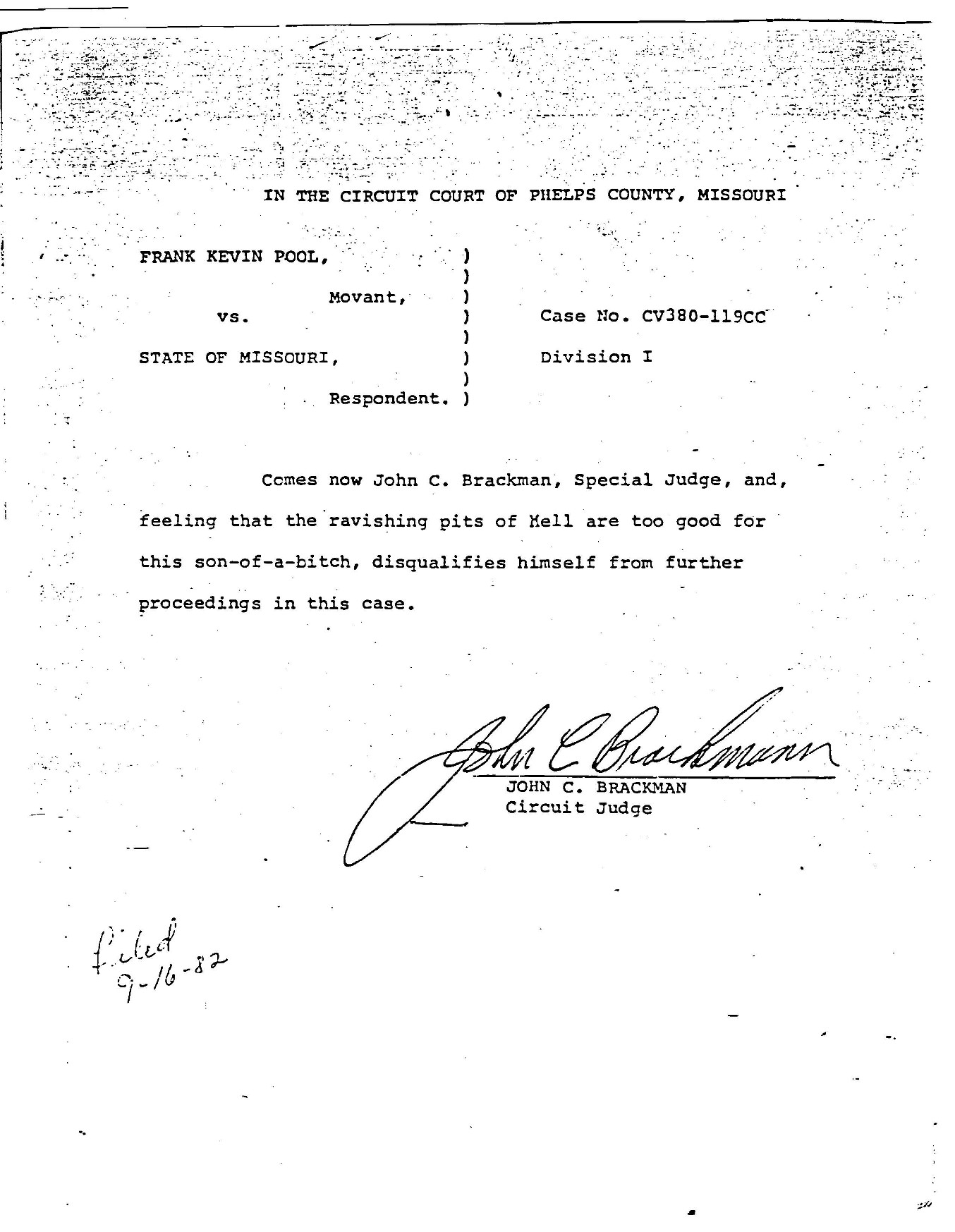
Judges are supposed to stay above the emotional fray. They are supposed to apply the law even-handedly. The attached court Order (which I recently found in some of my old paperwork) is a strikingly honest admission by one judge that he would have been unable to maintain judicial composure in a particular case. It’s an Order recusing himself from the case of a man that had been accused and convicted of murdering a police officer as that officer slept.

This is not a case I handled, but it was a case of which I was aware. I once met this judge (back in the 1980’s), and he was a generally pleasant man. A clerk from the Phelps County, Missouri Court verified for me that this case was actually handled in that Court.

I’m posting this Order because I find it to be a stark reminder that most judges maintain their composure, despite what they might be feeling inside. This Order is one of those glimpses inside one judge’s psyche, reminding us that judges are capable feeling strong emotions, which reminds me of this earlier post on emotions and decision-making.

brackman-order-1

0

Alabama Supreme Court restricts sales of dildos and vibrators based on “public morality”

In the recent decision of 1568 Montgomery Highway v. City of Hoover, the Alabama Supreme Court upheld the Alabama Legislature’s prohibition of dildos and vibrators, basing this decision on “public morality.” More specifically,

In its second counterclaim, Love Stuff asks to have Ala. Code § 13A-12-200.2 (which generally bans the sale of sex toys) deemed unconstitutional.

The trial Court had found that “The target market for Love Stuff [the name of the store in question] consists of females, ages 32-52.” The Court held that commercial public sales of devices geared toward masturbation can be prohibited (though the Court suggested that the decision would be otherwise if the devices were handed out gratuitously or if they were sold at private “Tupperwear”-like parties).

Geoffrey Stone harshly disagrees with the decision of the Alabama Supreme Court and properly characterizes this as an improper exercise of religion:

[W]hat is it about the use of a vibrator or a dildo that affronts the “public morality”? Why is a person who uses such a device “immoral”? The answer, I submit, turns entirely on religion. The pivotal shift from the world of the classical Greeks to our contemporary world, in this respect, was the advent of Christianity, with its emphasis on sexual pleasure as sinful. Much of this can be traced to Augustine, who reasoned in the fifth century that sexual pleasure was integrally related to Adam’s Fall from Grace. Adam’s original sin, he argued, had not been one of pride or disobedience, but of sex. Thus, sexual pleasure was born out of evil, and man’s best hope for redemption lay in repudiating the sexual impulse and, with it, the burden of guilt inherited from Adam. Sexual pleasure was therefore deemed defiling and shameful.

I agree with Stone’s thorough analysis.

14
Making children say the pledge of allegiance over and over is “teaching them history.”

Making children say the pledge of allegiance over and over is “teaching them history.”

I remember how, back in the 1960’s, I was forced to say the Pledge of Allegiance every day in grade school. Those were the days when we had nuclear bomb drills: we lined up and marched to the school basement, where we would presumably be safe from the fallout of atomic bombs. Some of my neighbors even had bomb shelters dug out in their yards.

Based on my own experience, children don’t like saying the pledge. It is mind-numbing to children; as proof, consider that you never see children saying the Pledge on their own. They say the Pledge only when they are forced to do so by insecure adults. All honest and rational people know that the children say the pledge only because they are forced to do so. All honest people also know that one can be a patriot without ever saying the Pledge of Allegiance. As proof, none of the following people ever said the Pledge of Allegiance: George Washington, Thomas Jefferson, Ben Franklin, Thomas Paine . . .

Here is some more history about the Pledge: It was created in 1892 and it didn’t originally contain any reference to “God.” The phrase “under God” was added in the late 1940’s and made popular through the 1950’s.

Fast forward to 2009. Many public schools force their students to say the Pledge of Allegiance each day. In addition to being mind-numbing, the Pledge forces children to acknowledge the existence of “God.” But isn’t it unconstitutional to allow government employees to force children to acknowledge “God”? No problem, according to a recent decision by the U.S. District Court of New Hampshire. According to the Court, the phrase “under God” merely recognizes “the historical fact that our nation was believed to have been founded under God.” You see, when we force the children to say the Pledge, we are (according to the Court) “teaching” them about what people in the past used to believe. How can it be that a Pledge that is written entirely in the present tense is somehow teaching children about something that happened in the past? This kind of reasoning should get an “F” in law school. In its long, contorted and evasive opinion, the Court invokes a state law “Patriot Act”:

The New Hampshire Pledge statute is titled “New Hampshire School Patriot Act.” RSA 194:15-c. The statute’s own words describe its purpose as continuing “the policy of teaching our country’s history to the elementary and secondary pupils of this state.” RSA 194:15-c, I. That is a secular purpose.

Note further that, to the extent that the Pledge is about history, it is false. “Liberty and Justice” were not “for all,” for long periods of our history. Many of our people were enslaved and denied any voice in our government. As “history,” the Pledge is facile and absurd. Children should be taught real history rather than be forced to stand up and repeat the same phrase over and over.

The Court also held that saying the Pledge (including the words “under God”) has no religious meaning, because it does not “thank God” or “give gratitude to God.” It constitutes “benign deism,” which, according to the Court, is not really about religion.

When Congress added the words “under God,” to the Pledge in 1954, its actual intent probably had far more to do with politics than religion — more to do with currying favor with the electorate than with an Almighty.

The Court concluded that the phrase “under God” is not religious, but merely an “historic artifact.” With this reasoning, saying the “Our Father” is also about history, not religion.” The Court came to this opinion even though the Pledge requires children to acknowledge the existence of God. This is a religion assertion with which many millions of Americans fervently disagree.

The Court further held that making children say the Pledge is not “coercion,” suggesting that little children had the power to decide not to participate. According to the Court, recitation of the Pledge is to “enhance instruction in the Nation’s history.” I guess it’s official now. Making children recite the same vague things over and over is “teaching them.” and having them acknowledge God is teaching them “history.” And putting the pressure on 8-year olds to affirmatively opt out of saying the Pledge when most of their classmates are too scared to do otherwise is supposedly giving them a “choice.”

I suppose, then, that if a public school in Detroit were to make children recite every day that the United States is “one nation under Allah,” that this would not be religious, but merely a history lesson, “teaching” the children about the beliefs of some of the people who have lived in the United States.

This Federal Court’s decision is about the most dishonest legal opinion since Plessy v. Ferguson. It’s a classic case of drawing the curve, then plotting the data–it is a perfect example of results-based jurisprudence. What an honest Court should have admitted is that the government is prohibited by the First Amendment of the Constitution from taking any position on whether “God” exists, and that the Pledge (written in the present tense) is a clear assertion that a supernatural being named God exists.

I’m not arguing that no one should say the Pledge. If someone can find a wayward child who, entirely on his/her own, wants to say the Pledge instead of playing at recess, have at it. As far as requiring groups of children to say it together, save it for churches.

See this related post: Religious Rituals are Adaptive Because they are Onerous.

1

One of the most egregious parts of the “Patriot Act” is held unconstitutional

Yesterday, one of the most egregious parts of the “Patriot Act” was held unconstitutional by the Second Circuit Court of Appeals.   This decision was a no-brainer, but you can never take things for granted.  The ACLU website summarizes the decision.   Here’s an excerpt:
A federal appeals court today upheld, in part, a decision striking [...]

7

Montana judge sticks her neck out for terminally ill patients

Let’s see . . . who should have the final say over whether a terminally ill person has suffered enough and should be allowed to check out of life Earth.  Based on the debacle involving Terry Schiavo I’m betting that the country will be split down the middle in this emerging battle in the culture [...]

1

Court bans sale of spyware

What do you think?  Should this sort of software be offered for sale?  One federal court based in Florida said “no”:
When consumer victims clicked on the disguised file, the keylogger spyware silently installed in the background without the victims’ knowledge. This spyware recorded every keystroke typed on the victim’s computer (including passwords); captured images of [...]

0

George Orwell’s contributions to clear legal writing

Best known for his dystopia, 1984, George Orwell cared deeply about language. A good example is Orwell’s “Politics and the English Language.” 
Judith D. Fischer reviewed Orwell’s contributions to the use of plain English in legal writing in “Why George Orwell’s Ideas About Language Still Matter for Lawyers.” Montana Law Review, Vol. 68, p. 129, 2007. [...]