rss

Tag: "ants"

1

How to build a raft and save the Queen when you have a tiny brain

What if the waters are rising and you’ve got to save the Queen, but you and your buddies have no cell phones, you don’t have anything resembling human spoken language, and your brain is really tiny? How tiny? Less than 300,000 neurons (for comparison, a mouse’s brain is 50 times bigger–it has 16 million neurons).

So how do you save the Queen with your incredibly tiny brain? You work elegantly as a collective, like the ants you are. Check out this incredible footage. I felt chills when I saw the workers helping their Amazonian Queen off the raft near the end. Un-be-liev-able, except you can see it with your own eyes.

0
More undocumented workers in my front yard

More undocumented workers in my front yard

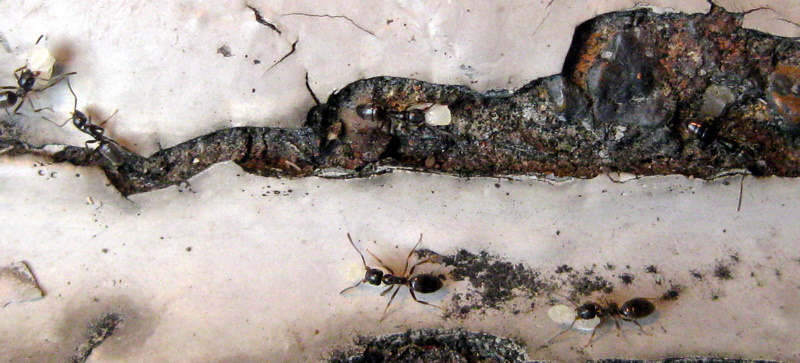
I spotted these guys today. I really admired the way they worked. I had to bring out a reading lamp to the front porch (during the daytime) to get a bright enough field to get a clear photo. I also liked the way the colors turned out here. There were hundreds of ants whisking their cargo from one side of the porch to the other. Nonstop. Unrelenting. Click on the photo for details.

img_7257

2
Superorganisms take the limelight

Superorganisms take the limelight

In the Natural History’s February 2009 article titled “Could an Ant Colony Read this Book,” ecologist Robert Dunn tracks the long-term collaborative efforts of Edward O. Wilson and Bert Holldobler, leading up to their new book: The Superorganism. In their new book, Hölldobler and Wilson

. . . have breathed new life into a notion that intrigued scientists before World War I: that a colony of social insects is analogous to an individual. The concept of the superorganism—which compares a colony’s members to a body’s cells and sometimes its nest to the body’s skeleton—fell out of favor as research increasingly focused on the genes of individuals. Hölldobler and Wilson, building on new insights into the evolution and workings of insect societies, seek to bring it back. To them, “superorganism” is more than a metaphor; it is a unit in the hierarchy of biological organization, falling somewhere between an ecosystem and an individual. And, they argue, it is the most useful level of biological organization at which to examine how pieces are assembled to make a whole—be it an association of bacteria, a single creature, or a whole society—as well as to understand what holds all organisms together, even when the pieces struggle toward independent goals.

According to Dunn (and Wilson and Holldobler), ants and other highly social creatures (such as termites, and honeybees) offer a rare opportunity to study the process by which individuals meld into an unified organism. Other examples include the early symbiosis of mitochondria with an early form of bacteria, plant cells (”which arose when a eukaryotic cell . . incorporated a photosynthetic bacterium”) and multicellular creatures in general (e.g., human beings). In each of these examples, individuals gave up reproduction “either partially or completely, to work for their overbearing mother.”

Wilson and Holldobler point to group selection (and individual selection) as a key component of the evolution of highly social species. “In group-selection models, evolution favors the groups whose member cooperate more effectively, regardless of whether such cooperation helps a given individual (or that individual’s kin) reproduce.” The key to allowing this process is “communication and the division of labor.” Apropos for a book that was five years in the making by Wilson and Holldobler.

3
Are human beings evolving into honeypots?

Are human beings evolving into honeypots?

I’m learning a lot about honeypot ants. They are incredible little creatures.  Also known as repletes or storage ants, certain members of these ant colonies serve as living storage jars for the nectar gathered by the other workers.  Their abdomens extend many times bigger than the ant originally was, such that each of these living [...]