The Specific Positions that U.S. Political Parties Take on Contentious Issues Lack Ideological Coherence

Many years ago, I read Moral Politics (1996), in which George Lakoff tried to make sense to the two baskets of positions taken by the two political parties. He was intrigued by the idea that Republicans strongly cling to positions that didn't seem to have any coherent underlying value. What does a strong Second Amendment position have to do with being anti-abortion? What does willingness to through one's weight around in the world using the military have to do with Prayer in Schools, cutting welfare assistance or attempting to limit jury awards on tort cases? Then Lakoff realized that he, a self-proclaimed liberal, took the opposite position on all of those issues. In short, he had his own basket of seemingly unconnected issues. But, he thought, there must be an underlying basis for these two opposing collections of issue-positions. When I read his book, I wondered the same thing.

Lakoff concluded that there, indeed, were separate foundations for the Liberal and Conservative mindsets. He called these the "Strict Father Model" and the "Nurturant Parent Model." See pp 33-35. Lakoff claims that at the center of the conservative worldview is the Strict Father Model.

This model posits a traditional nuclear family, with the father having primary responsibility for supporting and protecting the family as well as the authority to set overall policy, to set strict rules for the behavior of children, and to enforce the rules. The mother has the day-to-day responsibility for the care of the house, raising the children, and upholding the father’s authority. Children must respect and obey their parents; by doing so they build character, that is, self-discipline and self-reliance. Love and nurturance are, of course, a vital part of family life but can never outweigh parental authority, which is itself an expression of love and nurturance—tough love. Self-discipline, self-reliance, and respect for legitimate authority are the crucial things that children must learn.

Once children are mature, they are on their own and must depend on their acquired self-discipline to survive. Their self-reliance gives them authority over their own destinies, and parents are not to meddle in their lives.

According to Lakoff, the liberal worldview centers on a very different ideal of family life, what he calls the Nurturant Parent model:

Love, empathy, and nurturance are primary, and children become responsible, self-disciplined and self-reliant through being cared for, respected, and caring for others, both in their family and in their community. Support and protection are part of nurturance, and they require strength and courage on the part of parents. The obedience of children comes out of their love and respect for their parents and their community, not out of the fear of punishment. Good communication is crucial. If their authority is to be legitimate, parents must explain why their decisions serve the cause of protection and nurturance. Questioning by children is seen as positive, since children need to learn why their parents do what they do and since children often have good ideas that should be taken seriously. Ultimately, of course, responsible parents have to make the decisions, and that must be clear.

The principal goal of nurturance is for children to be fulfilled and happy in their lives. A fulfilling life is assumed to be, in significant part, a nurturant life; one committed to family and community responsibility. What children need to learn most is empathy for others, the capacity for nurturance, and the maintenance of social ties, which cannot be done without the strength, respect, self-discipline, and self-reliance that comes through being cared for. Raising a child to be fulfilled also requires helping that child develop his or her potential for achievement and enjoyment. Th it requires respecting the child’s own values and allowing the child to explore the range of ideas and options that the world offers.

Lakoff contrasted these two models in a way that would intuitively sound correct to many people who traditionally vote for Democrats:

Strict Father morality assigns highest priorities to such things as moral strength (the self-control and self-discipline to stand up to external and internal evils), respect for and obedience to authority, the setting and following of strict guidelines and behavioral norms, and so on. Moral self-interest says that if everyone is free to pursue their self-interest, the overall self-interests of all will be maximized. In conservatism, the pursuit of self-interest is seen as a way of using self-discipline to achieve self-reliance.

Nurturant Parent morality has a different set of priorities. Moral nurturance requires empathy for others and the helping of those who need help. To help others, one must take care of oneself and nurture social ties. And one must be happy and fulfilled in oneself, or one will have little empathy for others. The moral pursuit of self-interest only makes sense within these priorities.

There's a big problem with Lakoff's analysis. From 1996 to the present, those who identify as "liberals" have dramatically flipped their positions on censorship, warmongering, race consciousness, trust in the U.S. security state. Did these issues become more "nurturing?" It's impossible to account for these 180 degree turns using a Strict Parent/Nurturant Parent analysis. Over time, conservatives have also turned themselves into pretzels, as discussed in a new book, The Myth of Left and Right, by brothers Hyrum and Verlan Lewis (2023). When they voted for Trump in large numbers, Republicans decided that the type of morality they had strongly touted for decades was no longer important.

Self-identified conservatives and liberals have also recently switched places on the importance of personal morality in public officials. During the Clinton years, conservatives were nearly unanimous in believing that the personal char acter of a politician was crucial to his or her performance in office - it was one of their central justifications for impeaching President Clinton- but as soon as Trump assumed leadership of the right, conservatives reversed course. Before Trump, only 36% of Republicans believed that "public officials can behave ethically in their professional roles even if they acted immorally in their personal life," but after Trump's nomination, that number shot up to 70%.54 More recently, Gallup found that: [More . . . ]
Continue ReadingThe Specific Positions that U.S. Political Parties Take on Contentious Issues Lack Ideological Coherence

Neocons Who Are Being Rewarded for their Iraq 2003 Disgrace.

Some might wonder how it is that so many of our purported leaders who lied us into waging war against Iraq aren't still universally disgraced and ejected from government jobs and public influence. But no, in fact, they were responsible for leading us into war in Ukraine. This list of neocons includes Joe Biden, Victoria Nuland, Anthony Blinken, Robert Kagan, Max Boot, and William Kristol.  

Glenn Greenwald recently commented on the bizarre situation that all of these neocons not only remain in power and influential. Even worse, their warmongering views are embraced by modern day Democrats. What follows is the transcript of an excerpt from Glenn's System Update show, Episode 102:

One of the most extraordinary, alarming and baffling developments to witness in American politics is the complete rehabilitation of neoconservatives. Most Americans who know this term first learned of it in 2002 during the run-up to the American and British invasion of Iraq. The neocons were the most vocal and vehement advocates, not just of the invasion of Iraq, but more importantly, of the warmongering framework undergirding that attack, namely that the world is better off when the United States rules it, and especially the Middle East, through the application of superior military force, in essence, ordering all countries to do the bidding of the United States, always under the threat that failure to obey will result in attacks, invasions, bombings, regime change, coups and much more. This imperialistic and militaristic mindset was not exactly new.

This imperialistic and militaristic mindset was not exactly new. The U.S. fought wars, imposed tyrannies, and engineered coups all over the world, on every continent, during the Cold War and after but what distinguished neocons from standard warmongers and militarists were two qualities:

First, they have no other politics beyond their quest for endless war. Many neocons in fact began as liberals or even leftists and were willing to morph into anything they needed to be as long as doing so served the only issue they really cared about: placing the US in a state of endless war, almost always fought by other people's families and children rather than their own. Starting with the war in Iraq, a war they were craving and loudly demanding long before the 9/11 attacks – that attack became the pretext for the war in Iraq – they have supported every new and proposed American war since then. "Neocons" is a polite euphemism for "bloodthirsty, sociopathic warmongers."

Continue ReadingNeocons Who Are Being Rewarded for their Iraq 2003 Disgrace.

NYT Forced to Acknowledge U.S. Spy Efforts due to Third Party Release of Leaked Documents

In Daniel Ellsberg's day, the NYT was seen as a place friendly to whistle-blowers and those who have documents exposing secret government activities. No longer. Further, the NYT refuses to post a link to the leaked documents, only linking to its own hand-wringing articles. Nowadays, secret documents are leaked elsewhere and the NYT needs to play catch-up, coupling its reluctant acknowledgement with a warning about the damage that could be caused by leaks about secret U.S. activity:

The leak has the potential to do real damage to Ukraine’s war effort by exposing which Russian agencies the United States knows the most about, giving Moscow a potential opportunity to cut off the sources of information. Current and former officials say it is too soon to know the extent of the damage, but if Russia is able to determine how the United States collects its information and cuts off that flow, it may have an effect on the battlefield in Ukraine.

The leak has already complicated relations with allied countries and raised doubts about America’s ability to keep its secrets. After reviewing the documents, a senior Western intelligence official said the release of the material was painful and suggested that it could curb intelligence sharing. For various agencies to provide material to each other, the official said, requires trust and assurances that certain sensitive information will be kept secret.

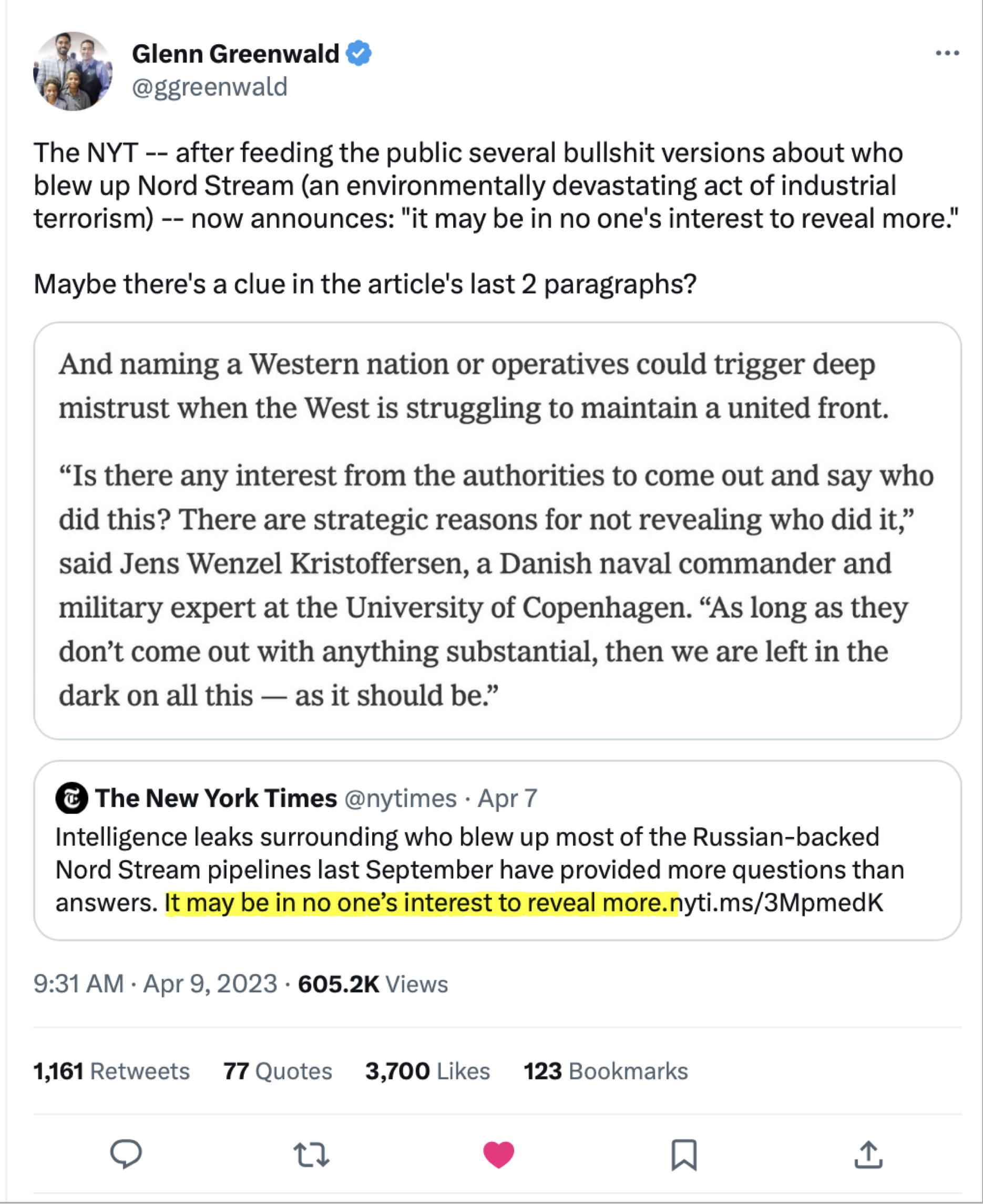
On the other hand, if you are part of the U.S. security state, the NYT is more than happy to post your propaganda, as it did in the case of the Nord Stream Pipeline. Unbelievably, knowing that it's "explanation" of the pipeline destruction is bullshit, the NYT suggests it's not a good idea to dig further into who destroyed the pipeline:

It's a good day to celebrate the immense good fortune of NYT reporters who get to draw big salaries while not having to do the difficult work of actually practicing journalism.

Proposed new Mission Statement for the New York Times: Pay No Attention to the Man Behind the Curtain.

Joe Biden promised to disable the pipeline prior to its destruction:

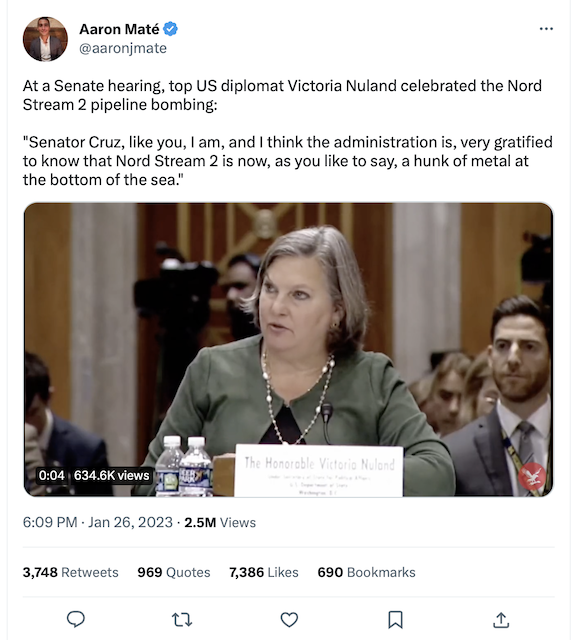
Biden's neocon crony, Victoria Nuland, helped to lead the post-destruction cheerleading, as Aaron Maté reminds us, but, again, Pay No Attention to the Man Behind the Curtain.

No wonder the corporate media and their U.S. government partners hate Twitter 2.0...

Continue ReadingNYT Forced to Acknowledge U.S. Spy Efforts due to Third Party Release of Leaked Documents

Invitation to Share DI Articles

Thank you for visiting Dangerous Intersection! As you can see, this website has no ads and all the articles are free. This will probably sound paranoid, but in past years, my readership was 15 times greater than it is now, even though I am posting a lot of new content every week. Currently, DI is visited by about 1,500 people per week. I suspect I'm being throttled by Google because my opinions are not "proper." I have no evidence of this other than my traffic patterns. Or maybe I used to be a better writer!

Whatever the cause, if you find interesting or useful content at DI please consider sharing my articles with anyone else who might also find them worthy of their time. There are three main ways to share: A) At the bottom of every post, you'll see an app for sharing on social media; B) To share any particular article, simply share the URL from the full version of the article (click into articles you see on the homepage to obtain that permalink); and C) Share this link for those who would like to subscribe: https://dangerousintersection.org/subscribe-to-dangerous-intersection/

One other thing - I have posted thousands of articles since I began this website in 2006. On the right-side column, you'll find two main ways to explore this site for particular articles that might interest you. On that right column, you'll see two versions of search boxes for keywords. You can also search by article category, using the drop-down category picker.

Again, thank you for visiting this website!

Erich

Continue ReadingInvitation to Share DI Articles