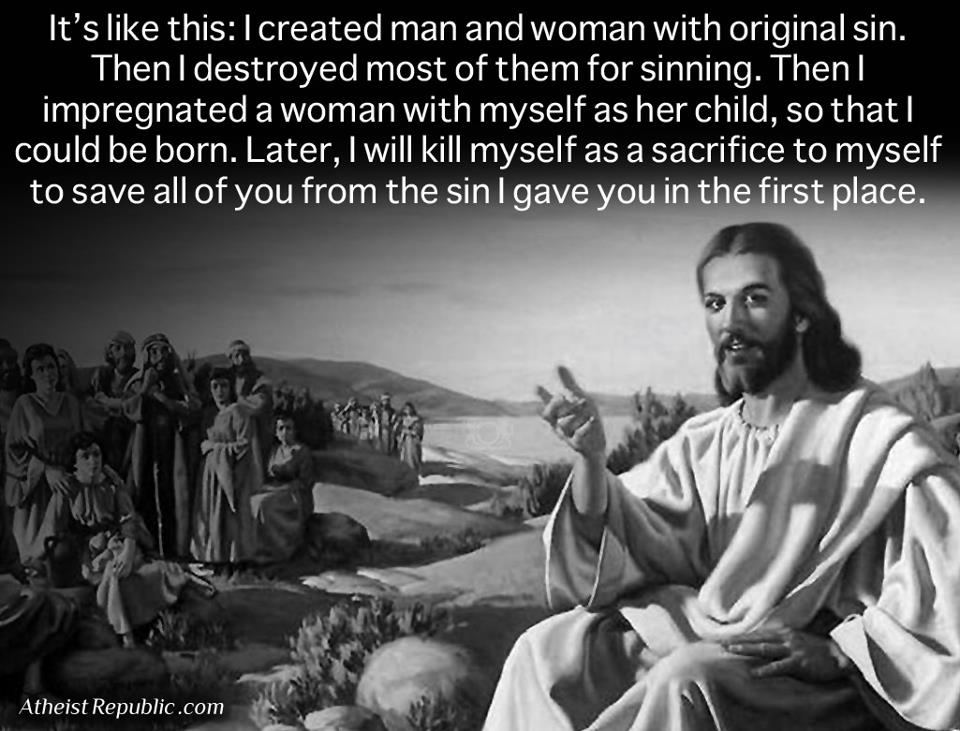
Believers constantly overlook the sins of "God." He literally gets away with murder when he slaughters little children. All of this should be a problem for Bible literalists--the inerrant folks--but they claim that it isn't. That works thanks to the big blind spot to occurs in all types of believers: Morality binds and blinds, and it does this especially well in the context of religions.
I spotted this image on Facebook--it details the seven "Godly" sins. There is no indication of who the author was--if anyone knows, I'd like to give credit. I can't argue with the logic of the chart.
Francis Kissling is a Catholic. In his article at The Nation, he sees no hope that choosing a new pope will improve the Catholic Church:
[The central teachings of the church are] cynicism—teaching things that are not true—at its most damaging, and it is the foundation of the modern church. The virgin birth is only the start of it. Heaven and hell, the turning of bread and wine into the body of Christ (a core teaching that polls tell us most Catholics reject), the bodily assumption of Mary into heaven (how could her body have gone to heaven when we are now clear it is not a real physical place?), the infallibility of the pope telling these untruths and insisting that Catholics must believe them to be Catholic—this all leads directly to corrupt popes and priests who lack compassion. Lying or just fudging it demoralizes those who teach in the name of the church. From such demoralization stems the need to protect the institution and oneself, to protect pedophiles, to let women die in childbirth by denying contraception, to allow the transmission of HIV and to keep alive a dysfunctional institution. It is no accident that priests have historically had a high rate of alcoholism; not only were they isolated by the solitude of the priesthood but by the dissonance in what they were bound to teach and preach and their own understanding of life and goodness. A new pope will change nothing.
As I indicated here, I never believed in God. Not even as a four year old. I was made to go to Catholic church services and Catholic schools, where I constantly questioned Catholic dogma, especially in religion classes. I felt like an outsider all of my childhood, up until I happened to spot a book by Bertrand Russell on the shelves of the public library. This was when I was about 17 years old. The title of this slim volume was "Why I Am Not a Christian." It was cause for exuberance, but I remember thinking that I really didn't know anyone with whom to share my excitement. More specifically, reading Russell allowed me to believe that there wasn't anything wrong with me. That's how you get when you are surrounded by people who would not allow themselves to ask dangerous questions.
The most important thing I learned back then was that I was not crazy, and that smart people were asking the same questions I was asking. Bertrand Russell became my mentor back then, back in about 1974, which is four years after he died. My memories of encountering his writing bring home the power of the written word and the power to preserve one's thought process, at least somewhat, long after one has died.
That is the background for the following video. Until a couple years ago, I had not seen any video of Bertrand Russell. I knew him as a witty writer who worked hard to avoid pretentious writing. In the following 4-minute video, the then 87 year old Russell discusses religion in a rather straight-forward way.
Hello, I invite you to subscribe to Dangerous Intersection by entering your email below. You will have the option to receive emails notifying you of new posts once per week or more often.