RFK, Jr: “We no longer have a democracy”

Robert F. Kennedy, Jr."

We do not have a Democracy now because the little guy in this country has absolutely no say in what's happening with his government.”

“That's part of the reason there’s a rise in this violence and the polarization, etc. People know that they don't own their government anymore, that the system's rigged, it's rigged against them, and it's rigged to shift money upward.

Continue ReadingRFK, Jr: “We no longer have a democracy”

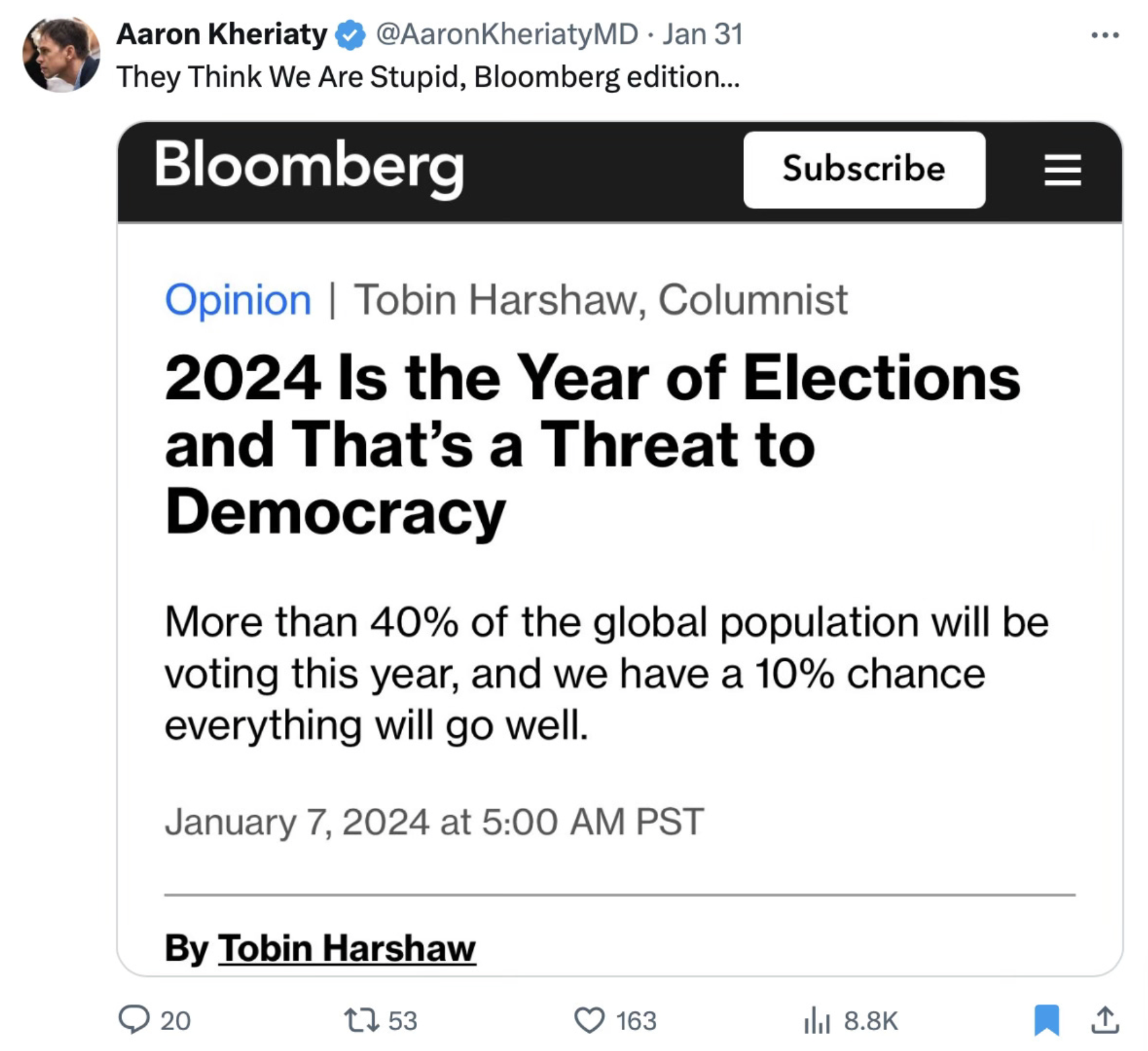
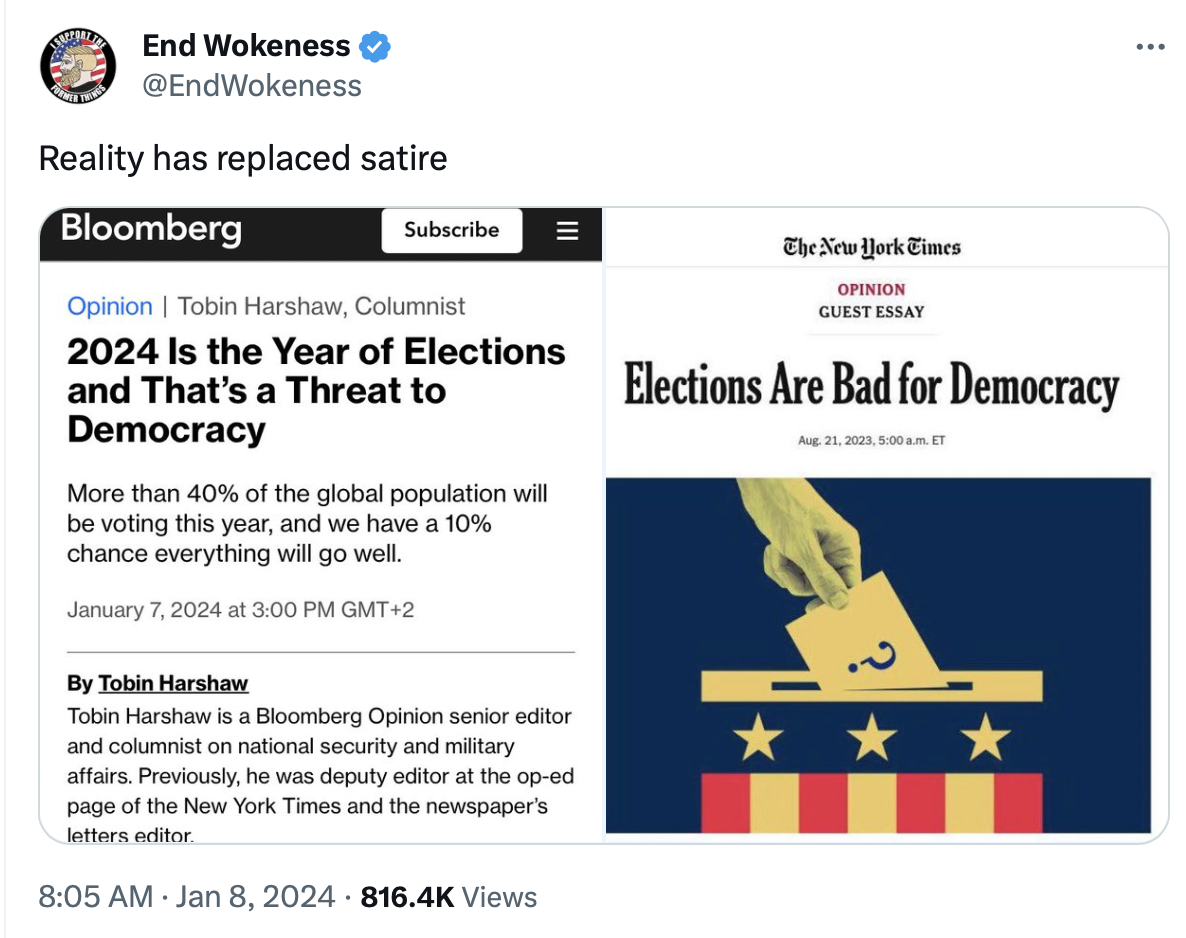
They Really Do Think We’re Stupid

Voting as a threat to democracy . . .

And this:

N. S. Lyons: “From this point forward the definition of democracy itself would begin to change: “democracy” no longer meant self-government by the demos – the people – exercised through voting and elections; instead it would come to mean the institutions, processes, and progressive objectives of the managerial civil service itself. In turn, actual democracy became “populism.” Protecting the sanctity of “democracy” now required protecting the managerial state from the demos by making governance less democratic.”

Continue ReadingThey Really Do Think We’re Stupid

The Specific Positions that U.S. Political Parties Take on Contentious Issues Lack Ideological Coherence

Many years ago, I read Moral Politics (1996), in which George Lakoff tried to make sense to the two baskets of positions taken by the two political parties. He was intrigued by the idea that Republicans strongly cling to positions that didn't seem to have any coherent underlying value. What does a strong Second Amendment position have to do with being anti-abortion? What does willingness to through one's weight around in the world using the military have to do with Prayer in Schools, cutting welfare assistance or attempting to limit jury awards on tort cases? Then Lakoff realized that he, a self-proclaimed liberal, took the opposite position on all of those issues. In short, he had his own basket of seemingly unconnected issues. But, he thought, there must be an underlying basis for these two opposing collections of issue-positions. When I read his book, I wondered the same thing.

Lakoff concluded that there, indeed, were separate foundations for the Liberal and Conservative mindsets. He called these the "Strict Father Model" and the "Nurturant Parent Model." See pp 33-35. Lakoff claims that at the center of the conservative worldview is the Strict Father Model.

This model posits a traditional nuclear family, with the father having primary responsibility for supporting and protecting the family as well as the authority to set overall policy, to set strict rules for the behavior of children, and to enforce the rules. The mother has the day-to-day responsibility for the care of the house, raising the children, and upholding the father’s authority. Children must respect and obey their parents; by doing so they build character, that is, self-discipline and self-reliance. Love and nurturance are, of course, a vital part of family life but can never outweigh parental authority, which is itself an expression of love and nurturance—tough love. Self-discipline, self-reliance, and respect for legitimate authority are the crucial things that children must learn.

Once children are mature, they are on their own and must depend on their acquired self-discipline to survive. Their self-reliance gives them authority over their own destinies, and parents are not to meddle in their lives.

According to Lakoff, the liberal worldview centers on a very different ideal of family life, what he calls the Nurturant Parent model:

Love, empathy, and nurturance are primary, and children become responsible, self-disciplined and self-reliant through being cared for, respected, and caring for others, both in their family and in their community. Support and protection are part of nurturance, and they require strength and courage on the part of parents. The obedience of children comes out of their love and respect for their parents and their community, not out of the fear of punishment. Good communication is crucial. If their authority is to be legitimate, parents must explain why their decisions serve the cause of protection and nurturance. Questioning by children is seen as positive, since children need to learn why their parents do what they do and since children often have good ideas that should be taken seriously. Ultimately, of course, responsible parents have to make the decisions, and that must be clear.

The principal goal of nurturance is for children to be fulfilled and happy in their lives. A fulfilling life is assumed to be, in significant part, a nurturant life; one committed to family and community responsibility. What children need to learn most is empathy for others, the capacity for nurturance, and the maintenance of social ties, which cannot be done without the strength, respect, self-discipline, and self-reliance that comes through being cared for. Raising a child to be fulfilled also requires helping that child develop his or her potential for achievement and enjoyment. Th it requires respecting the child’s own values and allowing the child to explore the range of ideas and options that the world offers.

Lakoff contrasted these two models in a way that would intuitively sound correct to many people who traditionally vote for Democrats:

Strict Father morality assigns highest priorities to such things as moral strength (the self-control and self-discipline to stand up to external and internal evils), respect for and obedience to authority, the setting and following of strict guidelines and behavioral norms, and so on. Moral self-interest says that if everyone is free to pursue their self-interest, the overall self-interests of all will be maximized. In conservatism, the pursuit of self-interest is seen as a way of using self-discipline to achieve self-reliance.

Nurturant Parent morality has a different set of priorities. Moral nurturance requires empathy for others and the helping of those who need help. To help others, one must take care of oneself and nurture social ties. And one must be happy and fulfilled in oneself, or one will have little empathy for others. The moral pursuit of self-interest only makes sense within these priorities.

There's a big problem with Lakoff's analysis. From 1996 to the present, those who identify as "liberals" have dramatically flipped their positions on censorship, warmongering, race consciousness, trust in the U.S. security state. Did these issues become more "nurturing?" It's impossible to account for these 180 degree turns using a Strict Parent/Nurturant Parent analysis. Over time, conservatives have also turned themselves into pretzels, as discussed in a new book, The Myth of Left and Right, by brothers Hyrum and Verlan Lewis (2023). When they voted for Trump in large numbers, Republicans decided that the type of morality they had strongly touted for decades was no longer important.

Self-identified conservatives and liberals have also recently switched places on the importance of personal morality in public officials. During the Clinton years, conservatives were nearly unanimous in believing that the personal char acter of a politician was crucial to his or her performance in office - it was one of their central justifications for impeaching President Clinton- but as soon as Trump assumed leadership of the right, conservatives reversed course. Before Trump, only 36% of Republicans believed that "public officials can behave ethically in their professional roles even if they acted immorally in their personal life," but after Trump's nomination, that number shot up to 70%.54 More recently, Gallup found that: [More . . . ]

Continue ReadingThe Specific Positions that U.S. Political Parties Take on Contentious Issues Lack Ideological Coherence

Jettison Your Tribal Politics!

I’ve repeatedly expressed my concern with the idea of a “political spectrum.  In their book, The Myth of Left and Right: How the Political Spectrum Misleads and Harms America Verlan Lewis and Hyrum Lewis argue that the notion of a “political spectrum” is the root of much of our political dysfunction. I agree and I would recommend reading their article at Heterodox Academy. Here are a few excerpts from their article:

For most of our history, Americans didn’t think in terms of a spectrum. They just saw (accurately) that America had a two-party system and that each of these parties stood for a bundle of unrelated positions. This all started to change after World War I when Americans imported the left-right model that had arisen in Europe during the French Revolution. Since then, the use of the spectrum has grown exponentially and actual policy has been obscured as Americans have become accustomed to placing every person, institution, or group somewhere on a left-right scale (with radicals on the far left, progressives and liberals on the center left, reactionaries on the far right, and conservatives on the center right). The political spectrum is, without question, the most common political paradigm in 21st-century America.

The central problem with this model is that it’s inaccurate for the simple reason that there’s more than one issue in politics and a spectrum can, by definition, measure only one issue. There are a multitude of distinct, unrelated political policies under consideration today (e.g., abortion, income taxes, affirmative action, drug control, gun control, health care spending, the minimum wage, military intervention, etc.), and yet our predominant political model presumes that there is just one.

So if there is more than one issue in politics, why do Americans use a unidimensional political spectrum to describe politics? Generally, it’s because they are convinced that there is one essential issue that underlies and binds all others, such as “change,” and therefore the political spectrum accurately models where someone stands in relation to this essence

We contend that this is exactly backward. There is no essential issue underlying all others—abortion and tax rates really are distinct and unrelated policies—and socialization, not essence, explains the correlation between them. People first anchor into a tribe (because of peers, family, or a single issue they feel strongly about), adopt the positions of the tribe as a matter of socialization, and only then reverse engineer a story about how all the positions of their tribe are united by some essential principle (e.g., progressivism or conservatism) . . . Left-right ideology is the fiction we use to justify and mask our tribal attachments.

. . .  Would it be useful for medical doctors to model all illnesses, treatments, and patients on a spectrum? Obviously not because medicine is multidimensional and trying to model all medical issues using a single dimension would do great harm. The same is true of politics. Doctors get along just fine by talking about specific illnesses and treatments (lung cancer, fractured tibia, bronchial infection, chemotherapy, bone setting, antibiotics), and political discourse would be much more productive if we simply talked about specific political problems and policies (crime, poverty, inflation, gun control, welfare spending, interest-rate tightening).

Yes, all models are simplifications of reality, but those models must also be accurate such that they improve rather than hinder our understanding of the matter in question. A bad model is actually worse than no model at all (as the four humors theory of disease makes clear), and the political spectrum is a bad model. It is a tool of misinformation, false association, and hostility.

. . .  Talking in terms of a spectrum serves no informational function, but it does serve to elevate the temperature of debate and make the public really angry about the “commies” or “fascists” on the other side.

Continue ReadingJettison Your Tribal Politics!