Overton Window Opens Wider re Vaccine Risks

RFK, Jr. is doing excellent work at HHS. Toby Rogers lists 5 things that would have seemed impossible 2 years ago:

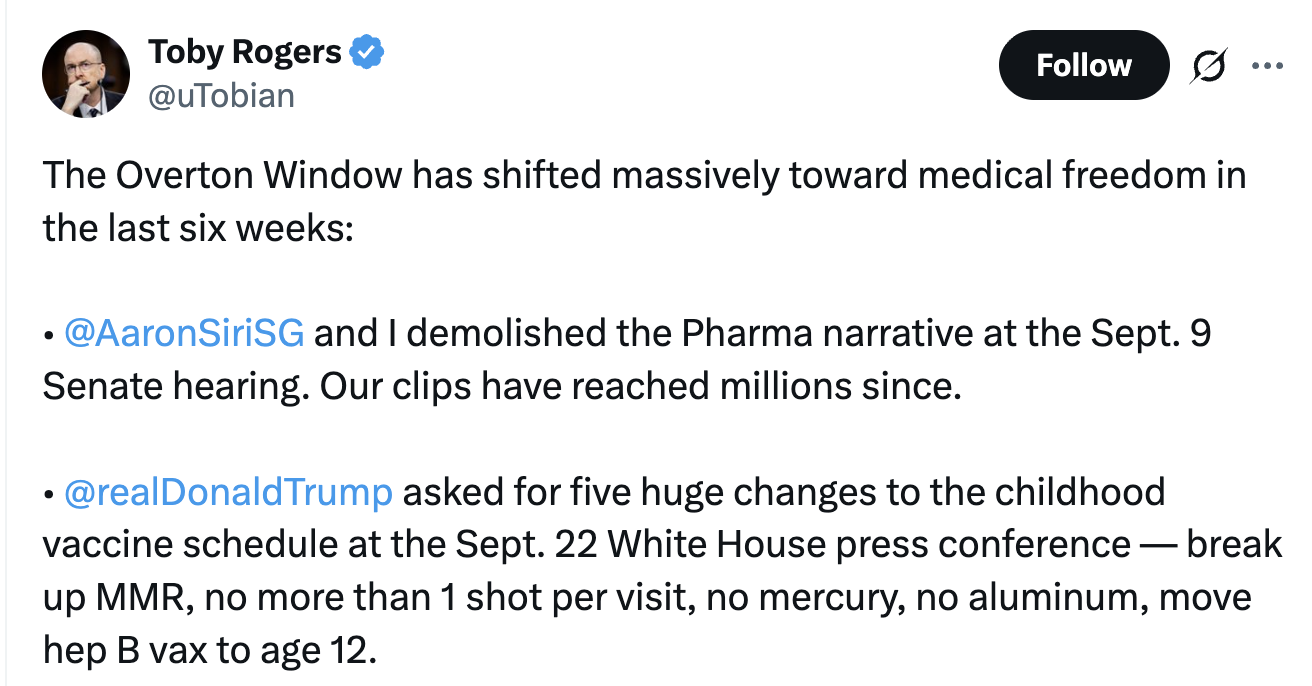
The Overton Window has shifted massively toward medical freedom in the last six weeks:

@AaronSiriSG and I demolished the Pharma narrative at the Sept. 9 Senate hearing. Our clips have reached millions since. @realDonaldTrump asked for five huge changes to the childhood vaccine schedule at the Sept. 22 White House press conference

A) break up MMR, B) no more than 1 shot per visit, C) no mercury, D_ no aluminum, E) move hep B vax to age 12 [instead of injecting it into one day old babies, even though hep B is only spread through sexual contact and drug needles].

The documentary, "An Inconvenient Study" (@AnInconvntStudy), was released Oct. 3 and has been seen several million times.

And now the @nytimes has abandoned the genetic narrative in connection with autism which (finally!) implicates toxicants.

Our reformers in D.C. can and should push for maximum change right now (e.g. remove liability protection by ending vaccine schedules altogether). Let's go!!!!!

https://x.com/uTobian/status/1979998573988393110

It's entirely consistent to dislike Donald Trump and/or many of his policies, yet to applaud these changes.

Continue ReadingOverton Window Opens Wider re Vaccine Risks

No True Inert Placebos Were Used for Testing Most Childhood Vaccines. Why Not?

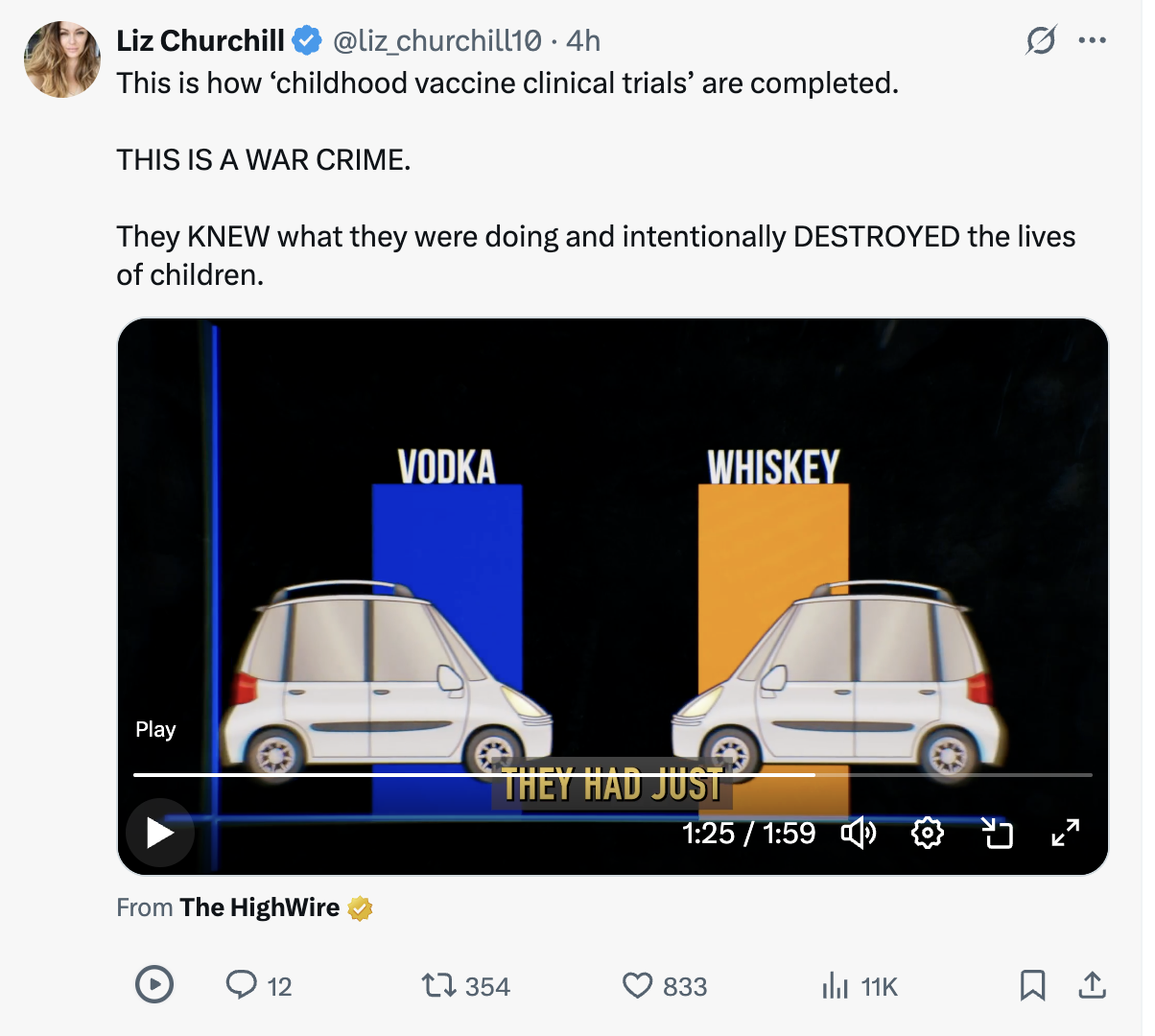
Industry allied experts claim that it would be unethical to test a vaccine against a true inert placebo like saline. Really? Del Bigtree explains that the Pharma-preferred tests (against already existing vaccines) are like testing the safety of whiskey by comparing it to the "placebo" of vodka.

But I keep coming back to the claim of "unethical." This makes no sense to me, no matter how many times I hear an industry insider make the claim. Aaron Siri explored this exact topic in his outstanding new book, Vaccines, Amen! Here's an excerpt from page 163:

Ethics of Using and Not Using a Placebo

In response to the lack of a placebo in some trials, the FDA and vaccinologists will assert that it is unethical to evaluate the safety of an unlicensed experimental vaccine in a placebo-controlled trial when there is already a licensed vaccine for the same disease.

This ethical concern, however, rings hollow because it ethics were a real concern, the FDA would require placebo-controlled trials before licensing new experimental vaccines at least where no licensed vaccine exists to prevent the same disease. For example, the very first vaccines for chickenpox or hepatitis A, both licensed in 1995, or HPV, licensed in 2006, could have easily included a placebo control group. No ethical issue with that. But as you now know, that is not what happened because that is not how the cult of vaccinology works.

Also, consider this: conducting a placebo-controlled trial will leave a clearly defined group of children unvaccinated only for the duration of the trial in a controlled setting where they can be monitored. In contrast, injecting a vaccine into millions of children in an uncontrolled setting without first assessing its safety in a placebo-controlled trial is, to any objective, reasonable observer, grossly unethical conduct."

Continue ReadingNo True Inert Placebos Were Used for Testing Most Childhood Vaccines. Why Not?

How Does Pharma Test the Vaccines on the Childhood Schedule?

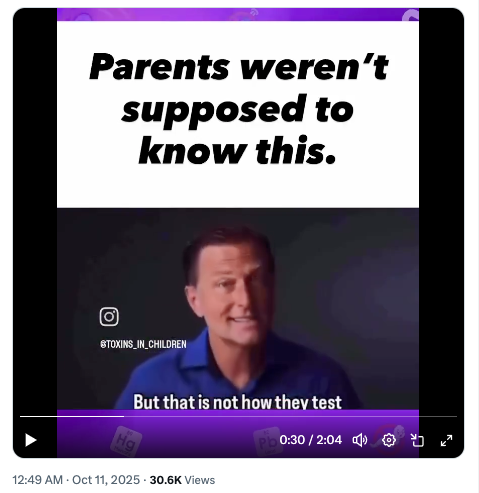
Eric Berg, MD explains how Pharma "tests" the vaccines on the childhood schedule. His explanation substantially overlaps that of Aaron Siri  (and see here and here). Here's how it was summed up on X by Valerie Anne Smith:

"When You Test A Drug, It's Against A Placebo."

"Vaccines Are Not Tested Against Placebos...They Are Tested Against Another Active Vaccine."

"That's Like Testing Whiskey Against Bourbon."

'Placebos' Used In Vaccine Clinical Trials As Listed From The Package Inserts For Common Vaccines:

Hepatitis B Clinical Trial...Placebo used was Aluminum Adjuvant & only safety tested for 5 days.

Vaxelis 6 in 1 Vaccine Trial...Placebo Was DTaP, Polio, HIB & Hep-B Vaccines.

HPV Gardasil Clinical Trial...Placebo used was Aluminum Adjuvant & Hep-A Vaccine. Only safety tested for 14 days.

Hepatitis A Clinical Trial...Placebo used was Hepatitis-B Vaccine & participants were monitored for 14 days.

Influenza A Clinical Trial...Placebo used was Influenza B Vaccine & clinical trial volunteers were followed for 28 days.

Meningitis Vaccine Clinical Trial...Placebo used was the DTaP Vaccine & adverse reactions were monitored for 7 days.

Pertussis Vaccine Clinical Trial...Placebo used was the Diphtheria & Tetanus Vaccine. Participants were followed for 14 days.

Prevnar-13 Pneumonia Clinical Trial...Placebo used was the Prevnar-7 Vaccine & volunteers were monitored for 7 days.

Polio Vaccine Clinical Trial...Placebo Was Diluted Polio Vaccine & patients were monitored for 2 days.

Chicken Pox Vaccine Clinical Trial...Placebo used was diluted Chicken Pox Vaccine & trial volunteers were monitored for 42 days.

Shingles Vaccine Clinical Trial...Placebo used was diluted Shingles Vaccine & participants were followed for 7 days.

mNEXSPIKE Covid Vaccine Clinical Trial...Placebo used was SPIKEVAX Covid Vaccine & only safety tested 7 days.

Without informed consent & without the use of a saline placebo skews all results & makes all vaccines appear "safe & effective" because the adverse events & side effects in both groups are the same.

The US CDC Government's belief on placebos as stated on the CDC website...

"Testing a new vaccine against a saline injection is considered unethical."

"Depriving half of the trial participants of an older vaccine(which is approved to use as placebo) & giving them a true saline placebo instead would not be fair: it would actually be unethical."

"Saline injections don’t cause a sore arm, which might unwittingly reveal to the 'double blind volunteers' that they are in the placebo group. Those who get the experimental vaccine & those who get placebo must be kept secret."

Who is Dr. Eric Berg. Per Grok:

Dr. Eric Berg, DC (Doctor of Chiropractic), is a health educator, best-selling author, and chiropractor specializing in nutrition, Healthy Keto diets, and intermittent fasting. Born around 1965, he faced personal health challenges that inspired his career shift toward natural health solutions.

Continue ReadingHow Does Pharma Test the Vaccines on the Childhood Schedule?

The Sorry State of Scientific Literature

It is surreal to read these quotes about the unreliability of science publications by people in a good position to evaluate this dysfunction.

“The case against science is straightforward: much of the scientific literature, perhaps half, may simply be untrue. Science has taken a turn toward darkness.”

-Richard Horton, former Editor-in-Chief of The Lancet (the world’s premier medical journal) [

Richard Horton, the editor-in-chief of The Lancet, wrote this statement in a comment titled "Offline: What is medicine's 5 sigma?" published in the journal on April 11, 2015.]

--

"Why Most Published Research Findings Are False" (2006)

John P. A. Ioannidis

There is increasing concern that most current published research findings are false. The probability that a research claim is true may depend on study power and bias, the number of other studies on the same question, and, importantly, the ratio of true to no relationships among the relationships probed in each scientific field. In this framework, a research finding is less likely to be true when the studies conducted in a field are smaller; when effect sizes are smaller; when there is a greater number and lesser preselection of tested relationships; where there is greater flexibility in designs, definitions, outcomes, and analytical modes; when there is greater financial and other interest and prejudice; and when more teams are involved in a scientific field in chase of statistical significance. Simulations show that for most study designs and settings, it is more likely for a research claim to be false than true. Moreover, for many current scientific fields, claimed research findings may often be simply accurate measures of the prevailing bias. In this essay, I discuss the implications of these problems for the conduct and interpretation of research.

--

Karl Kanthak posts this:

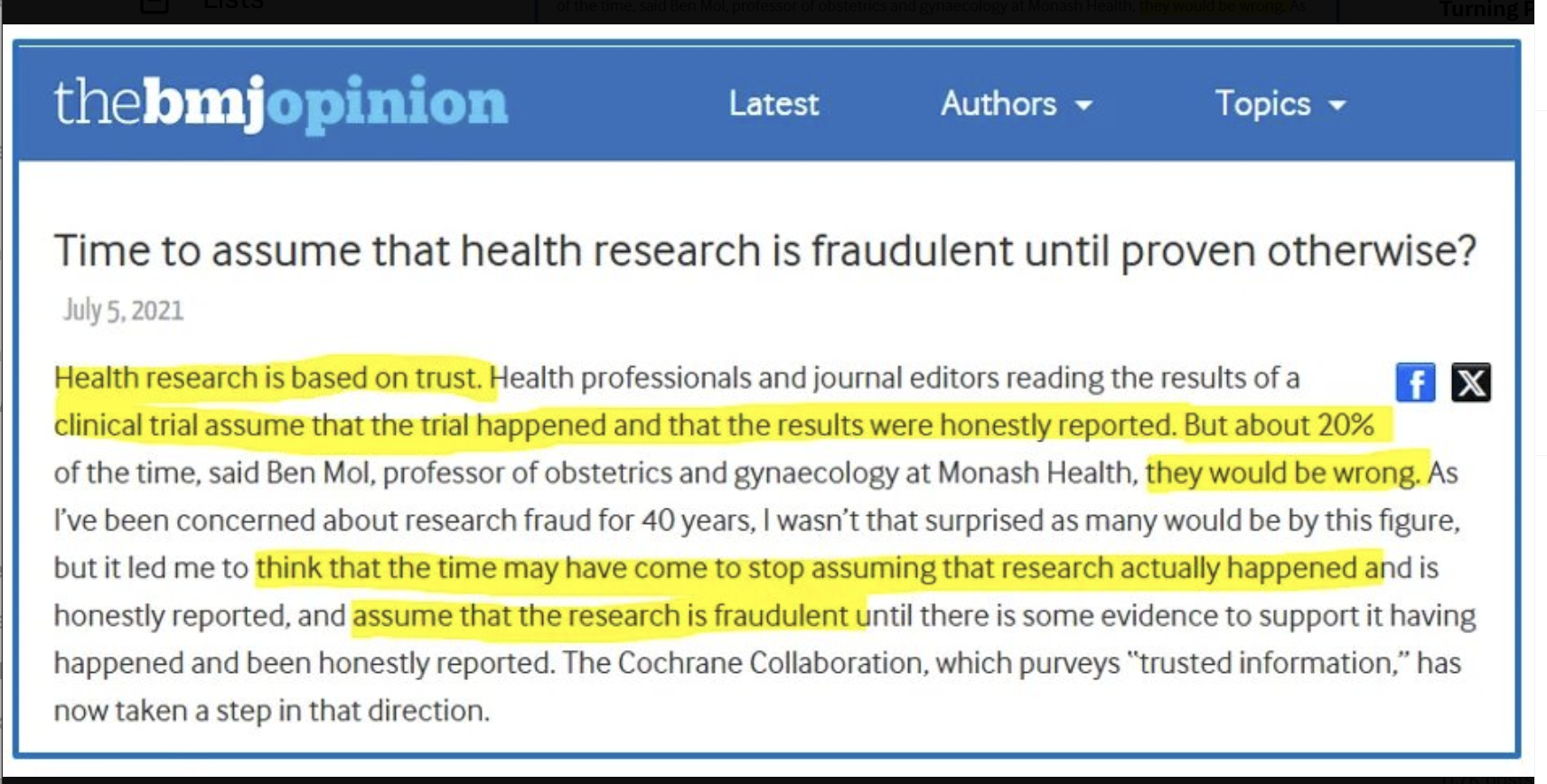
“Health research is based on trust. Health professionals and journal editors reading the results of a clinical trial assume that the trial happened and that the results were honestly reported. But about 20% of the time, said Ben Mol, professor of obstetrics and gynaecology at Monash Health, they would be wrong.”
--

Post by InsiderHCW:

It is simply no longer possible to believe much of the clinical research that is published, or to rely on the judgement of trusted physicians or authoritative medical guidelines. I take no pleasure in this conclusion.
- Marcia Angell, Editor, New England Journal of Medicine. [Marcia Angell wrote this statement in her article "Drug Companies & Doctors: A Story of Corruption," published in The New York Review of Books on January 15, 2009].

--

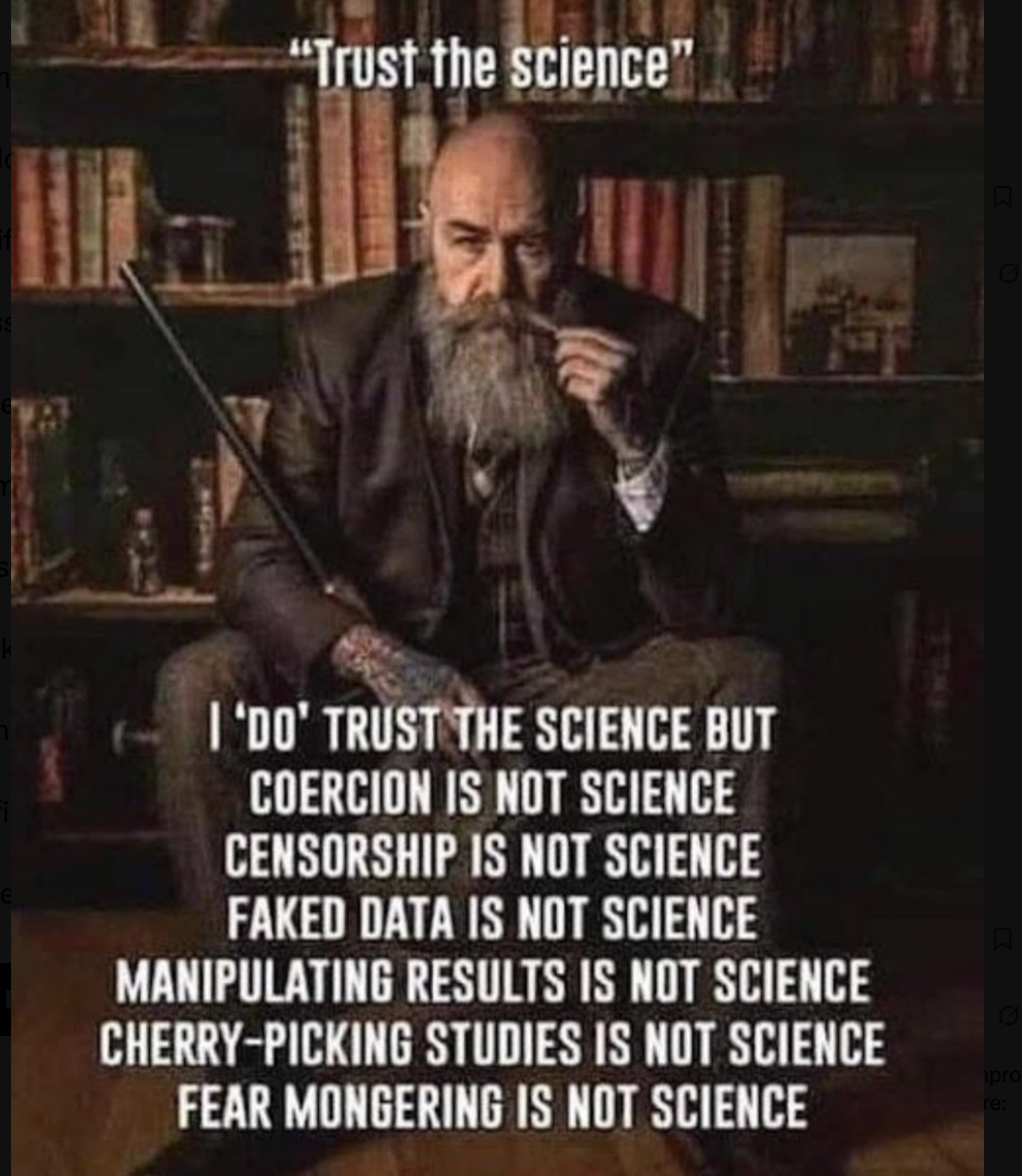
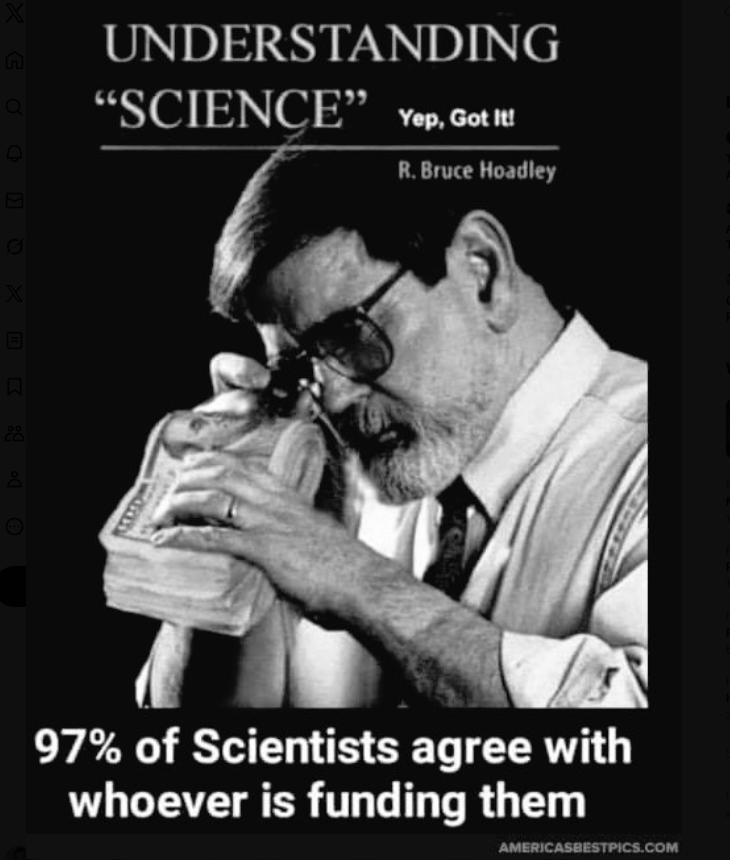
So how do we know who to trust, in science, media, politics, or anywhere else that people claim that they are experts and that we need to trust them? It makes one almost this cynical . . .

Continue ReadingThe Sorry State of Scientific Literature