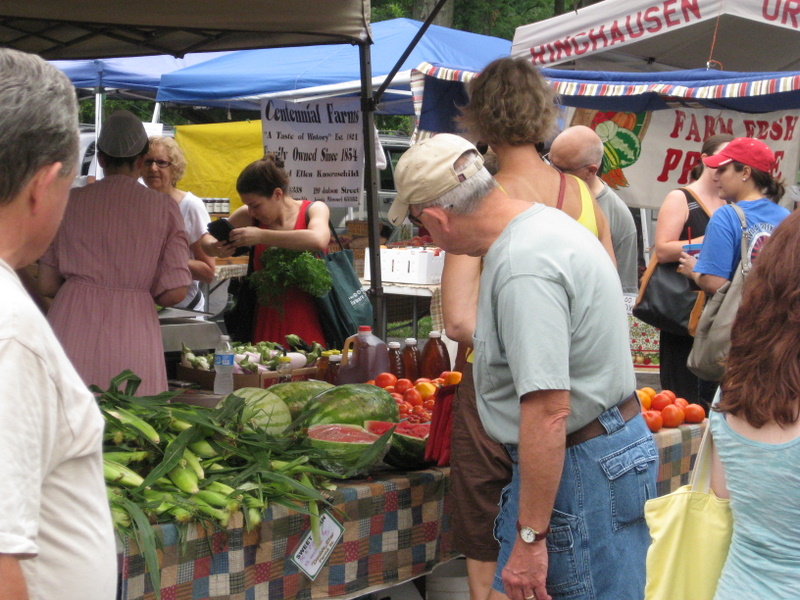
The Tower Grove Farmer's Market in South St. Louis was busy this morning, as it usually is.  A lot of people were purchasing organic produce because they believe that it is important to put only wholesome ingredients into their mouths.
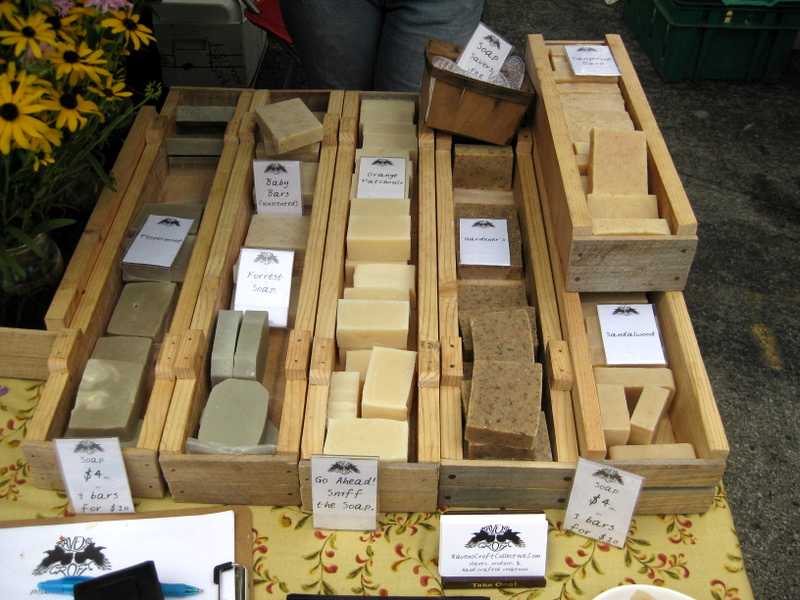
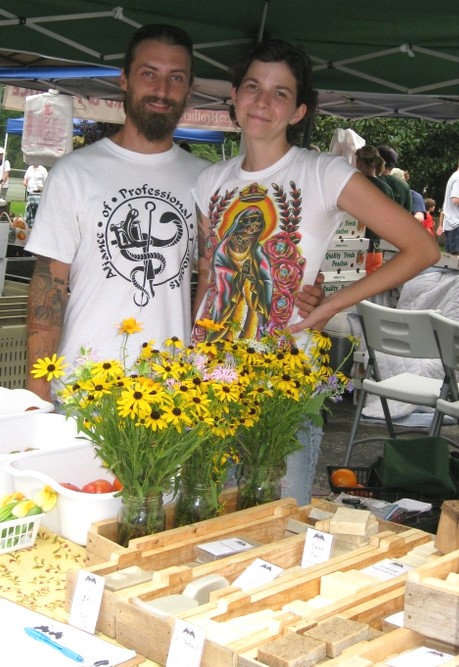
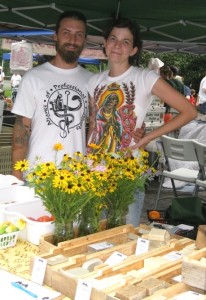
Stephanie and Bryan Shaner run a small family business called Ravenscroft. They sell produce, but they also make and sell their own soaps. I had the opportunity to discuss soap-making with them this morning. I learned that the process is fairly straightforward, based upon a family recipe described by Stephanie. It involves melting oils (they tend to use coconut, canola, olive oil or palm oil), and mixing them with lye (Bryan mentions that lye, also known as "sodium hydroxide" or "caustic soda" was traditionally made by pouring water through wood ash).
A lot of people were purchasing organic produce because they believe that it is important to put only wholesome ingredients into their mouths.
Stephanie and Bryan Shaner run a small family business called Ravenscroft. They sell produce, but they also make and sell their own soaps. I had the opportunity to discuss soap-making with them this morning. I learned that the process is fairly straightforward, based upon a family recipe described by Stephanie. It involves melting oils (they tend to use coconut, canola, olive oil or palm oil), and mixing them with lye (Bryan mentions that lye, also known as "sodium hydroxide" or "caustic soda" was traditionally made by pouring water through wood ash).
 As the mixture starts to thicken ("saponify"), they add the essential oils (the various natural ingredients that constitute the scents, such as lavender, mint or juniper). With homemade soap, one can be assured that the bar is free of petrochemicals. Here's some more background on the ways that soaps are manufactured. Stephanie estimated that her soap has a shelf life of about one year. By using homemade soaps, one can avoid all of the potentially harmful additives that one finds in petroleum-based (glycerin) commercial soaps.
I was surprised to hear that the main ingredient in homemade soap is plant oil. After all, if I spilled some plant oil on my hands, wouldn't it be logical that I would reach for a bar of soap, made largely of plant oil, to clean up the oil on my fingers? Stephanie indicates that it does seem counterintuitive, but that mixing and heating a bit of lye with the oil effects a dramatic transformation in the oil, allowing the oil to be transformed into soap. Again, here's more on that process.
As the mixture starts to thicken ("saponify"), they add the essential oils (the various natural ingredients that constitute the scents, such as lavender, mint or juniper). With homemade soap, one can be assured that the bar is free of petrochemicals. Here's some more background on the ways that soaps are manufactured. Stephanie estimated that her soap has a shelf life of about one year. By using homemade soaps, one can avoid all of the potentially harmful additives that one finds in petroleum-based (glycerin) commercial soaps.
I was surprised to hear that the main ingredient in homemade soap is plant oil. After all, if I spilled some plant oil on my hands, wouldn't it be logical that I would reach for a bar of soap, made largely of plant oil, to clean up the oil on my fingers? Stephanie indicates that it does seem counterintuitive, but that mixing and heating a bit of lye with the oil effects a dramatic transformation in the oil, allowing the oil to be transformed into soap. Again, here's more on that process.
 Stephanie urged that not only should we care about what we eat, but we should also care about what we put on our skin. Because homemade soap is free of the many additives of commercial soaps, some of her customers have found that rashes and other skin problems clear up simply by switching to homemade soap.
Stephanie indicates that she and Bryan are planning some workshops to teach others how to make soap. This is obviously more than just a money-making opportunity for her. She tells her customers, "There is nothing on this table we wouldn't help you to make yourself."
I bought a few bars, and my family and I will be trying them out. The going rate at this market was three bars of soap for $10. After I try them out, I'll report back in the comments. I'm interested in these natural ingredient soaps for the same reason that I've switched over to homemade shampoo (BTW, that "no poo" experiment has been wildly successful for me. I am perfectly happy with baking soda shampoo and apple cider vinegar conditioner).
Some might think that making these sorts of changes are trivial. I would respond by saying that we can clean up our environment one thing at a time, and there are hundreds of things each of us can do to live healthier and more sustainable lives. (See the recently released report by the President's Cancer Panel and see here. Figure, too, that even little changes can make a huge difference when tens of millions of people follow suit.
Stephanie urged that not only should we care about what we eat, but we should also care about what we put on our skin. Because homemade soap is free of the many additives of commercial soaps, some of her customers have found that rashes and other skin problems clear up simply by switching to homemade soap.
Stephanie indicates that she and Bryan are planning some workshops to teach others how to make soap. This is obviously more than just a money-making opportunity for her. She tells her customers, "There is nothing on this table we wouldn't help you to make yourself."
I bought a few bars, and my family and I will be trying them out. The going rate at this market was three bars of soap for $10. After I try them out, I'll report back in the comments. I'm interested in these natural ingredient soaps for the same reason that I've switched over to homemade shampoo (BTW, that "no poo" experiment has been wildly successful for me. I am perfectly happy with baking soda shampoo and apple cider vinegar conditioner).
Some might think that making these sorts of changes are trivial. I would respond by saying that we can clean up our environment one thing at a time, and there are hundreds of things each of us can do to live healthier and more sustainable lives. (See the recently released report by the President's Cancer Panel and see here. Figure, too, that even little changes can make a huge difference when tens of millions of people follow suit.