The Entirely Predictable Result of “Abolishing” the Police in Minneapolis

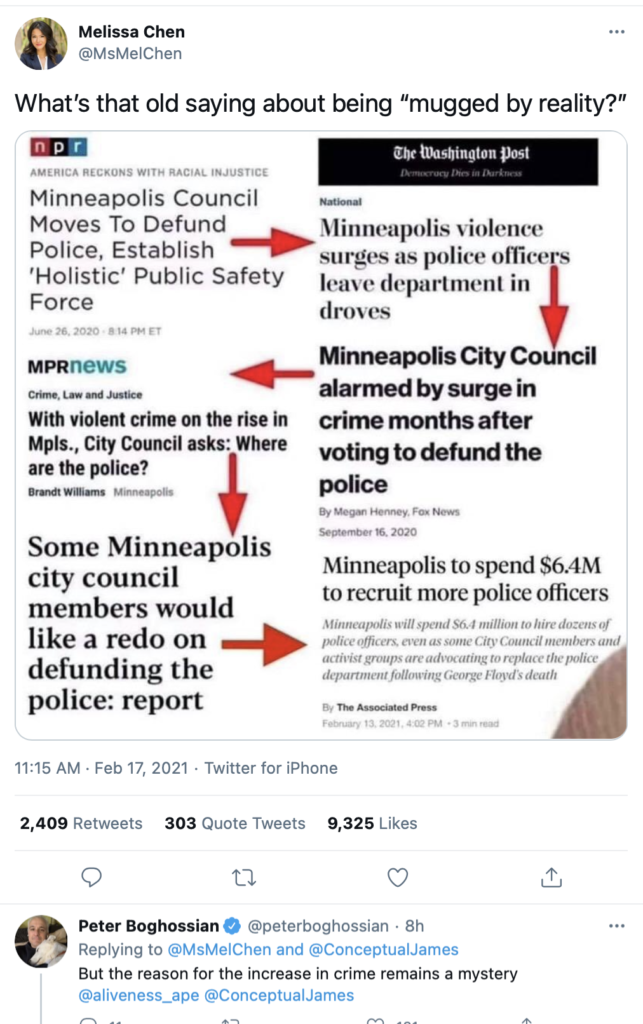
The statistics have been clear and unwavering for many years: Fewer police on the streets means more violent crime, young Black men will disproportionately be the homicide victims of this street violence and very few of these deaths will have anything to do with the police.

Minneapolis is finally figuring out the obvious, as described through a series of headlines assembled by Melissa Chen, with a cadenza by Peter Boghossian.

Continue ReadingThe Entirely Predictable Result of “Abolishing” the Police in Minneapolis

FTC Warns of Increased Rate of Romance Schemes During COVID

According to the FTC, there are a lot of broken hearts out there who also have broken wallets. I didn't realize the extent of the problem, which has skyrocketed since COVID:

Scammers fabricate attractive online profiles to draw people in, often lifting pictures from the web and using made up names. Some go a step further and assume the identities of real people. Once they make online contact, they make up reasons not to meet in person. The pandemic has both made that easier and inspired new twists to their stories, with many people reporting that their so-called suitor claimed to be unable to travel because of the pandemic. Some scammers have reportedly even canceled first date plans due to a supposed positive COVID-19 test.

While many people report losing money on romance scams that start on dating apps, even more say they were targeted on social media. These social media users aren’t always looking for love, and report that the scam often starts with an unexpected friend request or message.

Sooner or later, these scammers always ask for money. They might say it’s for a phone card to keep chatting. Or they might claim it’s for a medical emergency, with COVID-19 often sprinkled into their tales of woe. The stories are endless, and can create a sense of urgency that pushes people to send money over and over again.

What many of the largest reported dollar losses have in common is that people believe their new partner has actually sent them a large sum of money. Scammers claim to have sent money for a cooked-up reason, and then have a detailed story about why the money needs to be sent back to them or on to someone else. People think they’re helping someone they care about, but they may actually be laundering stolen funds. In fact, many reported that the money they received and forwarded on turned out to be stolen unemployment benefits.

In 2020, reports of gift cards being used to send money to romance scammers increased by nearly 70%. Gift cards, along with wire transfers, are the most frequently reported payment methods for romance scams. People said they mailed the gift cards or gave the card’s PIN number to the scammer. The median amount people sent romance scammers in 2020 using any method of payment was $2,500, more than ten times the median loss across all other fraud types.

Reports of money lost on romance scams increased for every age group in 2020. People ages 20 to 29 saw the most striking increase, with the number of reports more than doubling since 2019. People ages 40 to 69 were once again the most likely to report losing money to romance scams.7 And people 70 and older reported the highest individual median losses at $9,475.

Continue ReadingFTC Warns of Increased Rate of Romance Schemes During COVID

The Kinds of Things You Can Learn About Your Family for $99

Here's a rather amazing thing I recently learned about myself from 23 & Me: "You inherited a small amount of DNA from your Neanderthal ancestors. Out of the 7,462 variants we tested, we found 257 variants in your DNA that trace back to the Neanderthals." 23 & Me further told me I have up to 2% of Neanderthal DNA in my genome.

I've also checked out many hundreds of my 4th-6th cousins. They have many hundreds of last names and, based upon the profile photos, they come in every size, shape and skin color. They reside in dozens of countries all over the world. I have numerous relatives born in Africa, Asia and Australia. Six of my relatives are Egyptian. 34 of my closest 5,000 relatives are at least 25% Ashkenazi Jews.

As I'm learning these things, I'm recalling the joyous presentation A.J. Jacobs made about his expansive family tree at this TED talk.

That a company can reliably tell me these things for $99 would have been unfathomable even a few decades ago--It wasn't until 2003 that scientists could read the complete genetic blueprint for building a human being (the Human Genome Project). These findings and this modest cost to learn these things are stunning. So stunning that, as I found ever more about my family tree tonight, I even chuckled a little Neanderthal chuckle.

Continue ReadingThe Kinds of Things You Can Learn About Your Family for $99

Camille Paglia: How Postmodernism (Woke ideology) is Destroying Education

I just finished reading Camille Paglia's essay, "Free Speech and the Modern Campus," from a collection of her prior writings, a book titled Provocations."  This essay takes aim at practices that were once called "Political Correctness," which now fall under the description of excesses of the Woke or Wokeness.  Paglia begins her essay by recounting how and why many colleges and universities founded niche studies departments, such as women's studies. Colleges made the mistake of allowing these departments to serve as singularities, unengaged with traditional core studies of, for example, history or psychology. These departments

were so hastily constructed in the 1970s, a process that not only compromised professional training in those fields over time but also isolated them in their own worlds and thus ultimately lessened their wider cultural impact.. . . Working on campus only with the like-minded, they treat dissent as a mortal offense that must be suppressed, because it threatens their entire career history and world-view. The ideology of those new programs and departments, predicated on victimology, has scarcely budged since the 1970s.

These new departments confused scholarship with ideology. They became like churches:

Teaching and research must strive to remain objective and detached. The teacher as an individual citizen may and should have strong political convictions and activities outside the classroom, but in the classroom, he or she should never take ideological positions without at the same time frankly acknowledging them as opinion to the students and emphasizing that all students are completely free to hold and express their own opinions on any issue, no matter how contested, from abortion, homosexuality, and global warming to the existence of God . . .

A familiar trio of Continental philosophers was carted into these niche curricula:

The Derrida and Lacan fad was followed by the cult of Michel Foucault, who remains a deity in the humanities but whom I regard as a derivative game-player whose theories make no sense whatever about any period preceding the Enlightenment. The first time I witnessed a continental theorist discoursing with professors at a Yale event, I said in exasperation to a fellow student, “They’re like high priests murmuring to each other.”

At p. 379, Paglia explains the main problem with poststructuralism:

Post-structuralism, in asserting that language forms reality, is a reactionary reversal of the authentic revolutionary spirit of the 1960s, when the arts had turned toward a radical liberation of the body and a reengagement with the sensory realm. By treating language as the definitive force in the world—a foolish thesis that could easily be refuted by the dance, music, or visual arts majors in my classes—poststructuralism set the groundwork for the present campus impasse where offensive language is conflated with material injury and alleged to have a magical power to create reality. Furthermore, poststructuralism treats history as a false narrative and encourages a random, fragmented, impressionistic approach that has given students a fancy technique but little actual knowledge of history itself.

Another problem with political correctness is the inability to interpret the significance of events in the context of the time period in which they occurred (see here for a recent example):

The problem of political correctness is intensified by the increasing fixation of humanities and even history departments on “presentism,”that is, a preoccupation with our own modem period.

What are the solutions? Paglia offers three:

[E]ducators must first turn away from the sprawling cafeteria menu of over-specialized electives and return to broad survey courses based in world history and culture, proceeding chronologically from antiquity to modernism. Students desperately need a historical framework to understand both past and present.

Second, universities should sponsor regular public colloquia on major topics where both sides of sensitive, hot-button controversies are frilly discussed. Any disruptions of free speech at such forums must be met with academic sanctions.

[C]olleges and universities must stay totally out of the private social lives of students.The intrusive paternalism o f American colleges in this area is an unacceptable infringement of student rights.If a crime is committed on campus, it must be reported to the police.There is no such thing as a perfectly “safe space” in real life. Risk and danger are intrinsic to human existence.

Continue ReadingCamille Paglia: How Postmodernism (Woke ideology) is Destroying Education