The Most Important Thing we are Losing

On January 5, Sam Harris kicked off his newest season of his podcast, Making Sense, with an episode he titles "A Few Thoughts for a New Year. He covers a lot of ground in 30 minutes. I wish I could say that I disagree with him on any of the major points he is making. His main concern is that we seem to be losing grasp of our ability to work together to solve the problems we face as a country.

As always, Sam articulates his concerns precisely and he avoids taking political sides. His focus for the coming year is seeking real life solutions for the many pressing issues he touches in this podcast. I highly recommend listening in. If you can't afford it, he offers subscriptions without cost. Simply listen to the end of this episode for details.

Continue ReadingThe Most Important Thing we are Losing

Glenn Greenwald, Co-Founder of The Intercept, Resigns To Maintain Journalistic Integrity

I have been in the process of writing an article that I will title, "Everything Is Becoming Religion." This morning, while writing, I noticed that Glenn Greenwald has resigned from The Intercept, a news organization he co-founded. Here is an except from Greenwald's announcement:

The pathologies, illiberalism, and repressive mentality that led to the bizarre spectacle of my being censored by my own media outlet are ones that are by no means unique to The Intercept. These are the viruses that have contaminated virtually every mainstream center-left political organization, academic institution, and newsroom. I began writing about politics fifteen years ago with the goal of combatting media propaganda and repression, and — regardless of the risks involved — simply cannot accept any situation, no matter how secure or lucrative, that forces me to submit my journalism and right of free expression to its suffocating constraints and dogmatic dictates.

Greenwald's resignation comes on the heels of his riveting three-hour conversation with Joe Rogan earlier this week. During that discussion, Greenwald (and Rogan) aimed Greenwald's criticisms at our most prominent legacy media outlets across the entire political spectrum. And now our social media overlords are actively getting into the game. Three hours is a lot of time, but I would urge you to watch every minute of this. It would be a small investment, given that this discussion offers an accurate diagnosis of America's Dys-information Pandemic and some moral clarity about what needs to happen going forward.

Our prominent legacy news outlets have become sad jokes with regard to many critical national issues. Our "news" is now pre-filtered to protect us from basic facts and it treats thinking as though it is a team sport, much like the dogma people are offered in churches. It treats us like we are babies, as though we aren't able to think for ourselves. Our prominent legacy media outlets have so thoroughly choked off meaningful non-partisan information and discussion that this has ripped open up a dangerous information chasm---many of us now inhabit only one of two mostly non-overlapping factual worlds. This has, in turn, led to two exceedingly disappointing choices for President of this Duopoly. If I needed to hire an employee for any type of job in any business, I would never hire either of these candidates and neither would you. But this is where we are, unable to talk with one another about this sad situation with nuance. In fact, too many of us have been convinced that we should hate each other for having differing opinions, even when we are mostly "on the same side of the aisle."

Somehow, there are many Americans who are still convinced that they can uncritically sit back and "turn on the news." What they will actually be exposed to, for the most part, is reporters who are afraid to ask the same basic questions on the job that they actually and instinctively do ask each other in private. Instead of informing us with a wide range of facts and opinions, they are driven to please their bosses and audience. This is not news. This is Not-News. This parallels the deep dysfunction driven by social media, an issue address in the excellent new documentary, "The Social Dilemma."

We now have a News-Industrial Complex that is driven by money and ideology instead of integrity and courage to engage with inconvenient facts. This system is designed to please you, to give you more of what your intuitive side, your System 1, craves. Once you have this epiphany about what is really going on, you will no longer be able to stop seeing it. If you continue watching the "news," you will increasingly think, "Garbage in, Garbage out." It will increasingly realize that prominent legacy news outlets are fucking with our brains to make money and steer elections. Once you have this epiphany, you will experience a greatly heightened annoyance at what passes for "news" Once a critical mass of people have this epiphany, this will be our first step in a long slow recovery.

Continue ReadingGlenn Greenwald, Co-Founder of The Intercept, Resigns To Maintain Journalistic Integrity

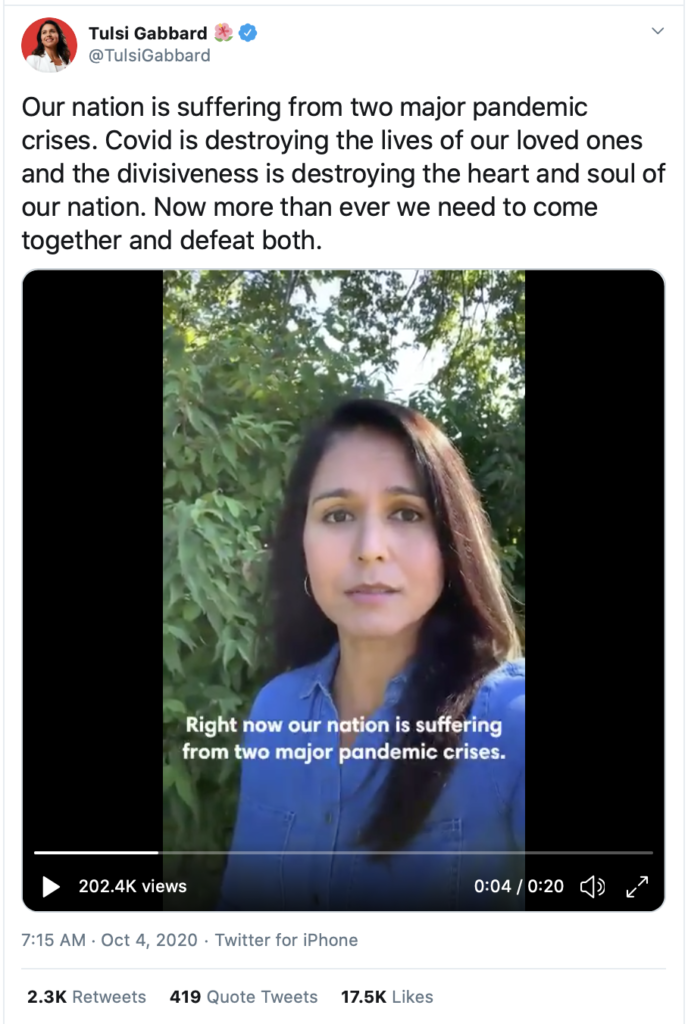
Pandemic #2: Divisiveness Caused by Social Media

For the first step in defeating Pandemic #2, please watch the new documentary, "The Social Dilemma." (You'll find it on Netflix).

As you use social media, try to cruise at 10,000 feet like a disinterested anthropologist and then ask yourself whether kind-hearted intelligent people should be talking at each other like much of what you will see.

Pandemic #2 is invisible, just like Pandemic #1, and you'll feel like you are in charge of your thoughts the entire time. Pandemic #2 quietly invades our minds, then erects filter bubbles around us that destroy the possibility of civil discourse on the most important issues facing us. Pandemic #2 destroys the possibility of e pluribus unum. We need to take action now, because huge misplaced financial incentives guarantee that Big Tech is not going to rescue us.

Continue ReadingPandemic #2: Divisiveness Caused by Social Media

The Problem with Stifled Dissent

Why should we care about suppressed and chilled speech on important issues of the day? Emily Elkins of the Cato Institute offers the statistics and a clear analysis in "Most Americans Are Scared Stiff to Talk Politics. Why?"

There are many reasons to resist this authoritarian urge to squash dissent. The first is that scientific progress, and by extension, the improvement of human well‐​being generally, requires free thought and open discourse. As Jonathan Rauch explains in his book, “Kindly Inquisitors,” the scientific method breaks down when people become reluctant to ask questions, be creative, challenge each other, and seek out and understand evidence.

Further, as Thomas Chatteron Williams explained in a New Yorker interview, the culture of canceling signals to people what the boundaries of “acceptable” ideas are or else suffer severe economic and emotional punishment. Thus many “steer far clear of the boundary,” causing a “narrowing…stifling effect on not just speech but on thought,” he explained.

Yet silencing people and stifling free thought isn’t an effective long‐​run strategy. It rarely changes minds. It just shuts down civil discourse and prevents people from having opportunities to modify their ideas in the face of new information. Instead, people hold onto their opinions, and just sweep them under the rug.

Political opponents’ disengagement doesn’t necessarily mean victory. Americans still vote. And their political views, silent or expressed, affect how they vote. Persuasion is necessary to change how people think and thus who and what they vote for. But persuasion is hard and requires open dialogue.

Social psychologists have found evidence that we aren’t very good at updating our opinions by ourselves. We need other people we respect to ask us to explain our views and then challenge us with new considerations. It’s typically through this back and forth process that we update our views when people we trust present us with new, compelling information.

But this only works when we feel comfortable to engage in a dialogue. Thus it is only with open dialogue that people’s opinions can be examined, understood, or reformed. Thereby, the best long‐​term strategy is persuasion, not silencing. And persuasion requires open debate.

Continue ReadingThe Problem with Stifled Dissent

The Stifled Discussion of Whether Peer Contagion is Triggering the Sharp Rise in Gender Transitions

Increasingly, when I express my concerns about the sudden dramatic increase in teenaged girls who are declaring themselves to be men trapped in women’s bodies, I receive a rash of ad hominem attacks. For example, I have been accused of being a “conservative,” though I have never affiliated myself with the Republican Party. I have been accused of being anti-trans, which is utterly false. In my view, every adult has the right to do whatever they want to do with their body. I will happily address every adult with whatever pronoun they choose. It is my opinion that all members of the transgender community should all be vigorously protected pursuant to civil rights laws and every other law that applies to every other person.

My concern in writing this article is not about adults. It is about teenagers, especially teenaged girls. Although there appear to be some teenaged girls who are legitimate candidates for transitioning, the recent numbers of girls clamoring for this treatment is extraordinarily and suspiciously high. I also have a personal stake in this controversy. I have friends whose daughters who in various stages of undergoing what might be needless and dangerous medical treatment.

Here are some of the facts that are cause for my concern. These are excerpts from a 2020 article by Abigail Schrier in Quillette titled, “Discovering the Link Between Gender Identity and Peer Contagion”:

In America and across the Western world, adolescents were reporting a sudden spike in gender dysphoria—the medical condition associated with the social designation “transgender.” Between 2016 and 2017, the number of gender surgeries for natal females in the United States quadrupled, with biological women suddenly accounting for—as we have seen—70 percent of all gender surgeries. In 2018, the UK reported a 4,400 percent rise over the previous decade in teenage girls seeking gender treatments. In Canada, Sweden, Finland, and the UK, clinicians and gender therapists began reporting a sudden and dramatic shift in the demographics of those presenting with gender dysphoria—from predominately preschool-aged boys to predominately adolescent girls. . .

In 2016, Lisa Littman, ob-gyn turned public health researcher, and mother of two, was scrolling through social media when she noticed a statistical peculiarity: Several adolescents, most of them girls, from her small town in Rhode Island had come out as transgender—all from within the same friend group. . . . Dr. Littman began preparing a study of her own, gathering data from parents of trans-identifying adolescents who’d had no childhood history of gender dysphoria. . . . She assembled 256 detailed parent reports and analyzed the data. Her results astonished her.  Two patterns stood out: First, the clear majority (65 percent) of the adolescent girls who had discovered transgender identity in adolescence—“out of the blue”—had done so after a period of prolonged social-media immersion. Second, the prevalence of transgender identification within some of the girls’ friend groups was, on average, more than 70 times the expected rate.

Many of the adolescent girls suddenly identifying as transgender seemed to be caught in a “craze”—a cultural enthusiasm that spreads like a virus. “Craze” is a technical term in sociology, not a pejorative, and that is how I use it here. (Dr. Littman never does.) It applies to Hula-Hoops and Pokémon and all sorts of cultural fads. If this sudden spike in transgender identification among adolescent girls is a peer contagion, as Dr. Littman hypothesized, then the girls rushing toward “transition” are not getting the treatment they most need. Instead of immediately accommodating every adolescent’s demands for hormones and surgeries, doctors ought to be working to understand what else might be wrong. At best, doctors’ treatments are ineffective; at worst, doctors are administering needless hormonal treatments and irreversible surgeries on patients likely to regret them. Dr. Littman’s theory was more than enough to touch a nerve.

Dr. Littman has been treated unfairly, even grotesquely, by the academic community and by the news media, as reported in this same article. This side issue is well worth considering, as a red flag indicating that many news outlets are being driven by ideology rather than science on this issue.

These same issues are in the process of being discussed in an ongoing series of letters between journalist Abigail Shrier and evolutionary psychologist Heather Heying. [Heying also discussed this issue at the DarkHorse Podcast with Brett Weinstein]. Here is an excerpt from the letters-in-progress:

There are many reasons to believe we are in the midst of a transgender “craze”— a mass enthusiasm that captivates a population so that matters more essential to its welfare fall neglected, to borrow Lionel Penrose’s use of the term. There are the alarming statistics, indicative of an epidemic: For a century, gender dysphoria has been understood to begin in early childhood (ages 2 to 4) and afflict males almost exclusively. In the last decade, apparently out of nowhere, gender dysphoria’s predominant demographic has shifted from young boys to teen girls. (The rise in girls presenting at gender clinics in the UK has been estimated at 4,400%).

All across the West, adolescent girls are suddenly identifying as “trans” with friends, clamoring for hormones and surgeries. Teen girls who are struggling with anxiety and depression but who had no childhood history of gender dysphoria at all. Under the guidance of numberless trans social media influencers, with the encouragement of peers, clusters of girls are transforming themselves from desperately unpopular to the toast of the virtual town.

In my book, I offer several explanations of how this particular social contagion came to befall teen girls. And one of the many flags I plant is this, garnered from academic psychologist Jean Twenge: Teen girls today spend a whole lot less time with each other in person (an hour less per day) than those of prior generations. That’s less time hanging out in each other’s rooms, combing the details of their lives for hidden grandeur; less time savoring gossip and telling secrets; less time caught in the current of breathless laughter, half-shrieking the lyrics of a song.

I wonder whether, as an evolutionary biologist, you agree with the significance of this loss?

[As indicated, the above series of letters is ongoing].

In light of these disturbing statistics, you would think that this topic of gender transitions would be a hot issue that is being vigorously discussed by news media from across the political spectrum. You would be wrong.


Continue ReadingThe Stifled Discussion of Whether Peer Contagion is Triggering the Sharp Rise in Gender Transitions