
How to Marginalize Ideas and People to Create an Illusion of Consensus, Hurting People in the Process

A story of hubris by the powers that be. This could also be characterized the sort of thing Jonathan Haidt would characterize as "structural stupidity":

People who try to silence or intimidate their critics make themselves stupider, almost as if they are shooting darts into their own brain.

What follows is an Excerpt From The Free Press. "Government Power v. People Power," By Dr. Jay Bhattacharya:

From the beginning of the Covid-19 pandemic, I was a vocal critic of lockdowns and school closures that I believed would cause more harm than good. In October 2020, with Sunetra Gupta of Oxford University and Martin Kulldorff of Harvard University, I wrote the Great Barrington Declaration, which proposed protecting vulnerable people while lifting lockdowns for the majority of the population. In other words, it advocated a return to classic principles of pandemic management that had worked to limit the harm of other respiratory virus pandemics. Tens of thousands of scientists signed on.

Four days after we wrote it, the head of the National Institute of Health, Francis Collins, wrote to Anthony Fauci, labeling us as “fringe epidemiologists” and calling for “a quick and devastating published takedown” of the declaration. A propaganda campaign quickly ensued, with various media sources falsely accusing me of wanting to let the virus rip. It wasn’t just the press. Recently I learned in these pages that Twitter placed me on a secret blacklist to limit the reach of my tweets.

So what did I learn in 2022? I learned in a very concrete and painful way the effects of Washington and Silicon Valley working together to marginalize unpopular ideas and people to create an illusion of consensus.

This censorship and smear campaign deprived the world of a needed debate over Covid policy and might have avoided much unnecessary suffering by children, the poor, and the working class harmed by lockdowns.

[Dr. Jay Bhattacharya is a professor of health policy at Stanford University, where he has taught in the medical school for over two decades].

Here is an excerpt from the Great Barrington Declaration:

Fortunately, our understanding of the virus is growing. We know that vulnerability to death from COVID-19 is more than a thousand-fold higher in the old and infirm than the young. Indeed, for children, COVID-19 is less dangerous than many other harms, including influenza.

As immunity builds in the population, the risk of infection to all – including the vulnerable – falls. We know that all populations will eventually reach herd immunity – i.e. the point at which the rate of new infections is stable – and that this can be assisted by (but is not dependent upon) a vaccine. Our goal should therefore be to minimize mortality and social harm until we reach herd immunity.

The most compassionate approach that balances the risks and benefits of reaching herd immunity, is to allow those who are at minimal risk of death to live their lives normally to build up immunity to the virus through natural infection, while better protecting those who are at highest risk. We call this Focused Protection.
Continue ReadingHow to Marginalize Ideas and People to Create an Illusion of Consensus, Hurting People in the Process

Ibram Kendi’s Confession

I sometimes think back to 2021, when Ibram Kendi unwittingly self-destructed. The episode was described by Professor of Political Science and author Wilfred Reilly at FAIR:

On October 29, the newly minted MacArthur “genius” posted the results of a widely discussed survey project on Twitter, saying simply: “More than a third of white students lied (about their race) on their college applications.” Kendi went on to claim that about half of the students who chose dishonesty falsely identified themselves as Native American—presumably to benefit from affirmative action programs—and that “more than three-fourths” of all students who lied about their racial background were accepted to colleges they applied to. As any academic should, Kendi duly linked his source, which I also provide here.

The backlash to Kendi’s comments was immediate, and, frankly, rather predictable. As Oliver Traldi details for Quillette, and as Jerry Coyne does for the popular blog Why Evolution Is True, conservative and heterodox intellectuals pointed out that Kendi’s claim about white students seeking to benefit from affirmative action logically debunks the main thesis of his scholarly work. Founder and former editor of The Intercept Glenn Greenwald not only questioned the objective accuracy of Kendi’s data, but also noted that his argument “negates every core contention about American society on which his career is based.” Journalist Alex Griswold described Kendi as having “blown up his life’s work,” noting that Kendi would “have to delete” his tweet, which, in fact, he did.

Reilly is the author of an excellent book of topics we should be discussing regarding social justice: Taboo: 10 Facts You Can't Talk About (2020).

Continue ReadingIbram Kendi’s Confession

My Current Default Position About COVID Booster Vaccines

I received two COVID shots as well as a booster. Then, about six months ago I got COVID, which had me feeling down in the dumps for 3 days, which also left me with a loss of strength and balance for a few weeks after that. I'm hearing a lot about the alleged need for all of us to get more and more boosters lately. Should I? I'm not a scientist. I don't know how to read the medical research with confidence. I thought we would all have clear answers about COVID and boosters by now, but it has never been less clear. And now we have Twitter Files indicating that the U.S. government has been warping the conversation about COVID and vaccines, even having a hand in shutting down well-decorated medical professionals who disagree with the national narrative of "get lots and lots of booster shots." I wish we had dependable information about the following:

1. Whether boosters are meaningfully effective

2. Whether boosters are safe; and

3. Whether the risks of boosters (according to some) outweigh the benefits of booster (according to others).

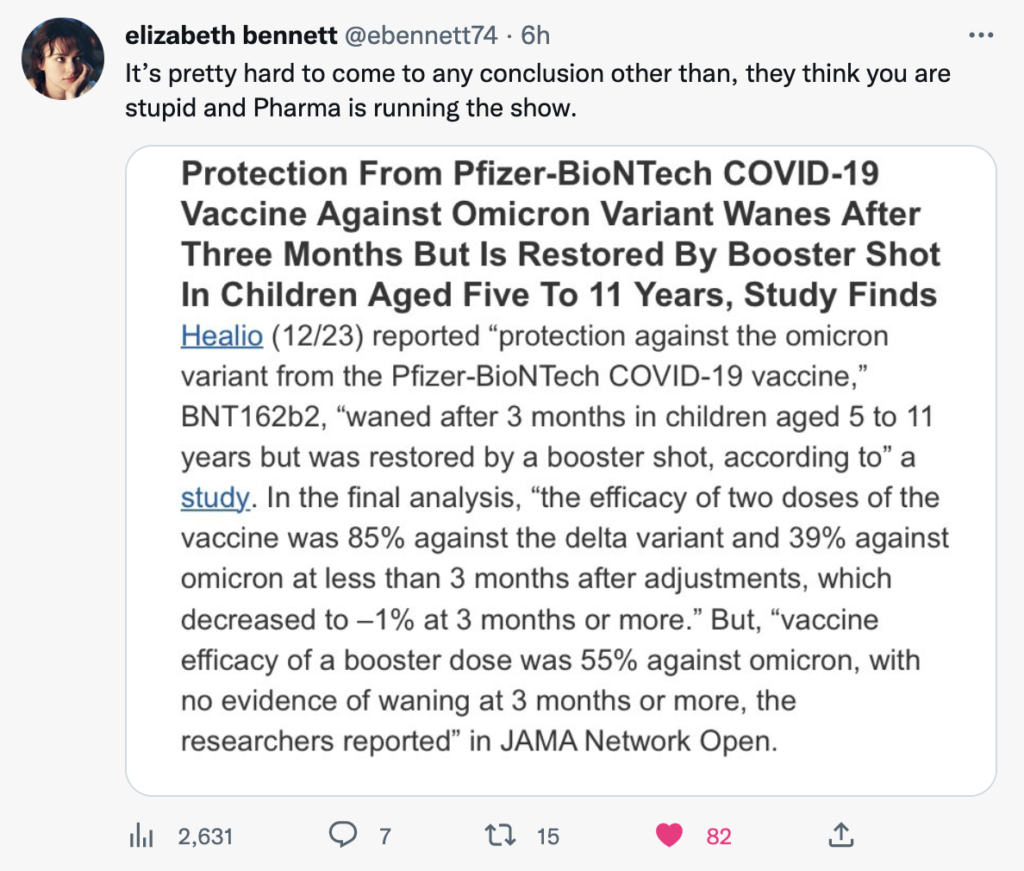
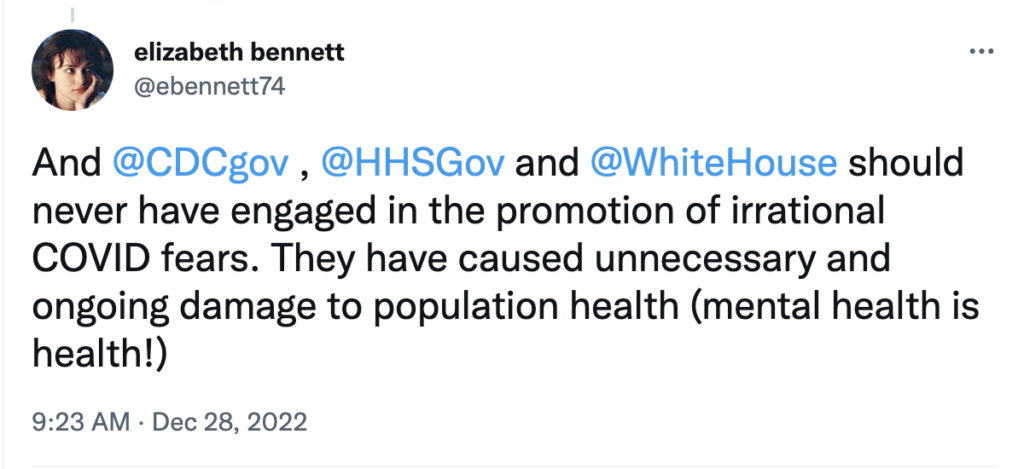
It doesn't help that public health officials and CDC have been so wrong about so many things over the last few years. The evidence on this includes the internal reversals of CDC policy (e.g., No need for a mask, then you must wear a mask; getting the jab will keep you from getting COVID, then not so much). Every time there is a new pronouncement reversing a prior pronouncement, it is presented with equal confidence. Thus, it is not surprising to see recent statistics showing that ever greater numbers of Americans are refusing to get the newest boosters. But also consider comments by doctors such as "Elizabeth Bennett" on Twitter:

I am one of the many people who are now somewhere between disoriented, distrusting and disgusted with the state of COVID information. I am not alone:

In the absence of reliable information and wide-open vigorous conversation among our medical professionals, the rest of us need to act on assumptions and guesses. I am assuming that I am at more risk if I get yet another new booster than if I refuse it. I'm open to new information, of course, but I'm highly concerned that doctors and researchers with legitimate concerns about the boosters are still being shut out of the conversation. I've seen ample confirmation of this censorship--many doctors and researchers being completely shut down by Twitter for instance.  I also see many serious sounding accusations like these.  I would like to know a lot more information. I would like to have credible answers to these 130 highly specific concerns assembled by Steve Kirsch.

In the meantime, no more boosters for me.

Continue ReadingMy Current Default Position About COVID Booster Vaccines

Stanford University Attempts to Dismantle Harmful Language

Stanford University has launched an initiative to protect us from harmful language. This language is so incredibly harmful that after the link to the website started getting passed around, Stanford shut down public access. Now only Stanford students will get to know the language that purportedly harms all of us.

Heather Heying had been poking around at the Stanford website that was designed to protect her (and me and you and everyone else) from certain terrible words and phrases, but before she could finish reviewing the website, Stanford closed off public access. Here's some of the information that Heather can report at her website, Natural Selections:

Finally, I grabbed a single screenshot of one of the recommendations on the site before access was restricted4. Here it is:

[More . . . ]

Continue ReadingStanford University Attempts to Dismantle Harmful Language

University of Missouri School of Journalism Embraces Censorship.

University of Missouri School of Journalism has announced that it is engaging in censorship based on comically vague criteria. Excerpt from City Journal:

One of the top journalism schools in the country endorses restrictions on free speech. The University of Missouri’s School of Journalism currently enforces a sweeping newsroom diversity policy that aims to eradicate “reporting that is racist or sexist in fact or in connotation” and to “eliminate nationalistic, racist, sexist and other demeaning remarks . . . whether said in seriousness or jest.” The policy applies to the university’s six affiliated news outlets, which are often staffed by faculty and students.

When asked, the journalism school refused to provide any definitions or examples of a “demeaning” remark. But recent incidents suggest that university students and faculty can encounter severe repercussions if they criticize the Black Lives Matter movement, hang flags in support of the police, or challenge gender ideology. The School’s vaguely defined policy allows university faculty and administrators to enforce speech restrictions as they see fit....

If one refers to the horrifically vague Newsroom Diversity Policy, one can see that the school is laser-beam discriminatory when it comes to students seeking work on-air. The university is proudly lispist, hissist and stutterist.

Criteria for air work will include clarity of diction; enunciation and elocution; well-modulated pitch and tone; lack of lisp, hiss, stutter, thickly accented speech or distracting mannerisms; correct inflection; and interpretation of delivery.

Continue ReadingUniversity of Missouri School of Journalism Embraces Censorship.