Performance versus Legitimate Concern on Racial Matters

John McWhorter is now writing several times per week at the New York Times. I can only assume that the NYT hired McWhorter to help deprogram them, to save from their self-induced immersion in the cult that is "antiracism." I'd like to be the fly on the wall when NYT staffers discuss this new hire among themselves. I expect that it would be, in equal parts, entertaining and distressing. But the good guys won this battle, an McWhorter has been handed a turbo-charged megaphone for his eloquent and witty brand of common sense.

Here is an excerpt from one of McWhorter's early columns at the NYT. The title is "The Performative Antiracism of Black Students at the U. of Wisconsin."

Treating a people with dignity requires not only listening closely and sympathetically to their grievances, but being able to take a deep breath and call them out on aspects of those grievances that don’t make sense. And there will be some, unless those airing the grievance are fictional creations instead of human beings.

On race, we should assess, look ahead rather than backward, channel our thoughts and feelings with cortex rather than brain stem, and think slow rather than fast — and the notion that this counsel is “white” is science fiction. That goes for both protesters and those whom they protest at. Instead, too much of what passes as enlightenment on race these days involves merely pretending that something makes sense out of fear.
Continue ReadingPerformance versus Legitimate Concern on Racial Matters

Daily Aphorism #6: We Think and Vote Like We Drive and Eat.

Most people claim that they are careful thinkers and conscientious voters, but I seriously doubt that claim. I've seen what happens on social media. It's a nonstop carnival of careless, invalid and fallacious reasoning. Further, we have a big problem here, in that people who don't know are unwilling to say "I don't know." But I have another reason for suggesting that we are sloppy thinkers: We sloppy even when we engage in highly risky activities.

Why would anyone take any more care in thinking or voting than they take when they engage in activities like eating or driving? After all, if you aren't careful with eating and driving, you could die.

We are lousy eaters for at least two reasons. First, we put all kinds of crap into our mouths. Many of us eat lots of food that is demonstrably unhealthy. Second, we put far too much of it into our mouths. 74% of American adults are overweight or obese. That's most of us. More than 42% of Americans are obese. Here are the definitions for "overweight" and "obese."

I won't point to any stats regarding driving. Anyone who drives has seen the insanity, the recklessness, the inattention. On second thought, I'll give two statistics:  any given moment 3% of us on the highway are texting and distracted driving (much of it texting) kills more than 3,000 each year. That is more than 10 people killed every day. That's as many people killed each year as died in the World Trade Center bombing.

I've discussed this matter in a prior post.  My very sad point is this: If a person is going put their life at risk with terrible eating habits and driving habits, why would we expect them to be more careful with how they inform themselves or attempt to persuade others?

I very much wish that none of what I have written above is true.

Continue ReadingDaily Aphorism #6: We Think and Vote Like We Drive and Eat.

Daily Aphorism #5: Fickleness and Death

It's like a on/off switch. When I'm feeling good and no one around me is notably ill, I feel like Superman, even though I am 65. All it takes to make me feel my age (or even older) is a tiny bit of morality salience. How tiny? A mild back ache often does the trick. Or noticing my gray hair. Or needing to stretch out after sitting over the computer for a couple hours. Or forgetting someone's name. That is major terror. Why "terror"? Because Terror Management Theory predicts that even subtle morality salience can send us into spirals. TMT is a power and innovative theory that explains so very many things that we encounter every day. Mainly it explains how human animals can carry one with their ordinary (and oftentimes trite) daily tasks as if everyone on the planet won't be dead in 125 years.

Truly, this is heavy stuff to consider. If you haven't before heard of Terror Management Theory, I've written more than a few articles on the topic, and you can find all of them at this link.

Continue ReadingDaily Aphorism #5: Fickleness and Death

Another Look at Robin DiAngelo’s White Fragility

First, some statistics:

White Fragility became a New York Times bestseller for more than a year. In September 2019, Slate noted that "White Fragility has yet to leave the New York Times bestseller list since its debut in June 2018, making it the fastest-selling book in the history of Beacon Press." In June 2020, during the George Floyd protests, it reached no. 1 on the New York Times list. The July 26, 2020 edition of the list marked the book's 97th week in the Paperback Nonfiction category, where it was ranked number 1.
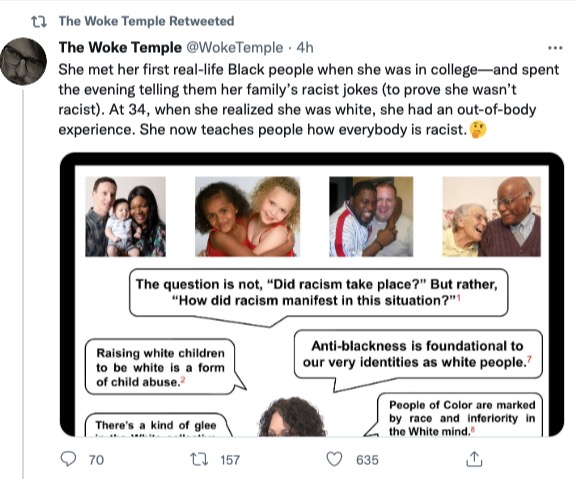
Now, some facts about Robin DiAngelo, carefully and accurately reported by The Woke Temple:

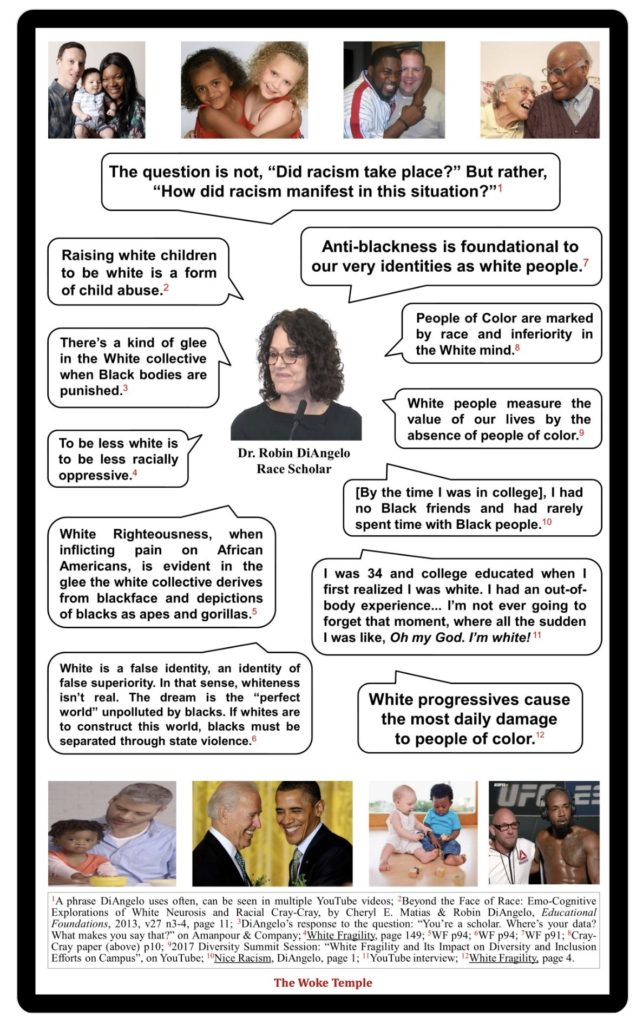
Here is DiAngelo's thought process, in all of its glory:

That so many American news media outlets, universities and HR Departments could embrace this divisive, poisonous, pathological, infantile, baseless nonsense for the past couple of years should send a chill through every one of us. How is it possible that so many people supported her patently racist ideas and her repeated infantilization of blacks? The fact that this utter crap was ubiquitously touted by American elites at the same time that they refused to honor Martin Luther King's brilliant time-tested idea to judge people only by their content of character demoralizes me.

It's difficult to determine how to de-program the thousands of people who run our sense-making institutions who continue to tout this garbage.

Continue ReadingAnother Look at Robin DiAngelo’s White Fragility