Sirhan Sirhan and Mismatched Bullets
I had never heard any of this before. I had only heard that RFKJr was denying the obvious, but in this interview he names names and discusses mismatched bullets. Now I'm wondering who really killed Bobby Kennedy.


I had never heard any of this before. I had only heard that RFKJr was denying the obvious, but in this interview he names names and discusses mismatched bullets. Now I'm wondering who really killed Bobby Kennedy.
In the recent affirmative action decision by the U.S. Supreme Court, Justice Jackson made a startling claim:
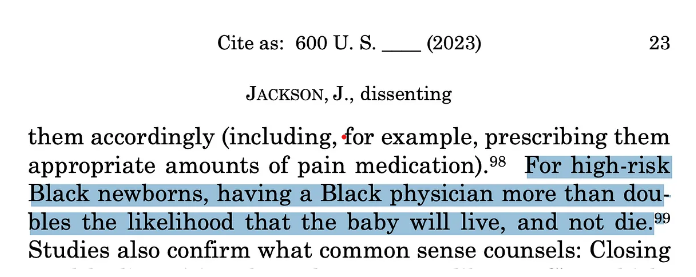
Dr. Vinay Prasad takes issue with the shoddy study on which Justice Jackson might well have relied upon in good faith. I will assume that neither she nor her law clerks have the necessary expertise for critically analyzing the study she cited for making the claim that Black doctors are twice as good at saving the lives of Black newborns. In this article, Dr. Prasad shows the skepticism one needs to show upon hearing such an extraordinary claim.
The paper in question is catastrophically flawed. First, consider that it is a bold claim that a white doctor is twice as likely to kill a black baby. The effect size (TWICE as likely!) is massive. . . .
Next, in my podcast from Aug 2020 I discuss why this paper is flawed (full podcast is 91 min. but relevant discussion runs from 1:31:00 to 0:52:00 mark). Those notes are also captured here.
Prasad also breaks down a second article claiming that Black doctors are substantially better at saving Black lives: "The Supreme Court’s affirmative action decision puts lives at risk."
Prasad sets forth the limitations on this second study, which also makes an extraordinary race-based claim:
At Forbes, Tomas Chammoro-Premuzic discusses each of these misconceptions about intelligence and IQ:
Transgender Medicine, British Approach versus American. Bari Weiss interviews BBC reporter Hannah Barnes. Topic: On what Tavistock’s closure means for youth gender care around the world. Excerpt:
BW: When you look at your reporting from a ten-thousand-foot view, do you think what happened at Tavistock is a unique scandal, or do you think the real scandal is how normalized this kind of medicalized treatment among young people has become?
HB: These are professional people who’ve dedicated their working lives to helping young people, and what they were saying boils down to: this is not good clinical practice. This isn’t how we’ve ever practiced in other places we’ve worked. Somehow, because this is a gender clinic, the same questions that we would ask normally were not welcome...
So, I’m going to start with my understated Britishness by saying that I avoid using the word scandal because we don’t know yet what the scale might be because we just don’t have the data. We know that some people have been harmed and we know that some people have been helped, and we just don’t know the numbers either way. But what I think is really striking is that people who worked in the clinic, who did those assessments, who made those referrals, fear they have played a part in a huge medical scandal. So I’m just going to start with that caveat. What I would say is that, yes, we have a different healthcare system here in the UK than the U.S., but the evidence base is the same wherever young people live in the world, and the evidence base is weak. No one has been able to replicate the findings of the Dutch team that pioneered this approach. Now, those studies have come under much more scrutiny, and those findings themselves are not strong. And yet that is the basis, really, for gender-affirming medical care in young people in its entirety. So, is what happened at the Tavistock clinic happening elsewhere? Absolutely. . . . This area of healthcare has avoided any of the normal scrutiny one would expect, particularly when dealing with children and with a drug that’s being used off-label. The questions and scrutiny that would normally apply from healthcare commissioners, from politicians, from society, and from the media, they just weren’t asked. And I think that’s what’s gone wrong. Collectively, there has been this fear that if you questioned the standard of care here, that you’re somehow questioning the patient population. We wouldn’t have some great cancer hospital applying treatments which haven’t gone through clinical trials and don’t appear to have any evidence of them working. That’s not attacking people with cancer. That’s attacking the system. It’s really strange that any scrutiny is seen as hateful when actually the reverse is true. Because if gender clinics and society and medicine can get this right, then care will be better both for patients who will thrive as trans adults, and for those for whom it won’t be the right pathway. It’s going to be better for everybody.
BW: Here in the U.S., this feels like a very partisan issue. I don’t think it actually is, but I think it feels that way to a lot of people. Hannah, why is this topic and conversation so important?
HB: It’s important because they’re children. It’s the rest of their lives, and adults need to protect children. Absolutely trans people face real transphobia and bigotry. But actually, the current system isn’t serving trans people very well. The adults need to come back into the room. It’s the job of adults to say no, and that’s not saying no to every one of these young people, because it’s more complicated than that. There is a lot of nuance and there’s this real desire for certainty, like “ban puberty blockers or everyone has them.” But the welfare of children is everybody’s responsibility. The judge of a civilized society is how we protect the most vulnerable.
The late Antonin Scalia explains that many despotic countries have someone in their laws akin to the American Bill of Rights. Without a method of preventing centralization of power, a bill of rights does not protect us.