Social Contagion and Kayfabe: When 2 + 2 = 5

Fascinated by the ubiquitous occurrences of social contagion, where seemingly intelligent people start saying things that don't add up. I've documented hundreds of these things at this website, many of which are illustrated under the category of "Media Narratives."

Recently, a friend of mine gave me an old example that is rather strange and stunning, the case of Florence Foster Jenkins, and exceedingly bad singer who was enthusiastically praised in the 1920s through the 1940s. I'll quote a few passages about her from Wikipedia:

Florence Foster Jenkins (born Narcissa Florence Foster;[a] July 19, 1868 – November 26, 1944) was an American socialite and amateur coloratura soprano who became known, and mocked, for her flamboyant performance costumes and notably poor singing ability. Stephen Pile ranked her "the world's worst opera singer ... No one, before or since, has succeeded in liberating themselves quite so completely from the shackles of musical notation."[1]

Despite – or perhaps because of – her technical incompetence, she became a prominent musical camp cult-figure in New York City during the 1920s, 1930s, and 1940s. Cole Porter, Gian Carlo Menotti, Lily Pons, Sir Thomas Beecham, and other celebrities were counted among her fans.[2][3] Enrico Caruso reportedly "regarded her with affection and respect".[4]

The poet William Meredith wrote that a Jenkins recital "was never exactly an aesthetic experience, or only to the degree that an early Christian among the lions provided aesthetic experience; it was chiefly immolatory, and Madame Jenkins was always eaten, in the end."

Perhaps this is not exactly social contagion. Maybe it's better described as Kayfabe, the classic example being pro wrestling, but it seems to have widespread application in our dysfunctionally performative modern culture. Kayfabe [pronounced Kay-Fabe] is described by Grok as follows:

Kayfabe is a term originating from professional wrestling, referring to the practice of presenting staged events, characters, storylines, and rivalries as genuine or "real" to maintain the illusion for audiences.

It's essentially a form of suspension of disbelief, where wrestlers (and sometimes promoters) stay in character both in and out of the ring to preserve the fiction of the sport.

The word itself is believed to derive from carny slang (carnival worker lingo), possibly a Pig Latin variation of "be fake" or "fake," though its exact etymology is debated and dates back to the early 20th century in wrestling circles.

History and Usage in WrestlingIn the early days of pro wrestling, kayfabe was strictly enforced to protect the industry's secrets. Wrestlers would avoid being seen together in public if their characters were rivals, and they'd even use separate travel arrangements or fake injuries to sell storylines.

Breaking kayfabe—revealing the scripted nature of events, going off-script, or acknowledging the fakery—could result in fines, suspensions, or blacklisting. For example, in the 1980s and '90s, figures like Hulk Hogan or The Undertaker maintained their personas rigorously outside the arena.Over time, with the rise of the internet and "dirt sheets" (insider newsletters), kayfabe has become harder to uphold. The 1999 documentary Beyond the Mat and WWE's own "reality era" in the 2010s blurred lines further, leading to more meta-storylines where wrestlers reference real-life events.

Today, it's more flexible, but elements persist—like wrestlers "working" the crowd or media with in-character interviews.Broader Cultural MeaningBeyond wrestling, kayfabe has entered wider slang to describe any situation where people collectively pretend something scripted or artificial is authentic, such as in politics, reality TV, or corporate culture. For instance, it might apply to politicians maintaining a public facade despite behind-the-scenes deals.

It's about a tacit agreement to ignore the "fourth wall" for the sake of the performance.
Continue ReadingSocial Contagion and Kayfabe: When 2 + 2 = 5

Batya Ungar-Sargon: The Political Left Intentionally Cultivate Real Life Violence

Batya Ungar-Sargon makes a strong case that the violent killing of Charlie Kirk is not a "both sides" issue:

I'm finding myself very caught between, on the one hand, wanting to honor his legacy of unity through debate and coming together to take down the temperature, and then wanting to honor his legacy of telling the truth. And the truth is this is not a both sides issue. The killer killed him, according to police reports, because he found Charlie Kirk to be spreading hate. This is a view shared by every single prominent Democrat.

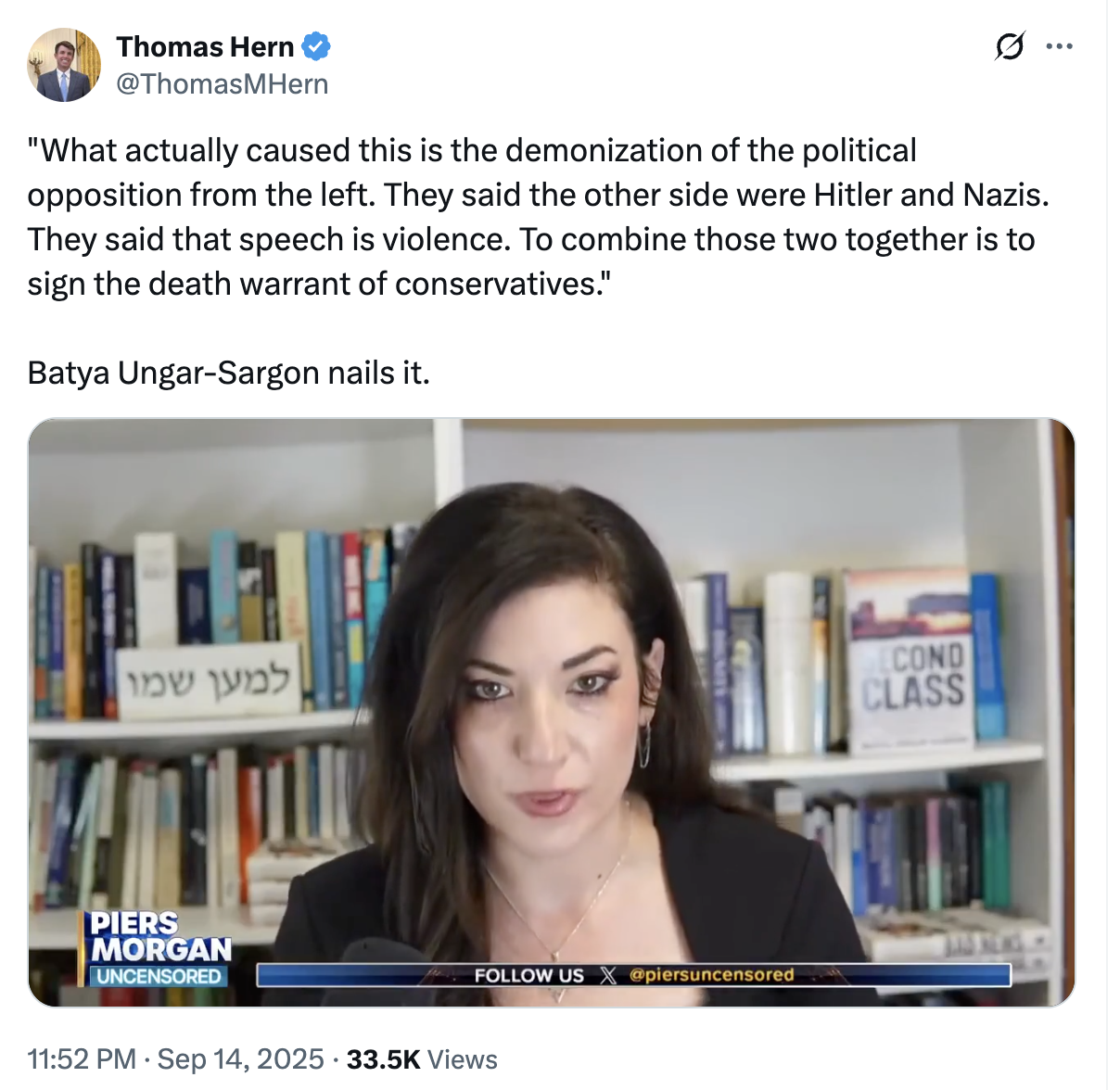
Yes, there are people on blue sky advocating for violence, but what actually caused this was the utterly quotidian, utterly ubiquitous demonization of the political opposition from the left, and it has just led to violence because they said the other side were Hitler and Nazis. They said that speech is violence. To combine those two things together is to sign the death warrant of prominent conservatives, and that is what we are seeing again and again and again.

And it is utterly facetious to suggest that there is any comparison between political violence on both sides. Every example they bring is not actually showing that, whether it's Governor Shapiro whose attempted assassination was from a free, Palestine leftist, or whether it was the Minnesota assassinations, which were from somebody who said he was operating at the behest of Democrat Governor Tim Walz. There is a culture among Democrats at the highest level to suggest that their political opposition are a danger, and that suggests that their lives are forfeit.

And I want to come together. I do. I love what Shanks said. It brought tears to my eyes. I reached for a tissue while you were playing Charlie's words. But at the same time, we cannot unite with people who are lying to our faces about who we are, who will not take responsibility for the fact that they suggested that we are Nazis because of totally legitimate views that reflect the majority of Americans.

So what I say is, let the left say we were wrong. It is legitimate to vote for Donald Trump. It is legitimate to be pro life. It is legitimate to believe that there are only two genders, and we were wrong to suggest that that was not the case. We were wrong to say that that is hateful. When they say that, I am waiting with open arms to take down the temperature.

Continue ReadingBatya Ungar-Sargon: The Political Left Intentionally Cultivate Real Life Violence

Our Class Problem. The Populism Problem of the Super-Rich

Ed Dowd, former BlackRock fund manager.

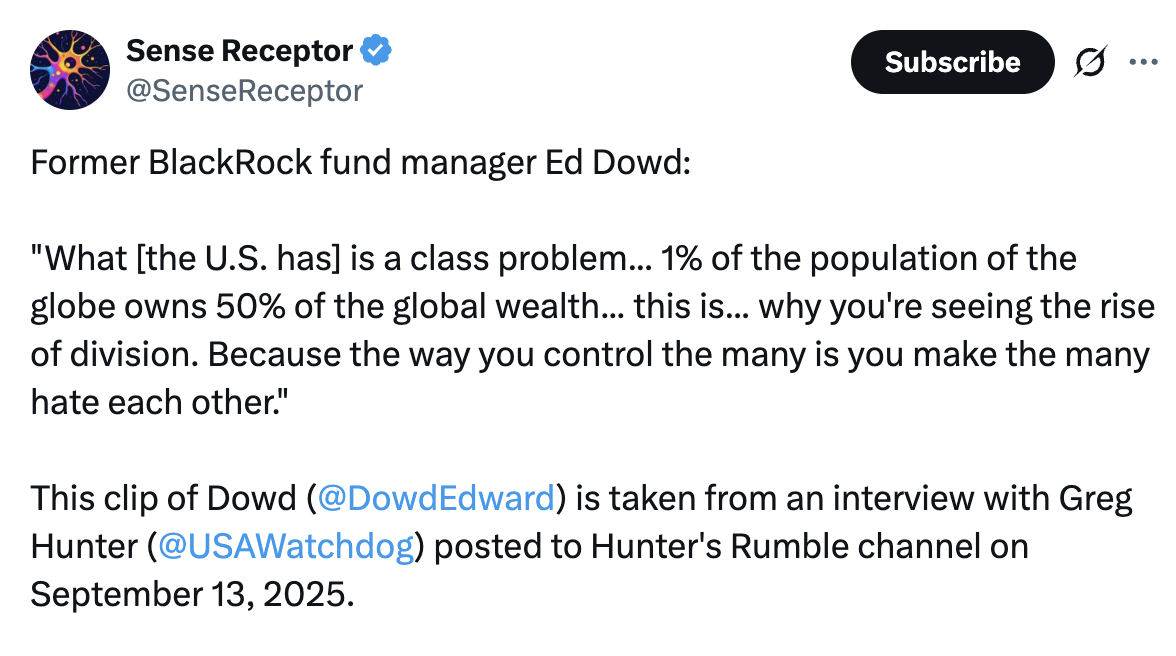
"What [the U.S. has] is a class problem... 1% of the population of the globe owns 50% of the global wealth... this is... why you're seeing the rise of division. Because the way you control the many is you make the many hate each other."

"What we have in this country is a class problem. We have, you know, 1% of global wealth is the 1% of the population of the globe owns 50% of the global wealth. So this is a class issue. It's been going on for a long time, since the great financial crisis and since 2000. And we have, And this is not just a US Problem. This is a global problem.

"And when we get to these types of situations they're cured one of two ways. The elites pay an existential price and or the system collapses and they're forced to share the wealth again. So this is how it's done.

"I'm not suggesting it's imminent, but this is why you're seeing the rise of populism, and this is also why you're seeing the rise of division. Because, the way you control the many is you make the many hate each other. You make the pitchfork guy look at the torch guy and say, hey, the torch guys are trying to take our pitchforks. And that's what's going on today. We got all this finger pointing. This is a class issue. It's not a black, white, Hispanic, left, right, Muslim. This is a class issue."

Continue ReadingOur Class Problem. The Populism Problem of the Super-Rich

The Words that Cultivate Free Speech

Samual Abrams:

“It’s a free country” signals that disagreement is permissible. “Everyone’s entitled to their own opinion” acknowledges dignity in dissent. “Sticks and stones” reminds us to meet speech with speech, not violence or censorship. Without such reminders, the civic muscle memory that protects a free society begins to atrophy. That last idiom in the table — “Address the argument, not the person” — may be the most telling of all. Only 30% of Americans even recognize it, and barely 1 in 10 say it often.

This absence shows up everywhere: in the pile-ons of cancel culture, the readiness to attack a person’s character rather than engage their reasoning and in why viewpoint diversity is so hard to come by on many college campuses. If you never learn the habit of separating people from their ideas, disagreement becomes personal and dissenters become enemies to be silenced.

And in their place? New slogans, often adversarial and absolutist. We hear “words are violence” or “speech is harm” far more than “defend to the death your right to say it.” The FIRE/NORC survey found that a quarter of Americans now say the “words are violence” framing describes their own view “mostly” or “completely.”

Samuel J. Abrams is professor of politics at Sarah Lawrence College and a senior fellow at the American Enterprise Institute.

Continue ReadingThe Words that Cultivate Free Speech