Tesla Camera Did its Job Well

Last week I was in an accident while driving my 2025 Tesla Model 3 with FSD (supervised self-driving). I was in a right-side left-turn lane at an intersection when a big Chevy pickup in the mandatory left turn lane to my left went straight. He came into my path. My car saw him and tried to avoid the collision by swerving right, but he scraped up my side, ripping off my driver-side mirror. Then the other driver fled the scene.

I had configured the Tesla to save footage whenever I honk, which I did immediately. I reviewed the video, got the truck’s license plate, and reported it to the police. I also gave the footage to my insurance company. They identified the other driver and his insurer, and his company is now paying for all of my damage — approaching $9,000.

That wasn’t the only incident that the Tesla helped me with. About eight months ago, the same car saved me from being in an accident. A vehicle coming from behind on the left started entering my lane. The Tesla swerved right onto the shoulder and avoided what would certainly have been a sideswipe crash. Its cameras instantly saw that car coming from behind and to my left.

I bought my Model 3 last year for $36,000. It has eight cameras, so it can see dangerous things surrounding the car, including behind and to both sides, while a human can only look in one direction at a time. Statistics currently show that FSD is nine times safer than human drivers, and you can see why after just a little time in the car. It’s also loaded with dozens of other useful high-tech and safety features.

It’s also economical. One day last week I drove 139 miles and it cost only $4 for the electricity. Gasoline would have been about $19.One last thing: I asked Grok how many hit-and-run accidents there are in the city of St. Louis each year. Out of 12,000 car collisions in St. Louis city each year, 5,000 of them are hit-and-runs.
Continue ReadingTesla Camera Did its Job Well

Data-Driven Portrait of Wokeness

I've followed psychologist Steve Stewart-Williams for years and really enjoy his rigorous scientific analysis of many aspects of the world. He recently posted: "12 Things Everyone Should Know About Wokeness: A data-driven look at the rise, effects, and psychology of one of the major cultural movements of our time." Many of his conclusions about wokeness, but not all, seem to be true to those of us who simply are watching what's going on around us. You've got the link to his article now and I would highly recommend reading the details, but I will give you the titles to though sections of his article on wokeness:

1. The woke worldview is associated with depression and anxiety

2. Women are more woke than men

3. Younger people are more woke than older ones

4. Many people pretend to be more woke than they are

5. Safe-space culture may function as reverse CBT (Cognitive Behavioral Therapy)

6. Many woke views are inaccurate

7. Woke people underestimate minority success

8. Woke ideas may foster dislike of majorities rather than concern for minorities

9. The woke may secretly look down on those they see as oppressed

10. Many interventions favored by the woke don’t work

11. Wokeness took off in the 2010s

12. We may have hit “peak woke” - or maybe not

Continue ReadingData-Driven Portrait of Wokeness

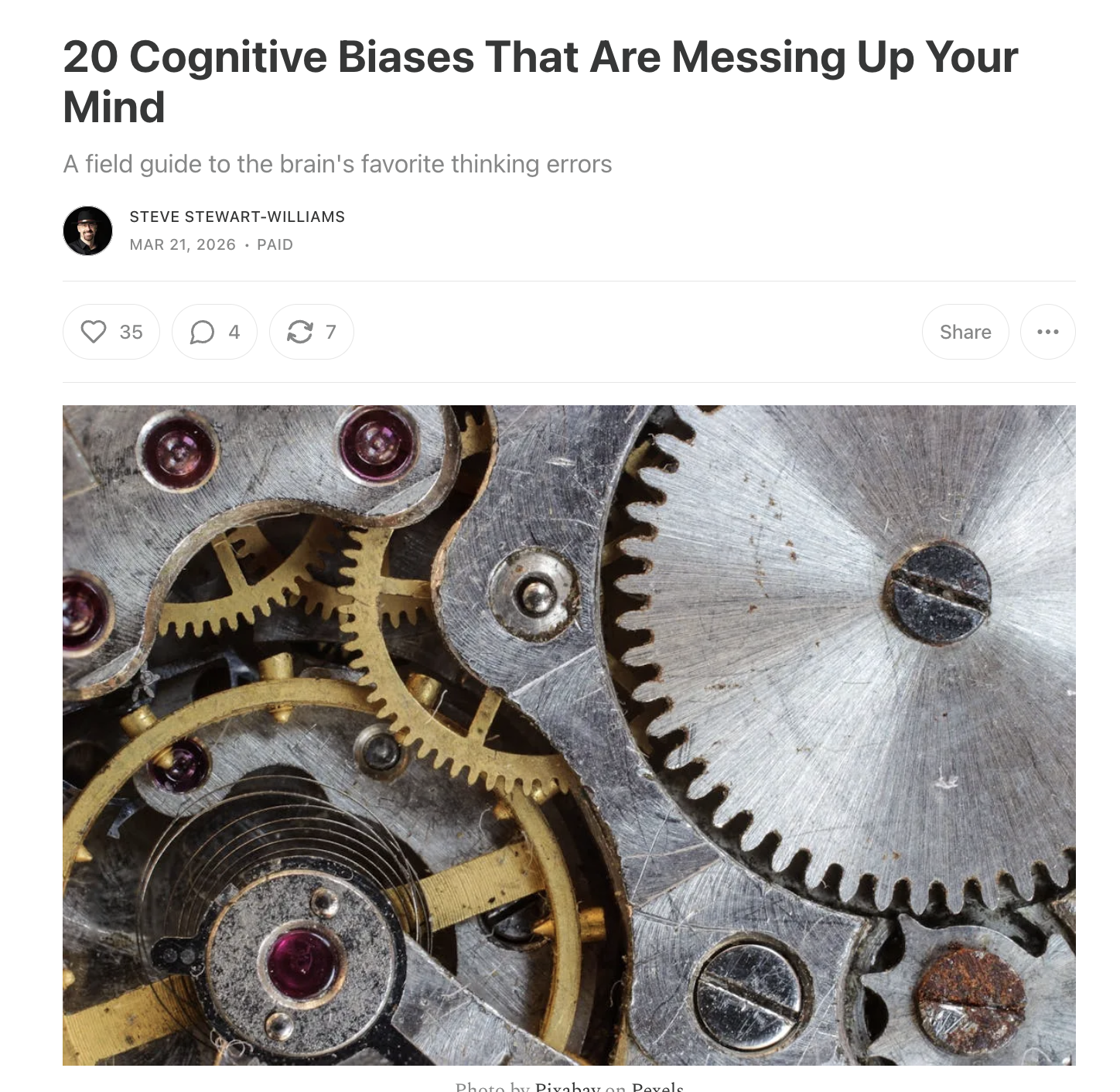
20 Human Cognitive Biases Explained by Steve Stewart Williams

Excellent summary of 20 cognitive biases by psychologist Steve Stewart-Williams.  His Intro:

The human mind is a remarkable piece of biological engineering. It’s capable of an astonishing range of feats like inventing calculus, composing rock operas, and putting spacecraft on other planets. But it’s also capable of an equally astonishing range of predictable reasoning errors. Psychologists call these cognitive biases, and they’re as common as the common cold.

In this post, I’ll outline 20 major biases that distort our judgments about evidence, ourselves, and the world. Once you learn about them, you’ll start seeing them everywhere: in politics, in the news, on social media - and occasionally even in your own thinking. (Mostly, though, in other people’s.)

Continue Reading20 Human Cognitive Biases Explained by Steve Stewart Williams

Sons’ DNA Found in Mothers’ Brains

Amazing!

Anish Moonka:

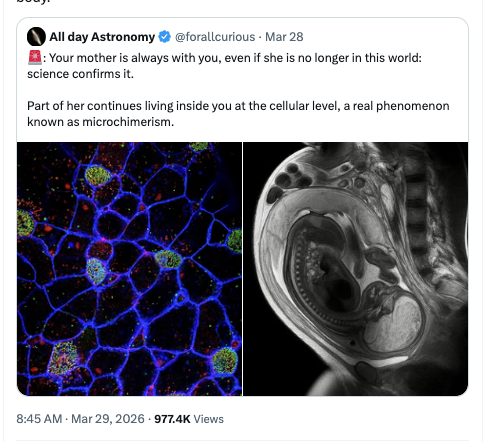
You have your mother's cells in your brain right now. If she ever carried you, yours are in hers. Scientists looked at the brains of 59 women after they died, ages 32 to 101. In 63% of them, they found their sons' DNA scattered across different brain regions. The cells had traveled from the womb, through the blood, past the wall that normally keeps foreign material out of the brain, and settled in. The oldest woman still carrying her son's cells in her brain was 94. In mice, those cells became functional brain cells. The transfer starts as early as 7 weeks into pregnancy. Your cells slip through the placenta into your mother's body. Hers slips into yours. One study found a mother still had her son's cells in her blood 27 years after giving birth. After delivery, between 50 and 75% of women carry their child's cells. During pregnancy, up to 6% of a woman's blood DNA comes from the baby.

Continue ReadingSons’ DNA Found in Mothers’ Brains