The Sorry State of Scientific Literature

It is surreal to read these quotes about the unreliability of science publications by people in a good position to evaluate this dysfunction.

“The case against science is straightforward: much of the scientific literature, perhaps half, may simply be untrue. Science has taken a turn toward darkness.”

-Richard Horton, former Editor-in-Chief of The Lancet (the world’s premier medical journal) [

Richard Horton, the editor-in-chief of The Lancet, wrote this statement in a comment titled "Offline: What is medicine's 5 sigma?" published in the journal on April 11, 2015.]

--

"Why Most Published Research Findings Are False" (2006)

John P. A. Ioannidis

There is increasing concern that most current published research findings are false. The probability that a research claim is true may depend on study power and bias, the number of other studies on the same question, and, importantly, the ratio of true to no relationships among the relationships probed in each scientific field. In this framework, a research finding is less likely to be true when the studies conducted in a field are smaller; when effect sizes are smaller; when there is a greater number and lesser preselection of tested relationships; where there is greater flexibility in designs, definitions, outcomes, and analytical modes; when there is greater financial and other interest and prejudice; and when more teams are involved in a scientific field in chase of statistical significance. Simulations show that for most study designs and settings, it is more likely for a research claim to be false than true. Moreover, for many current scientific fields, claimed research findings may often be simply accurate measures of the prevailing bias. In this essay, I discuss the implications of these problems for the conduct and interpretation of research.

--

Karl Kanthak posts this:

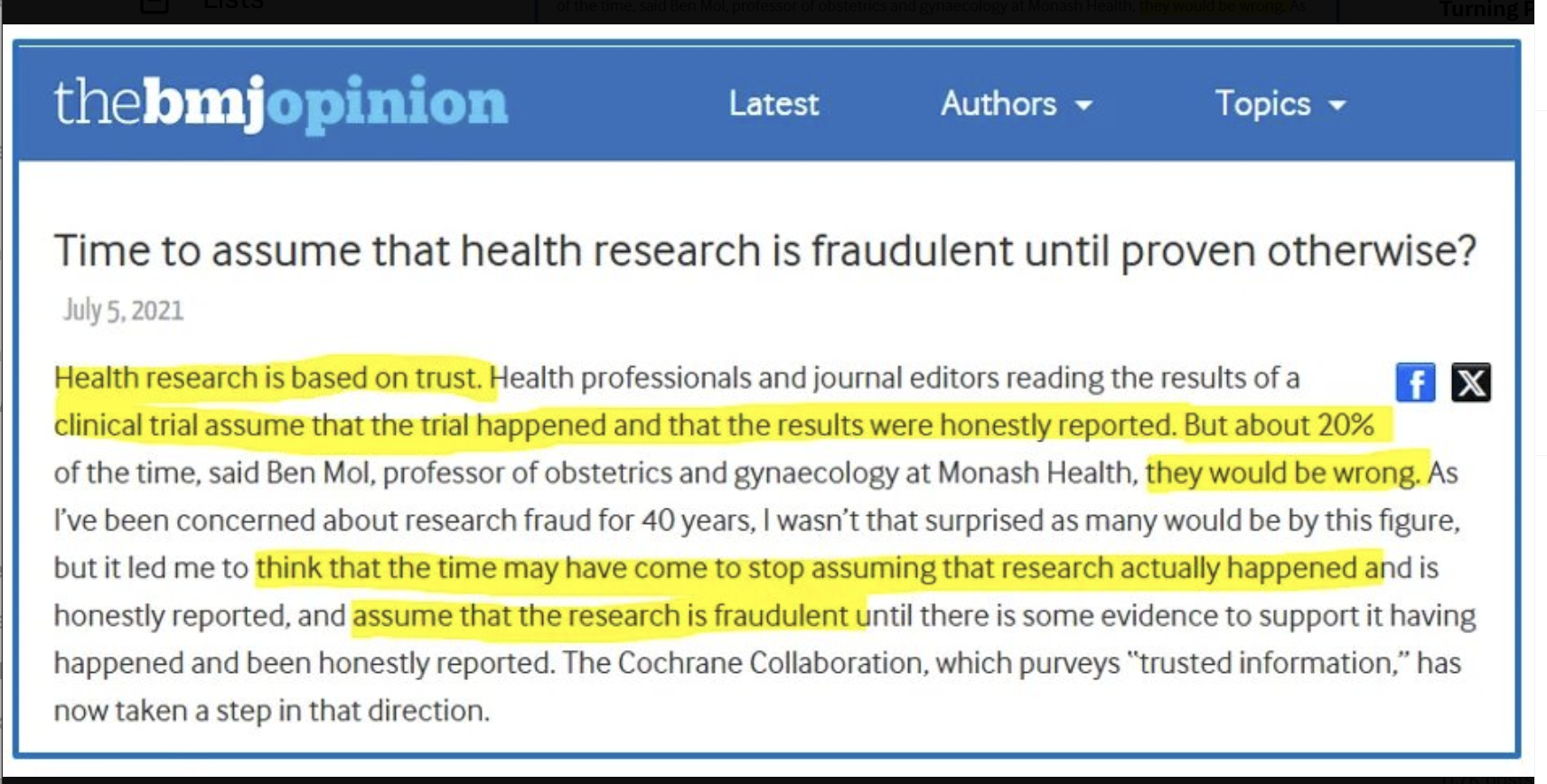
“Health research is based on trust. Health professionals and journal editors reading the results of a clinical trial assume that the trial happened and that the results were honestly reported. But about 20% of the time, said Ben Mol, professor of obstetrics and gynaecology at Monash Health, they would be wrong.”

--

Post by InsiderHCW:

It is simply no longer possible to believe much of the clinical research that is published, or to rely on the judgement of trusted physicians or authoritative medical guidelines. I take no pleasure in this conclusion.
- Marcia Angell, Editor, New England Journal of Medicine. [Marcia Angell wrote this statement in her article "Drug Companies & Doctors: A Story of Corruption," published in The New York Review of Books on January 15, 2009].

--

So how do we know who to trust, in science, media, politics, or anywhere else that people claim that they are experts and that we need to trust them? It makes one almost this cynical . . .

Continue ReadingThe Sorry State of Scientific Literature

Nicolas Hulscher Discusses the Journal Cartel

Is there a journal cartel? Nicolas Hulscher says yes and claims it is rife with corruption in this post on X:

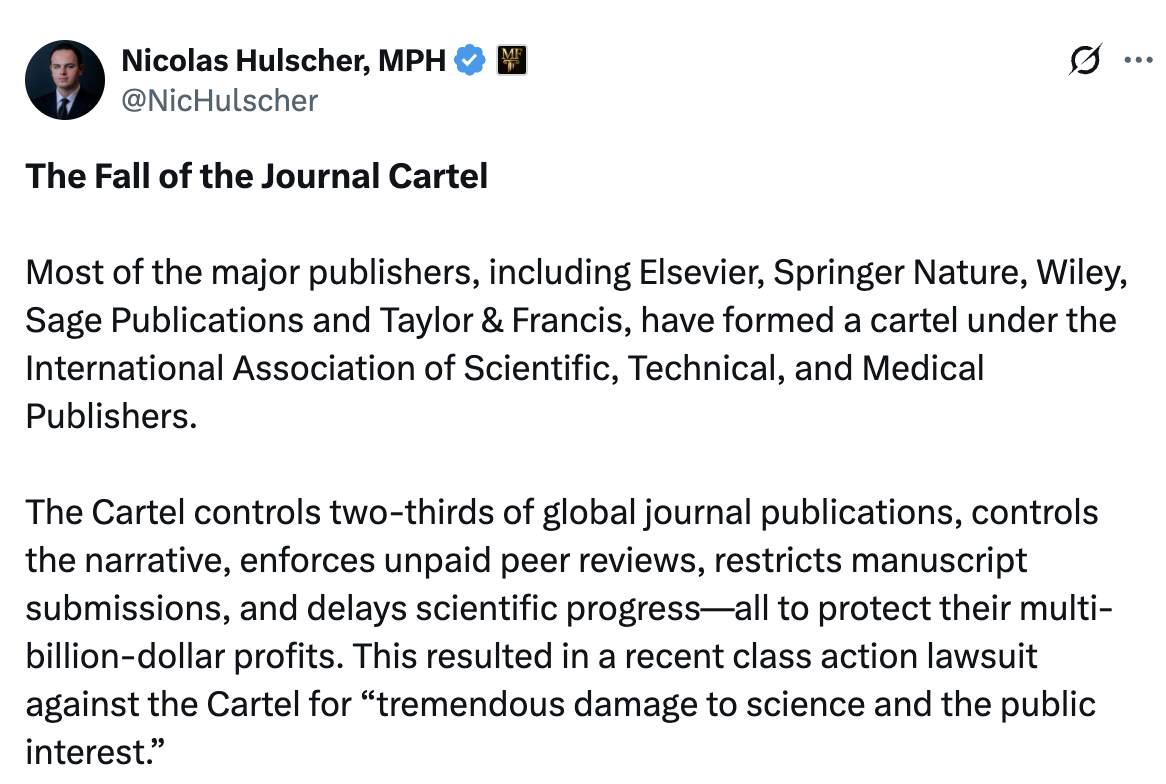
The Fall of the Journal Cartel

Most of the major publishers, including Elsevier, Springer Nature, Wiley, Sage Publications and Taylor & Francis, have formed a cartel under the International Association of Scientific, Technical, and Medical Publishers.

The Cartel controls two-thirds of global journal publications, controls the narrative, enforces unpaid peer reviews, restricts manuscript submissions, and delays scientific progress—all to protect their multi-billion-dollar profits. This resulted in a recent class action lawsuit against the Cartel for “tremendous damage to science and the public interest.”

Nearly half of medical journal editors have financial conflicts of interest with pharmaceutical companies. Moreover, 59% of peer-reviewers for major medical journals received more than $1 billion from drug companies from 2020 to 2022.

The widespread corruption embedded within the nearly closed system of the Journal Cartel operates in a way that resembles a high-entropy state, as described by the second law of thermodynamics.

According to this principle, isolated systems naturally progress toward greater disorder, a state of entropy that ultimately becomes unsustainable and leads to system collapse.

In the case of the academic publishing industry, the compounded effects of internal corruption, lack of transparency, unethical censorship, and growing public awareness act as catalysts, pushing the system toward inevitable instability. Consequently, unless radical structural reforms are introduced, the Journal Cartel will face eventual collapse under the weight of its own entropy.

The Cartel’s unsustainable global monopoly on science will fall in due time, in accordance with natural laws. Until then, we can and will continue to battle against them and publish with journals outside the Cartel’s influence in our best attempt to advance scientific knowledge and protect public health.

Truth always prevails in the end.

Continue ReadingNicolas Hulscher Discusses the Journal Cartel

Does Treatment for People Who Claim to be Transgender Reduce Suicides?

?Would you rather have a live daughter or a dead son? Transgender activists would ask this question to incentivize parents to provide "gender affirming care" to their sexually confused children.

But is it true that medical interventions reduce the number of suicides?

Consider this excerpt from "ACLU Attorney Confesses: Transgender-Suicide Claim is a Myth." Arguing before the Supreme Court, the ACLU's Chase Strangio concedes that suicide is “thankfully and admittedly rare” among transgender-identifying people:

Unfortunately for Strangio, Justice Alito had done his homework. Citing the U.K.’s Cass Review, Alito observed that “there is no evidence that gender-affirmative treatments reduce suicide.”

Then came Strangio’s remarkable concession:

MR. STRANGIO: What I think that is referring to is there is no evidence in some—in the studies that this treatment reduces completed suicide. And the reason for that is completed suicide, thankfully and admittedly, is rare and we’re talking about a very small population of individuals with studies that don’t necessarily have completed suicides within them.

However, there are multiple studies, long-term longitudinal studies that do show that there is a reduction in—in suicidality . . .

Here, the ACLU’s star attorney on trans issues seems to be at odds with Solicitor General Prelogar, who had said that the “rates” of “suicide” among gender-dysphoric youth were “striking.” Strangio admits, under oath, that suicide is actually “rare,” and that the research purporting to demonstrate benefits from hormones concerns suicidality, not suicide. Strangio’s use of “admittedly” is also striking, as it suggests the attorney is aware that claims about suicide prevention through sex “change” are false.

Continue ReadingDoes Treatment for People Who Claim to be Transgender Reduce Suicides?

About the Creation of the Peer Review Process

Eric Weinstein: "If you screwed up covid this badly by getting inside of the Lancet and Nature. Peer review is this fake thing that supposedly stretches back to the founding of the Royal Society. And it's very clear from the scholarship around it that it comes out of the period between 1965 and 1975 initiated by the Medicare Act, predicated on the need for editors for the journal expansion, founded by Pergamon Press and Robert Maxwell. By 1975 there's a giant battle between the [National Science Foundation] NSF and both fiscal and cultural conservatives against something called “Man: A Course of Study” (MACOS), where peer review was born in a Utah clinic. [It] came out of the medical literature because the federal government in 1965 with The Medicare Act picked up the need to pay for so many medical procedures. They wanted to say "Why are we assigning this many medical procedures?" The doctors circled the wagons and said, "We will peer review each other." Then in night, by 1975 the NSF was under the microscope, and they used peer review as a self defense of last resort to say we will be reviewing each other, right? Peer review is a myth."

Continue ReadingAbout the Creation of the Peer Review Process