
Eli Steele is Over it

Eli Steele (son of Shelby Steele) is "over it":

We are over black power

We are over white guilt

We are over white privilege

We are over respectability politics

We are over white fragility

We are over white-adjacent

We are over inclusivity/belonging

We are over BIPOC

We are over victimhood

We are over oppressor vs. oppressed

We are over cancel culture

We are over antisemitism

We are over cultural appropriation

We are over systemic racism

We are over Black Lives Matter

We are over DEI

We are over systems of oppression

We are over reparations

We are over Uncle Tom

We are over performative allyship

We are over ideology

We are individuals.

Who is Eli Steele?

[From Grok] Eli Steele is an award-winning American filmmaker, writer, and commentator known for his documentaries that critically examine race, identity, and social issues in the United States. Born around 1974, he is Black, Jewish, and deaf (relying on cochlear implants and lip-reading), and he lives in Los Angeles with his two children. He is the son of Shelby Steele, a prominent Black conservative author and senior fellow at the Hoover Institution, with whom Eli has frequently collaborated on projects.Background and HeritageSteele's family history reflects resilience and diverse experiences: his paternal great-grandfather was born into American slavery, while his maternal grandmother escaped Nazi persecution in Europe before returning to rescue her family. These roots inform his perspective on identity and freedom, often framing his work around themes of individual agency over group-based ideologies.

I'm not over the modern versions of these things because I immediately recognized these things to be the grifts they are, performative grabs for money and power.

Continue ReadingEli Steele is Over it

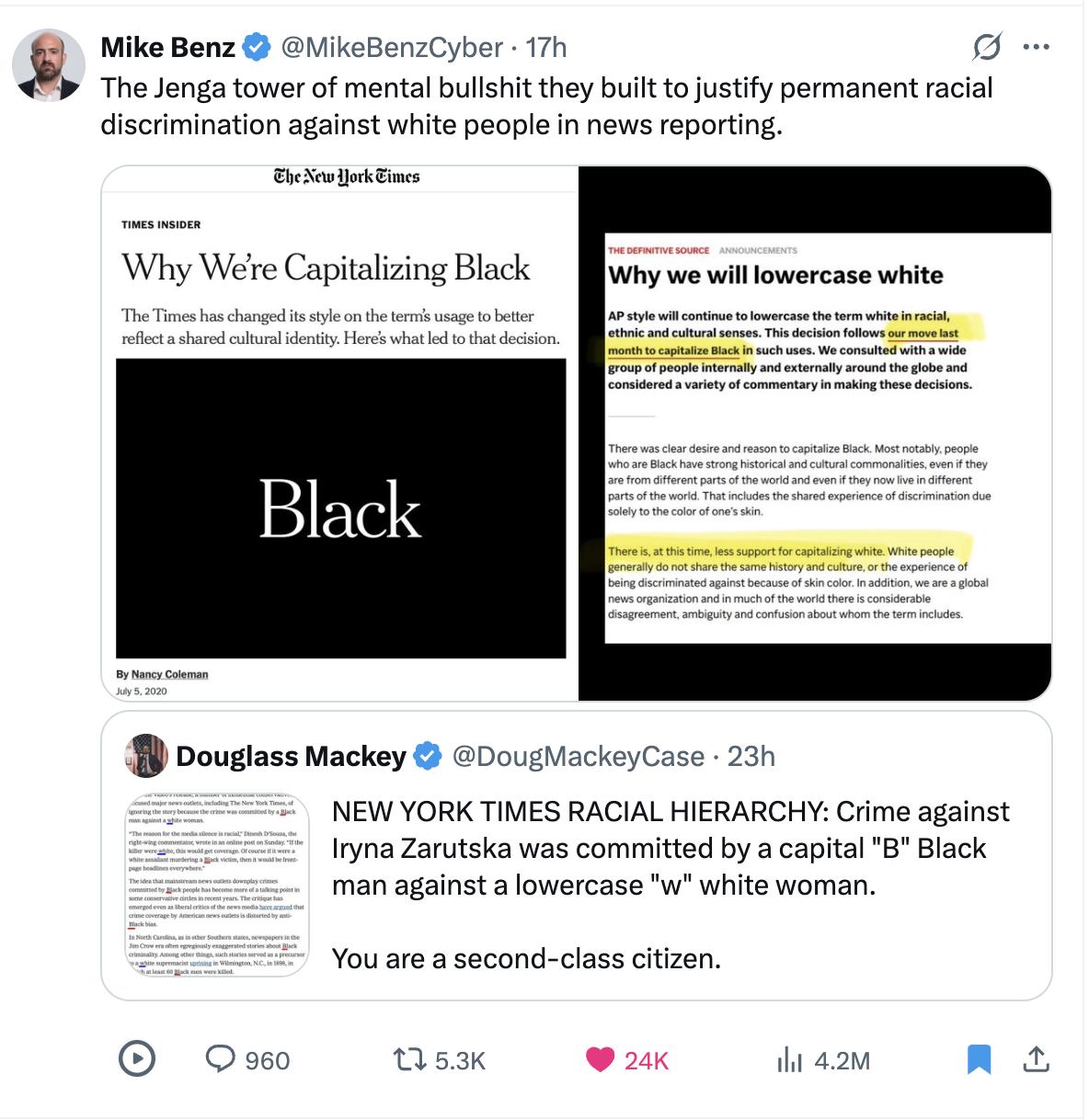
Capitalizing on Race

I'll start with this post by Mike Benz:

If one really wanted to diminish the importance of "race," one would not capitalize only one "race" but not others. But this is a minor skirmish. As I've written before, the very concept of "race" is a grift; the usage of the concept of "race" has never enhanced human flourishing. It only pits us against one another. It's time for all of us to wake up and abolish the use of "race." We can talk about each other perfectly well without use of the term "race," which, at best, serves as a proxy for other things.

Sheena Mason argues that "race" is not biologically real—she points to evidence showing extensive human migration and mixing, where traits like skin color do not reliably correlate with ancestry (e.g., two dark-skinned South Africans can be more genetically divergent than one is from a light-skinned Swede).

She argues that "race" serves to perpetuate racism, a hierarchical system that disguises itself as innate differences. She critiques both "anti-racist resistance" (which centers race in analysis, as seen in thinkers like Ibram X. Kendi) and "color-blindness" (which ignores race but still treats it as real) for inadvertently reinforcing racial categories.

For Mason, undoing racism requires dismantling the belief in race altogether. A central tool in her approach is the "racelessness translator," which "translates" race-based language into non-racial terms to reveal underlying issues (e.g., reframing "racial disparities in policy effects" as class-based inequities).

There is no such thing as "race," even though racism can still be found. There are people who will nevertheless assure us that "race" is a meaningful term and who discriminate against those of a particular "race." They should be prosecuted under civil rights laws. It's time for the rest of us to move on.

For more, see my previous post, "Race is like Astrology."

Continue ReadingCapitalizing on Race

The Complex Story of Slavery and Abolition

Next time someone tells you the simple story of slavery, suggest that they read this article by myth-buster Edward Campbell. The title: "The West Didn’t Invent Slavery: But It Fought to End It: Abolition and the birth of moral restraint."  Here's an excerpt:

Slavery was the norm for over 5,000 years. Abolition was the rupture.

In this essay, I challenge the comforting myth that history bends naturally toward justice. Instead, I trace the global story of slavery and argue that the real anomaly wasn’t oppression—it was restraint. The West didn’t invent slavery, but parts of it did something almost no civilization had done before: use power to end it.

Featuring the West Africa Squadron, the Haitian Revolution, and moral crusaders from Wilberforce to Tubman—this is a story about conscience, power, and the rare moments when they align.

Slavery is as old as civilization—dating back over 5,000 years. It was present in the earliest empires of Mesopotamia, Egypt, and China. For millennia, it was accepted as natural, necessary—even sacred. Every society practiced it; few questioned it. From pharaohs to emperors, slavery was a pillar of power. v Then—within barely a century—it virtually vanished from the earth. This essay is about the exception that proved the rule.

Slavery was the norm. Abolition was the rupture.

Continue ReadingThe Complex Story of Slavery and Abolition

Status and Power Seeking on the Backs of the Unfortunate

The elites portray themselves as good-doers. The could be some of that, of course, but there is a Machiavellian side to such displays too. Rob Henderson explains:

Elite overproduction happens when a society produces too many people who believe they deserve high status. To get there, they often try to align themselves with genuinely marginalized groups in order to unseat the current elites and replace them. A lot of the time, when you hear someone loudly criticizing elites, what you’re really hearing is an audition to join them—an attempt to co-opt the suffering of people who are actually mistreated.

Even if someone has never personally experienced hardship, they can point to history or to the struggles of people who share their traits and say: they suffered, I’m like them, therefore you should give me power. That might mean a spot at a university, a job at a prestigious firm, or some other coveted position.

What’s interesting is how this shift away from individualism and toward group identity makes it possible for someone who’s only ever known affluence and comfort to be rewarded, so long as they share something in common with a historically marginalized group. Meanwhile, the people who really have been mistreated may get nothing. And yet people seem surprisingly willing to go along with it.

Continue ReadingStatus and Power Seeking on the Backs of the Unfortunate

The Culture Wars Are Not Organic

The culture wars are not organic. They were inflicted on us in a systematic way by powerful monied elites who simultaneously and systematically censored dissent to the official narratives. They did this to distract us and pit us against each other, as Dave Smith explains:

Dave Smith:

Go track how many times the word racism was mentioned. Around 2012 it shoots up. "Social justice" shoots up. Transgenderism shoots up, white privilege shoots up. This was forced on the American people. Why are we having these conversations now? The people did not wake up one day and decide we want to have a national conversation about chicks with dicks. That didn't happen. This wasn't an organic movement.

It was all of the most powerful people decided this is what we're going to talk about. And why was that? Look, when you're failing on policy, you pivot to a culture war. You pit people against each other, so they're fighting each other. We had in this country, we had an Occupy Wall Street movement where leftists were standing outside of big banks, screaming, we are the 99% right wingers had a populist movement called the Tea Party, where they were outraged about the bailouts of big banks, unsustainable debt, government spending. They all like that. That's not what the powers that be like. Look, they like you fighting about issues like abortion. Now, I'm not saying abortion isn't a very important issue. It's a very important issue. But us fighting about that issue doesn't scare anyone at the Federal Reserve. It doesn't scare anyone in the CIA. They don't care if you fight about that issue. They love you fighting over transgender bathrooms.

Continue ReadingThe Culture Wars Are Not Organic