New Evidence Regarding COVID Lab Leak Possibility Puts More Light on Partisan Faultline

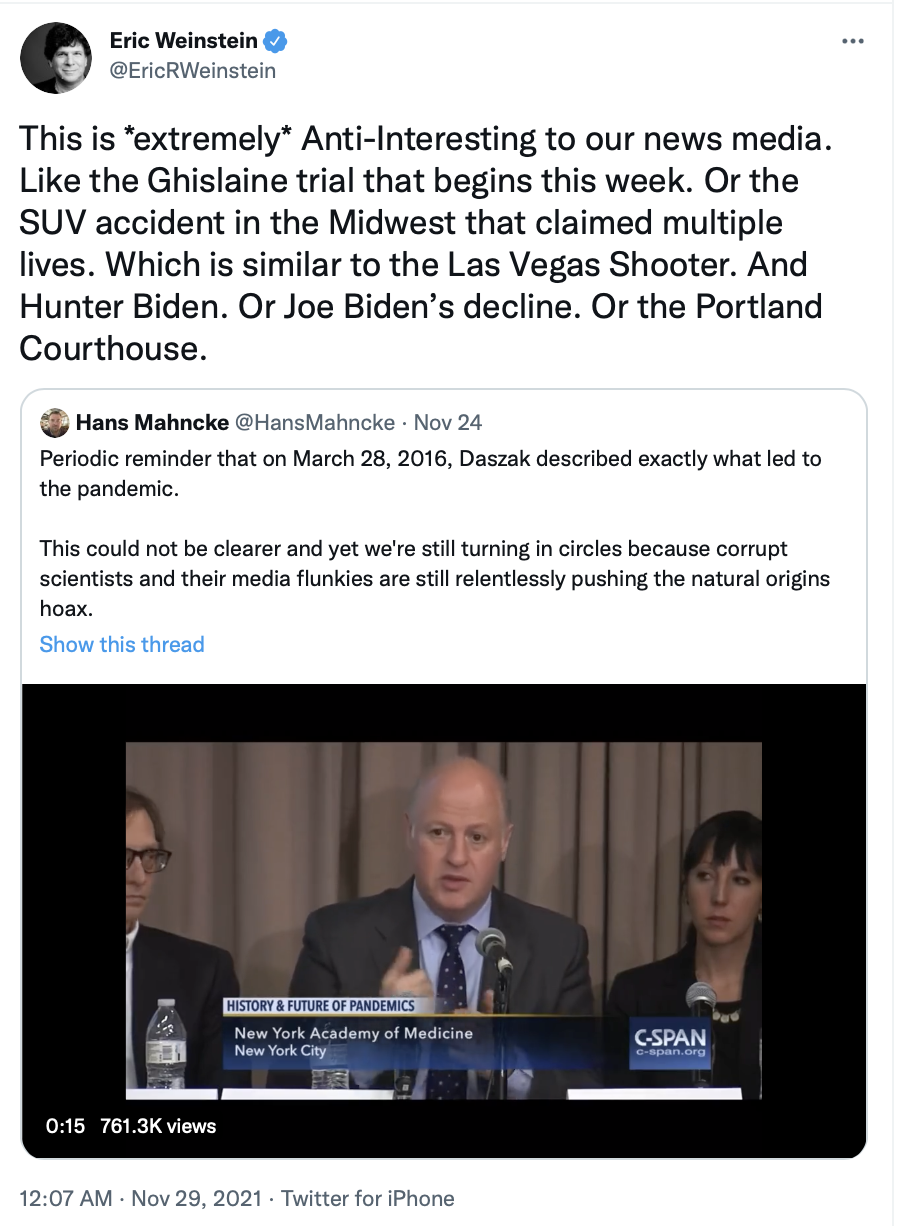
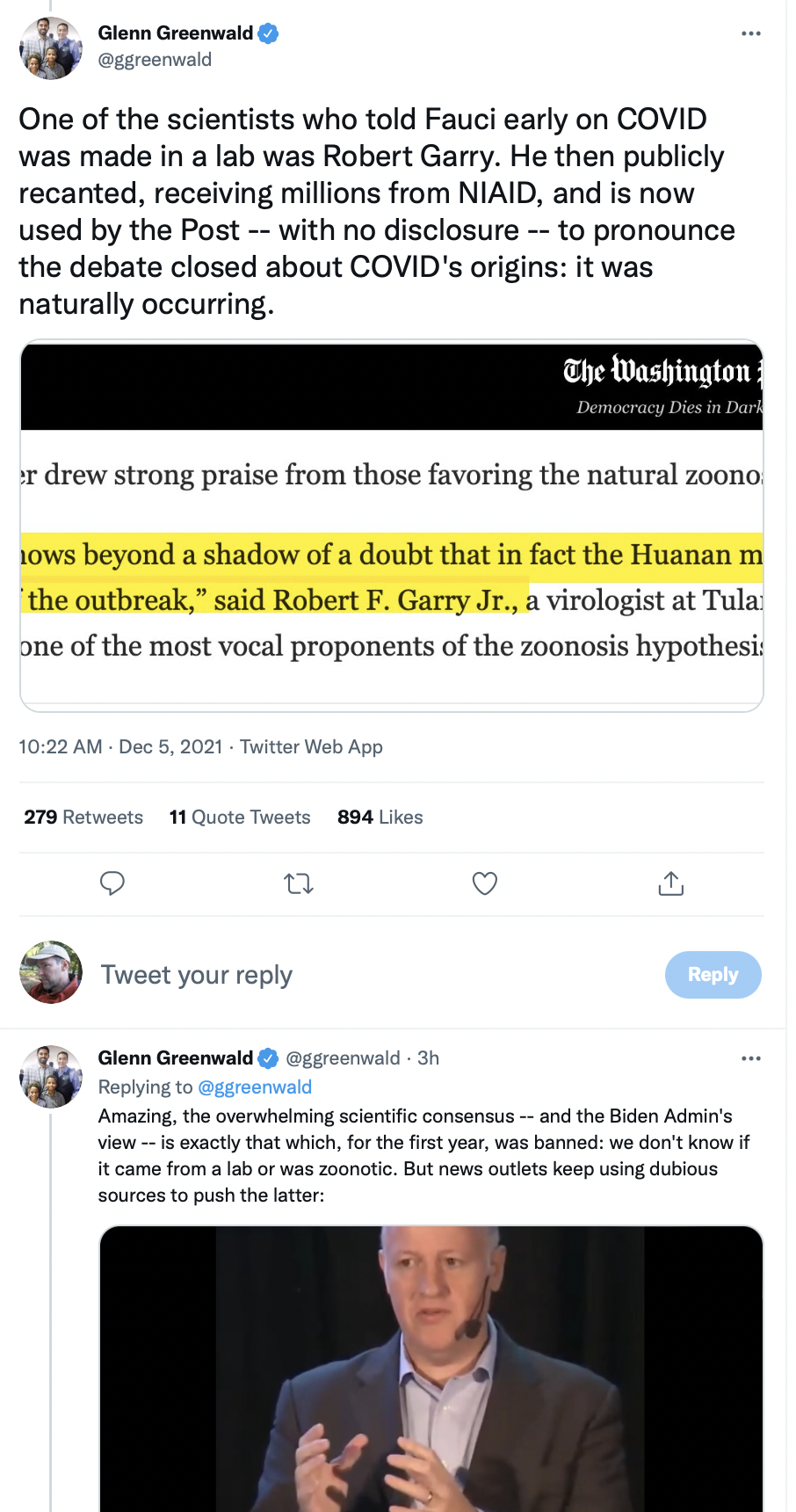
I don't claim to know the ultimate answer, but this new willingness to look at the evidence reflects poorly on many scientists (including some with blatant conflicts of interest) and ultra-credible news outlets, including the NYT, which declared that the lab leak hypothesis was a conspiracy theory and even published an 05/26/2021 article by Apoorva Mandavilli, claiming that to even ask the question about lab leak origin was "racist."

Now we have a new book shedding light on this question, described at Reason in this article: "Was It a Lab Leak? The Mysterious Origin of COVID-19: Matt Ridley and Alina Chan, authors of the new book Viral: The Search for the Origin of COVID-19, say the preponderance of evidence now points toward a lab origin and genetic engineering." Here's an excerpt:

Ridley says that White House COVID-19 adviser Anthony Fauci's emails, which were made public through a Freedom of Information Act request, show that behind the scenes scientists were taking the lab-leak theory seriously all along.

"A number of leading virologists were talking to each other and were saying to each other, 'we think this might look a bit like a virus that's been engineered in the laboratory,'" says Ridley, referencing a January 31, 2020, email in which researcher Kristian G. Andersen says that "one has to look really closely at all the sequences to see that some of the features (potentially) look engineered." Fauci replies a day later, "Thanks, Kristian. Talk soon on the call."

"And at the end of that phone call, they all did a very rapid volte-face, and started writing articles almost immediately," says Ridley, referring to an influential article Andersen and his colleagues published in Nature on March 17, 2020, stating that "our analyses clearly show that SARS-CoV-2 is not a laboratory construct or a purposefully manipulated virus." On March 6, Andersen emailed Fauci to tell him the paper had been accepted for publication, to which Fauci replied, "Nice job on the paper."

From Plindia:

Two New York Times workers have confirmed to The Spectator on Monday that a top editor of the American daily newspaper had told employees early in the year 2020 when the world was just about starting to come to terms with the global pandemic that had been unleashed on it, that they should not probe or follow up the origins of the deadly and highly contagious virus.

The NYT journalist reportedly told Dominic Green, the deputy editor of the US edition of The Spectator: “In early 2020, I suggested to a senior editor at the paper that we investigate the origins of COVID-19. I was told it was dangerous to run a piece about the origins of the coronavirus. There was resistance to running anything that could suggest that [COVID-19 was manmade or had leaked accidentally from a lab].

Google and other social media outlets also drank the Koolaid and decided to shut down the conversation because they were so damned certain of the answer:

HBO host Bill Maher criticized social media and search engine companies for suppressing and blocking stories about the origins of the coronavirus over this past year, specifically the lab leak theory.

"Facebook banned any post for four months about COVID coming from a lab. Of course, now, even the Biden administration is looking into this," Maher said Friday during a panel discussion on his show Real Time.

Continue ReadingNew Evidence Regarding COVID Lab Leak Possibility Puts More Light on Partisan Faultline

Krystal and Saagar Offer Non-Partisan Discussion of COVID

I often look forward to hearing the nonparisan analysis of the news offered by Saagar and Krystal. On this episode they talk about COVID in ways you will not hear on left-leaning or right-leaning legacy news outlets. You'll hear their views on the segments re the TV show, "The View," and on Saagar's own segment. They love the vaccines but are opposed to mandates. They believe that masks should be optional. They shoot down the hyperbole that we are hearing from the right and the left and they are highly critical of Fauci's arbitrary targets. They offer some statistics that I hadn't heard before, e.g., children are more like to die of the flu than COVID, which means they should be back in school. They urge that it's time for America to move on, as many Americans are now doing.

Krystal and Saagar also offer a worrisome segment about Joe Biden's physical and political performance (they have applauded Biden's decision re Afghanistan, and I agree). If you are trapped in the FOX bubble or the NPR/NYT/WP bubble, I recommend that you listen to an episode of Breaking Points.

Continue ReadingKrystal and Saagar Offer Non-Partisan Discussion of COVID

Michael Shellenberger Discusses The Origins of San Francisco’s Homeless Problem with Joe Rogan

This is an excerpt from a much longer discussion. Michael Shellenberger is discussing San Francisco's homeless problem with Joe Rogan. One of his conclusions is the well-intentioned attitude by many liberals that all homeless people are purely victims and that they cannot be blamed for any of their behaviors, including their uses of dangerous drugs.

Continue ReadingMichael Shellenberger Discusses The Origins of San Francisco’s Homeless Problem with Joe Rogan

Walking Turbo-Charges Creativity

There is a significant connection between walking and creativity:

Oppezzo designed an elegant experiment. A group of Stanford students were asked to list as many creative uses for common objects as they could. A Frisbee, for example, can be used as a dog toy, but it can also be used as a hat, a plate, a bird bath, or a small shovel. The more novel uses a student listed, the higher the creativity score. Half the students sat for an hour before they were given their test. The others walked on a treadmill.

The results were staggering. Creativity scores improved by 60 percent after a walk.

A few years earlier, Michelle Voss, a University of Iowa psychology professor, studied the effects of walking on brain connectivity. She recruited 65 couch-potato volunteers aged 55 to 80 and imaged their brains in an MRI machine. For the next year, half of her volunteers took 40-minute walks three times a week. The other participants kept spending their days watching Golden Girls reruns (no judgment here; I love Dorothy and Blanche) and only participated in stretching exercises as a control. After a year, Voss put everyone back in the MRI machine and imaged their brains again. Not much had happened to the control group, but the walkers had significantly improved connectivity in regions of the brain understood to play an important role in our ability to think creatively.

Walking changes our brains, and it impacts not only creativity, but also memory."

Continue ReadingWalking Turbo-Charges Creativity