How the COVID Vaccine Works (Animation)
Watch this awesome animation to see how the COVID vaccines work.


Watch this awesome animation to see how the COVID vaccines work.
This is an excerpt from a much longer discussion. Michael Shellenberger is discussing San Francisco's homeless problem with Joe Rogan. One of his conclusions is the well-intentioned attitude by many liberals that all homeless people are purely victims and that they cannot be blamed for any of their behaviors, including their uses of dangerous drugs.
There is a significant connection between walking and creativity:
Oppezzo designed an elegant experiment. A group of Stanford students were asked to list as many creative uses for common objects as they could. A Frisbee, for example, can be used as a dog toy, but it can also be used as a hat, a plate, a bird bath, or a small shovel. The more novel uses a student listed, the higher the creativity score. Half the students sat for an hour before they were given their test. The others walked on a treadmill.The results were staggering. Creativity scores improved by 60 percent after a walk.
A few years earlier, Michelle Voss, a University of Iowa psychology professor, studied the effects of walking on brain connectivity. She recruited 65 couch-potato volunteers aged 55 to 80 and imaged their brains in an MRI machine. For the next year, half of her volunteers took 40-minute walks three times a week. The other participants kept spending their days watching Golden Girls reruns (no judgment here; I love Dorothy and Blanche) and only participated in stretching exercises as a control. After a year, Voss put everyone back in the MRI machine and imaged their brains again. Not much had happened to the control group, but the walkers had significantly improved connectivity in regions of the brain understood to play an important role in our ability to think creatively.
Walking changes our brains, and it impacts not only creativity, but also memory."
I used to weigh 30 pounds more than I currently weigh. My secret is that I avoided most refined carbs, ate less overall and exercised more. One of the prime reasons I lost the weight was a concern with diabetes. This study should give hope to many other people concerned with diabetes. It was sent to me by a friend who decided to take control of his weight, losing 50 pounds early in the pandemic. The title: "Nutritional basis of type 2 diabetes remission."
Type 2 diabetes mellitus was once thought to be irreversible and progressive, but a series of clinical studies over the past 12 years have clarified the mechanisms that cause the disease. We now know that the processes that cause type 2 diabetes can be returned to normal functioning by restriction of food energy to achieve weight loss of around 15 kg.1 Around half of people who are within the first 10 years of diagnosis and manage to follow food energy restriction can stop all diabetes medication and return to non-diabetic glucose control.23 Remission is achieved when haemoglobin A1c concentrations of 48 mmol/mol are recorded after weight loss and at least six months later without any anti-diabetic medications (box 1).4 Here we summarise the new understanding of type 2 diabetes and consider how different changes to food intake can achieve the necessary weight loss and maintenance required for remission of diabetes.
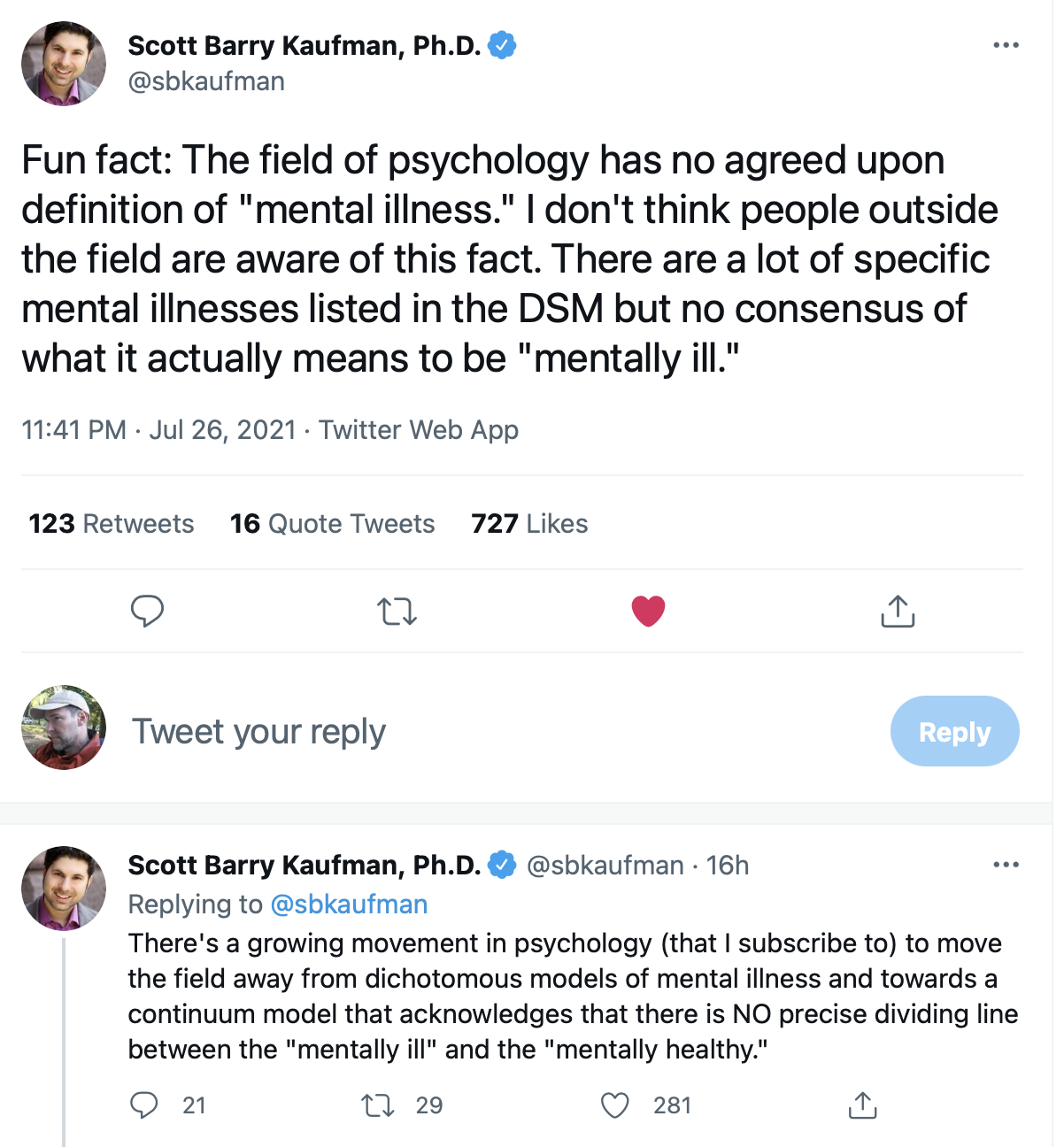 Fascinating. So what is it, at bottom, to call someone "mentally ill? Is it essentially name calling? We are surrounded highly functional people who periodically and temporarily seem highly dysfunctional in specific ways. We have been cobbled together by natural selection, living Rube Goldberg machines, we are also equipped with sophisticated built-in PR departments that make it seem like we are more purposeful, more functional than we actually are. Further, Randolph Nesse has made a strong case that many "mental illnesses" are adaptive. What does it help use a global stamp of "mentally ill"?
Here's an excerpt from Nesse's 2020 book, Good Reasons for Bad Feelings:
The question “What is a mental disorder? ”has been addressed by Jerome Wakefield, a social worker, clinician, researcher, and philosopher at New York University. His pithy conclusion is that mental disorders are characterized by “harmful dysfunction.”“Dysfunction”means a malfunction in a useful system shaped by natural selection. “Harmful”means that the dysfunction causes suffering or other harm to the individual. Wakefield’s analysis grounds psychiatric diagnosis in an evolutionary understanding of the normal functions of brain/mind, the same way the rest of medicine understands pathology in the context of normal physiology. His cogent analysis has, however, had little influence on how psychiatrists make diagnoses.