
Our Class Problem. The Populism Problem of the Super-Rich
Ed Dowd, former BlackRock fund manager.
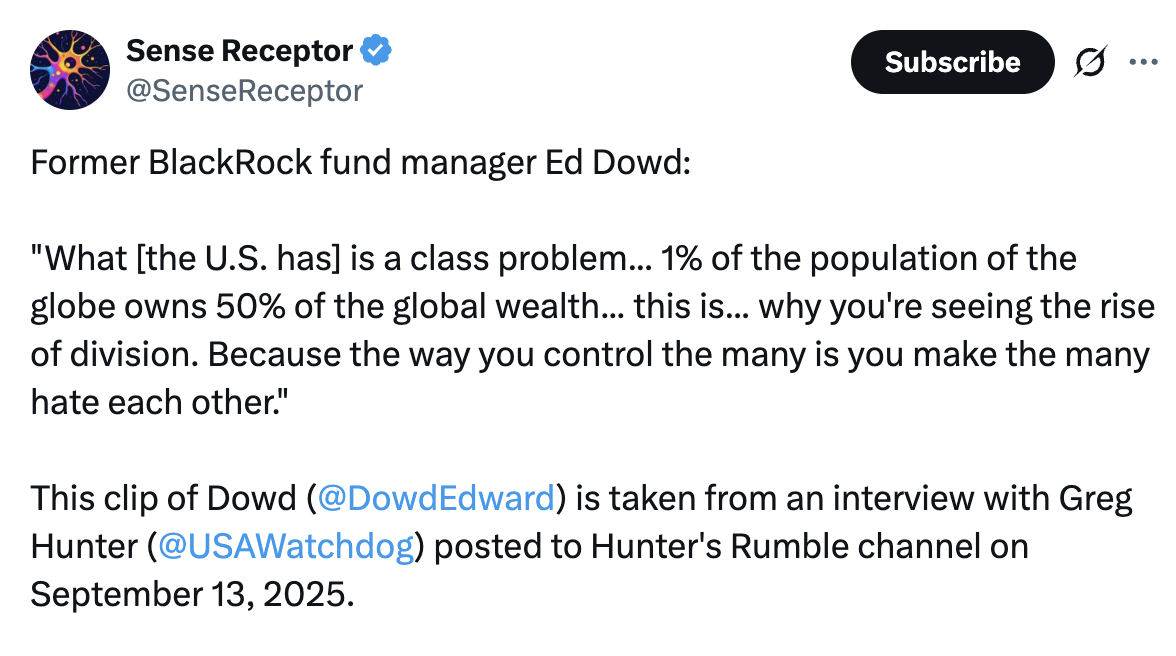
"What [the U.S. has] is a class problem... 1% of the population of the globe owns 50% of the global wealth... this is... why you're seeing the rise of division. Because the way you control the many is you make the many hate each other."
"What we have in this country is a class problem. We have, you know, 1% of global wealth is the 1% of the population of the globe owns 50% of the global wealth. So this is a class issue. It's been going on for a long time, since the great financial crisis and since 2000. And we have, And this is not just a US Problem. This is a global problem.
"And when we get to these types of situations they're cured one of two ways. The elites pay an existential price and or the system collapses and they're forced to share the wealth again. So this is how it's done.
"I'm not suggesting it's imminent, but this is why you're seeing the rise of populism, and this is also why you're seeing the rise of division. Because, the way you control the many is you make the many hate each other. You make the pitchfork guy look at the torch guy and say, hey, the torch guys are trying to take our pitchforks. And that's what's going on today. We got all this finger pointing. This is a class issue. It's not a black, white, Hispanic, left, right, Muslim. This is a class issue."
Status and Power Seeking on the Backs of the Unfortunate
The elites portray themselves as good-doers. The could be some of that, of course, but there is a Machiavellian side to such displays too. Rob Henderson explains:

Elite overproduction happens when a society produces too many people who believe they deserve high status. To get there, they often try to align themselves with genuinely marginalized groups in order to unseat the current elites and replace them. A lot of the time, when you hear someone loudly criticizing elites, what you’re really hearing is an audition to join them—an attempt to co-opt the suffering of people who are actually mistreated.
Even if someone has never personally experienced hardship, they can point to history or to the struggles of people who share their traits and say: they suffered, I’m like them, therefore you should give me power. That might mean a spot at a university, a job at a prestigious firm, or some other coveted position.
What’s interesting is how this shift away from individualism and toward group identity makes it possible for someone who’s only ever known affluence and comfort to be rewarded, so long as they share something in common with a historically marginalized group. Meanwhile, the people who really have been mistreated may get nothing. And yet people seem surprisingly willing to go along with it.
The Disastrous Effect of US Trade Policy on the US Middle Class
I agree with David Sacks here. To see the disastrous effects of US trade policy on the US middle class, take a road trip through America's many decimated town and small cities.

BTW, a lot of the people who worked these middle class jobs were men. How are men doing in education and the job market now that many of these jobs no longer exist? Steve Stewart-Williams tells us in his article, "The Other Half: Six gender gaps we rarely talk about" Here are his conclusions:
- Young Women Now Often Out-Earn Young Men
- Boys Are Falling Behind at School
- Fewer Men Are Finishing College
- More Men Die on the Job
- Men’s Health Gets Less Funding
- Men Are More Likely to Take Their Own Lives
Treasury Secretary Scott Bessent Discusses Trump’s Tariffs and the U.S. Economy
There's a big difference between longer form interviews and the 20 second hit jobs you see on legacy media. In this interview, Treasury Secretary Scott Bessent discusses Trump's tariff plan. He makes two main points. This is an effort to bring back the middle class. Second, his main concern is that the US no longer manufactures physical things and this constitutes a major security risk. I agree with both of these points. I don't claim to know all of the risks and benefits of jacking up tariffs, but I do know that the countries who are most complaining are the ones who have been nailing the US with tariffs for years. Bessent also discusses the effect of tariffs on the US stock market, making the argument that the market is lagging in reaction to far more than the tariffs. Further, in recent times, the fact that the market has generally been rising has not reflected the true state of the US economy, especially on Main Street. I also agree with Batya Ungar-Sargon, who has made a strong case that the biggest divide today in the US is between the long-suffering middle class and the wealthier elites, who have become the main concern of Democrats.
- 1
- 2
- 3
- 4
- …
- 12
- Go to the next page