A few weeks ago, I attended the True Spin Conference in Denver. There were plenty of thoughtful presenters, but my favorite was Andy Goodman, author of a blog called Free Range Journal. Andy has latched onto an extraordinarily powerful theme: Telling stories is the most powerful communication tool there is. Andy earns his living by teaching people how to convey the purposes and functions of their organizations by telling stories. Over the years, he has assembled an impressive repertoire of ideas all based on the power of story telling.
To be sure, the importance of telling stories has been recognized by numerous other people, including several other speakers at True Spin. It is often claimed that through story-telling, one frames one's message in a way that makes it memorable. It is also widely recognized that communicating through story-telling allows one to package arguments in such a way that they look like mere information rather than lecturing. How powerful is story telling? Consider this quote:
"If you can control a nation’s stories, you need not worry about who writes the nation's laws."
The author of this intriguing idea was Adolf Hitler.
Building upon an entertaining blend of common sense and cognitive science, Andy Goodman takes story-telling to new heights. He has worked hard to become quite a storyteller about storytelling. In this post, I will recap some of the ideas he presented during his keynote talk.
According to Andy, we all want to tell the truth, but in order to do this, we first need an operative definition for “truth” in order to give ourselves focus. "The truth isn't just what happened, but how we felt about it when it happened and how we feel about it now." As you might imagine, Andy has little patience for the dry presentations of facts that we often find on the websites of do-gooder organizations. For an example, take a look at this jargon-laden blurb offered by the
American Cancer Society:
The American Cancer Society's international mission concentrates on capacity building in developing cancer societies and on collaboration with other cancer-related organizations throughout the world in carrying out shared strategic directions.
This is not an unusual example. As part of his presentation, Goodman displayed the websites of several of the organizations in attendance at True Spin, pointing out the bureaucratese. This tactic drew a mixture of embarrassed groans (by those belonging to the organizations responsible for the websites) and nervous chuckles (by those who worried that their own websites would be featured next). He warned that those who run organizations must be careful to not allow "mission-speak get in the way of your mission."
What is the alternative to presenting dry "factual" information? As you might expect, the solution involves a conscious and careful use of narrative--storytelling. Narrative is so incredibly powerful because it sets forth our history, our identity, how are remember, why we give, and to whom we give. These emotionally charged ideas don’t readily sink in without the use of stories. In fact, without the power to tell its own stories, a culture has no opportunity to "grow up." Goodman made reference to the children's classic,
Peter Pan, asking the audience why Peter didn’t grow up. According to the story, Peter’s answer was, "I don't know any stories."
As we grow up to become adults, most of us stop telling stories. Becoming a grown-up in modern culture too often means that we are taught to communicate with technical jargon in order to be "serious." It is a travesty that so many of us get caught up like this. We are told to be more like “adults” and this is a shame because our stories effectively tell others (and ourselves) who we actually are.
Stories allow us to
remember who we are.
[more . . . ]

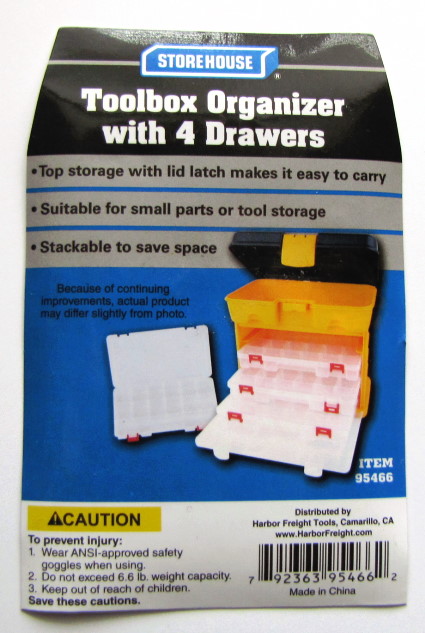 I need ANSI-Approved eye protection to open a drawer? Did an actual lawyer sign off on this?
This box is actually lower quality than a similar one that I'd bought at Target a couple of years earlier for the same price. Target doesn't have them any more, so I resort to Harbor Freight.
I've been mail-ordering from Harbor Freight since the 1980's, long before they had stores east of California. This is a cheap tools import house that now has an outlet a few blocks west of
I need ANSI-Approved eye protection to open a drawer? Did an actual lawyer sign off on this?
This box is actually lower quality than a similar one that I'd bought at Target a couple of years earlier for the same price. Target doesn't have them any more, so I resort to Harbor Freight.
I've been mail-ordering from Harbor Freight since the 1980's, long before they had stores east of California. This is a cheap tools import house that now has an outlet a few blocks west of 
