
Against all odds: How marijuana was legalized in Denver

If your quest were to convince the people of your city to legalize a highly demonized drug which was entirely safe, how would you run your campaign? At the recently concluded True Spin Conference in Denver, I had the opportunity to listen to an animated yet highly focused Mason Tvert describing for the audience how he and his small and not-well-funded organization (“SAFER”) convinced the people of Denver to legalize marijuana in 2005, with 51% of the people voting in favor. He also spearheaded a 2006 campaign to legalize marijuana throughout Colorado. Although that latter measure failed, an astounding 41% of the people of Colorado voted in favor. In case you’re thinking that I’m promoting the use of marijuana, I am not, but neither would I attempt to prohibit any other adult from using it. I’ve never used marijuana (even though I once worked as a musician and the opportunities were ubiquitous. Millions of gainfully employed and otherwise law abiding people do like to use marijuana, but they are paying dearly for their attempts to feel good and seek stress relief. I am for the legalization of marijuana because that our country arrests more than 750,000 people each year for possessing or using an extremely safe drug that successfully makes people feel good. This destructive and expensive waste of government law enforcement is absolutely shameful. The number of people arrested each year is more than the entire population of South Dakota. and these users include many people you know and respect. There is rank hypocrisy in the air, given that marijuana inexpensively offers the harmless escape that most of us seek much of the time (in one way or another), without any serious side effects and without the expense of many other methods of escape. If there were no such thing as marijuana, when it was finally invented by a pharmaceutical company, we would hail it as a miracle drug (Big Pharma wouldn’t need to lie about its efficacy or safety, as it does for many other drugs). Governments would allow it to be sold at drugs stores and they would happily tax it.
Continue ReadingAgainst all odds: How marijuana was legalized in Denver

Judicial Temperment

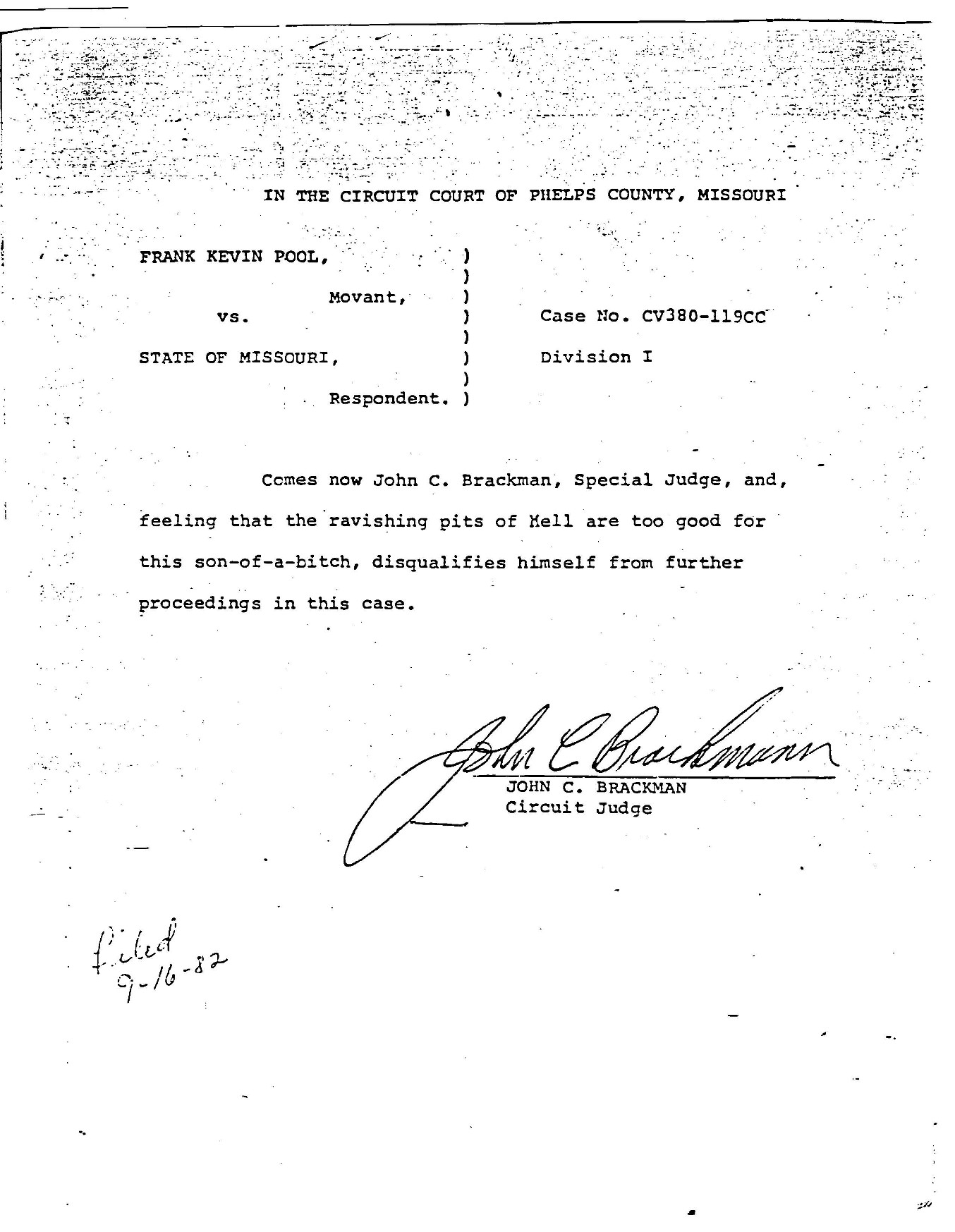
Judges are supposed to stay above the emotional fray. They are supposed to apply the law even-handedly. The attached court Order (which I recently found in some of my old paperwork) is a strikingly honest admission by one judge that he would have been unable to maintain judicial composure in a particular case.  It's an Order recusing himself from the case of a man that had been accused and convicted of murdering a police officer as that officer slept. This is not a case I handled, but it was a case of which I was aware.  I once met this judge (back in the 1980's), and he was a generally pleasant man. A clerk from the Phelps County, Missouri Court verified for me that this case was actually handled in that Court. I'm posting this Order signed by Judge John Brackman of Franklin County, Missouri, because I find it to be a stark reminder that most judges maintain their composure, despite what they might be feeling inside.  This Order is one of those glimpses inside one judge's psyche, reminding us that judges are capable feeling strong emotions, which reminds me of this earlier post on emotions and decision-making. brackman-order-1

Continue ReadingJudicial Temperment

Right to Link

We all know how nearly fastidious Erich has been about making sure that we don't violate any copyrights with the images we use on this blog. One way we manage this is by linking to content that we cannot properly copy or post. But now the issue of whether one can violate a copyright merely by linking to another web site is making legal rounds. I found out about the Right to Link movement via my WebProNews subscription. There is more information at www.right2link.org. What's stirring this up is Rupert Murdock blocking access to his content coming from certain legitimate url's. Here's a link to the story.

Continue ReadingRight to Link

Google, China, and hypocrisy

You've probably heard the stories in the news. A superpower has been shamed, a totalitarian state has been outed. A tyrannical government has been spying on the private communications of its citizens, including that of activists and journalists. What they plan to do with the fruits of their techno-espionage is not well understood, but given their history they can hardly be up to any good. What is clear is that this government is fanatical about crushing any challenge to their perceived supremacy, whether those challenges are internal or external. They even demand that private companies aid them in censoring unfavorable news (with a stunning degree of success), and these private companies (mostly based in the United States) may even have helped them spy on their citizenry. You could be forgiven for thinking that this was just another blog posting about Google and China. It's actually a post about hypocrisy. First, if you haven't heard, Google is re-evaluating their decision to do business in China, ostensibly as a result of some cyber-attacks directed at the Gmail accounts of some human-rights activists. The U.S. State Department is planning to lodge a formal protest on the alleged attacks. Plenty of others have already analyzed this story. As usual, the real story is behind the headlines. The San Francisco Chronicle reported last week:

The Google-China flap has already reignited the debate over global censorship, reinvigorating human rights groups drawing attention to abuses in the country and prompting U.S. politicians to take a hard look at trade relations. The Obama administration issued statements of support for Google, and members of Congress are pushing to revive a bill banning U.S. tech companies from working with governments that digitally spy on their citizens.
To prevent United States businesses from cooperating with repressive governments in transforming the Internet into a tool of censorship and surveillance, to fulfill the responsibility of the United States Government to promote freedom of expression on the Internet, to restore public confidence in the integrity of United States businesses...
So far, so good. Restoring public confidence in the integrity of U.S. businesses might be a tall order for any bill, but whatever. The rest are all noble goals: preventing repressive governments from using the internet as a tool of censorship and surveillance, promoting freedom of expression, and so on. Just one problem: none of these provisions apply to the U.S. Government. You see, the U.S. Government is the tyrannical superpower from the first paragraph of this blog post. You might have asked yourself why it is that the Chinese people put up with having their private communications read by their government. The real question is this: Why do you put up with it? [More . . . ]

Continue ReadingGoogle, China, and hypocrisy

Tortucans and the Problem of Truthful Perception

The actor Dan Blocker, who played Hoss on the old television show Bonanza, suffered through an incident once that is by turns charming and chilling. He was at a public event, signing autographs, when an older lady came up to him and started complaining that the cook on the Ponderosa, Hop Sing, wasn’t feeding them right. “When you get back there,” she insisted, “you tell you pa that you need to get someone who knows how to cook good American food, feed you all properly.” Blocker, who by all accounts was the epitome of a gentleman, explained to her after a couple of minutes of this that there was no Ponderosa, that Bonanza was a tv show—fiction—and that he was just an actor playing a part. “Yes, yes,” she said impatiently, “I know that. But really you must tell Ben to fire that Chinaman and get a real cook before all you boys dry up and blow away.” She was absolutely convinced of the reality of the Cartwrights, the “fact” of the Ponderosa, and the need to be concerned on their behalf, as if the events on the show were somehow as real as anything she encountered in her daily life. Charming, yes, but chilling in the respect of encountering a rock hard, immovable assertion of the reality of something fabricated. Made up. One can dance around this in a variety of ways, philosophically speaking. As a writer of fiction I object when critics assert that what I do is tell lies for a living. “What you create is not true.” In one sense, I must agree completely. The events I depict in my stories have never, nor will likely ever, “happen” in so-called “real life.” But there is another level in which the “fact” of the story is itself a reality—the story exists, the events depicted have an effect in the reader’s imagination, there is no contravention of consensual reality in the sense that the story replaces the actual world, and yet there is a substance to them (if I’ve done my job well enough) that is not so easily dismissed as a lie. On yet another level, the question of truth comes into it in regards to the felicity of the essence of the story to what we might recognize as truthful observations, mainly about the human condition. A piece of fiction can tell a truth—in fact, good fiction does exactly this by examining human nature under conditions where a revelation about how people are takes place. We find ourselves responding to characters, in the course of reading fiction, as if they were, in some sense, real. This is what Art does. It reveals truth. [more, including several videos . . . ]

Continue ReadingTortucans and the Problem of Truthful Perception