More euphemisms for sex
I thought I had heard them all, but I hadn't heard the euphemisms for sex from the 1800s. They include such terms as "Take a flyer" and "Lobster kettle." I suppose people did have sex, even back in the 1800s.

I thought I had heard them all, but I hadn't heard the euphemisms for sex from the 1800s. They include such terms as "Take a flyer" and "Lobster kettle." I suppose people did have sex, even back in the 1800s.
At Edge.org, Thomas W. Malone explains that in order to have a smart group of people you need more than a bunch of smart individuals.
We thought that there might be such a factor, but that it would really just be essentially the intelligence of the individual people in the group. What we found was that the average and the maximum intelligence of the individual group members was correlated, but only moderately correlated, with the collective intelligence of the group as a whole. If it's not just putting a bunch of smart people in a group that makes the group smart, what is it? . . . . [T]hree factors . . . were significantly correlated with the collective intelligence of the group. The first was the average social perceptiveness of the group members. We measured social perceptiveness in this case using a test developed essentially to measure autism. It's called the "Reading the Mind and the Eyes Test". It works by letting people look at pictures of other people's eyes and try to guess what emotions those people are feeling. People who are good at that work well in groups. When you have a group with a bunch of people like that, the group as a whole is more intelligent. The second factor we found was the evenness of conversational turn taking. In other words, groups where one person dominated the conversation were, on average, less intelligent than groups where the speaking was more evenly distributed among the different group members. Finally, and most surprisingly to us, we found that the collective intelligence of the group was significantly correlated with the percentage of women in the group. More women were correlated with a more intelligent group. Interestingly, this last result is not just a diversity result. It's not just saying that you need groups with some men and some women. It looks like that it's a more or less linear trend. That is, more women are better all the way up to all women. It is also important to realize that this gender effect is largely statistically mediated by the social perceptiveness effect. In other words, it was known before we did our work that women on average scored higher on this measure of social perceptiveness than men. . . . The most intelligent person is not the one who's best at doing any specific task, but it's the one who's best at picking up new things quickly. That's essentially the definition we used for defining intelligence at the level of groups as well. We said that a group is intelligent if it's able to perform well on a wide range of different tasks. It was actually performance that we were looking at.When I read Malone's comment about the importance of social perceptiveness, I thought about many of the unproductive groups of which I've been a part. Quite often there are a couple people who dominate the talking, people who lack this perceptiveness. The result is that a lot of the quieter folks, many of them with heads full of ideas, never get a chance to talk. Why is Malone focused on group intelligence?
[W]e want to understand how the world works, and in particular, how the world of groups of people and computers work together. How human societies and human networks work. Second, we want to help businesses, governments and other kinds of organizations know how to work better themselves. How can we create more intelligent organizations, more intelligent businesses, more intelligent governments, more intelligent societies? . . . [W]e are trying to understand how our whole world and society is evolving in a way that I think is making us more collectively intelligent.Now I suspect that I'm about to over-extend Malone's findings, but I do suspect that the national conversations we have are subject to these principles too. Two things that we sorely lack when "discussing" national issues as a nation are social perceptiveness and turn taking. What we actually have are a few loud-mouthed players, enabled by big money. They run roughshod over most of us, and they use their wealth to hog the national media. When this happens, it doesn't matter that there are lots of smart people in this country, because they aren't getting an opportunity to function as part of a group. As Amy Goodman often says, national conversations should occur at the equivalent of a big table, with all of us having a seat at the table. Throw in the relative lack of women's voices in that conversation, and we are far from that ideal, for the reasons pointed out by Malone.
Using the example of General Petraeus, the Electronic Frontier Foundation explains how the federal government looks at private email. What can be done about these abuses?
[The Electronic Communications Privacy Act (ECPA (1986)] is hopelessly out of date, and fails to provide the protections we need in a modern era. Your email privacy should be simple: it should receive the same protection the Fourth Amendment provides for your home. So why hasn’t Congress done anything to update the law? They’ve tried a few times but the bills haven’t gone anywhere. That's why [Electronic Frontier Foundation] members across the country are joining with other advocacy groups in calling for reform. This week, we’re proud to launch a new campaign page to advocate for ECPA reform.
In 2007, Privacy International conducted a survey to determine the extent to which countries conducted surveillance on their citizens. The U.S. was in the same category as China and Russia.
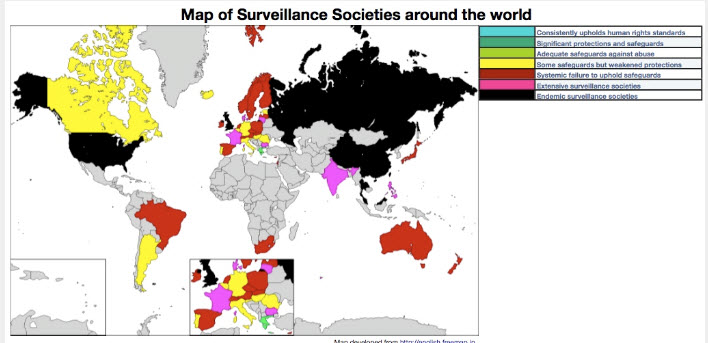 Glenn Greenwald supplements this image with some stunning data:
The US operates a sprawling, unaccountable Surveillance State that - in violent breach of the core guarantees of the Fourth Amendment - monitors and records virtually everything even the most law-abiding citizens do. Just to get a flavor for how pervasive it is, recall that the Washington Post, in its 2010 three-part "Top Secret America" series, reported: "Every day, collection systems at the National Security Agency intercept and store 1.7 billion e-mails, phone calls and other types of communications."
For more on the ever-increasing U.S. surveillance state, view this excellent video by Glenn Greenwald:As usual, Florida is still undecided, a mess. According to NPR, though, it is leaning heavily toward Obama, despite the shenanigans of the state GOP in suppressing the vote. I didn’t watch last night. Couldn’t. We went to bed early. But then Donna got up around midnight and woke me by a whoop of joy that I briefly mistook for anguish. To my small surprise and relief, Obama won. I will not miss the constant electioneering, the radio ads, the tv spots, the slick mailers. I will not miss keeping still in mixed groups about my politics (something I am not good at, but this election cycle it feels more like holy war than an election). I will not miss wincing every time some politician opens his or her mouth and nonsense spills out. (This is, of course, normal, but during presidential years it feels much, much worse.) I will not miss… Anyway, the election came out partially the way I expected, in those moments when I felt calm enough to think rationally. Rationality seemed in short supply this year and mine was sorely tasked. So now, I sit here sorting through my reactions, trying to come up with something cogent to say. I am disappointed the House is still Republican, but it seems a number of the Tea Party robots from 2010 lost their seats, so maybe the temperature in chambers will drop a degree or two and some business may get done. Gary Johnson, running as a Libertarian, pulled 350,000 votes as of nine last night. Jill Stein, the Green Party candidate, got around 100,000. (Randall Terry received 8700 votes, a fact that both reassures me and gives me shivers—there are people who will actually vote for him?) Combined, the independent candidates made virtually no difference nationally. Which is a shame, really. I’ve read both Stein’s and Johnson’s platforms and both of them are willing to address the problems in the system. Johnson is the least realistic of the two and I like a lot of the Green Party platform. More . . .