How to Be a Human Animal, Chapter 17: Conversations Worth Having

Chapter 17: Conversations Worth Having

Greetings once again, hypothetical newborn baby!  Instead, I'm here once again to teach you another Life Lesson. I had to learn these at the School of Hard Knocks. No, I'm not claiming that you're not as able as me to learn those lessons.  I'm just trying to spare you some pain and frustration.  OK OK!  I admit that this is merely a thought experiment by which I am trying to set forth the most important things I've learned in 65 years. By the way, if you aren’t completely satisfied with these lessons, I’ll refund all of the money you paid for them ! This is Chapter 17 already.  Wow.  Aren't you tired of hearing my voice? No?  OK. Then I'll continue. If you need to review any of the past lessons, can find them all here. 

Today we’re going to talk about conversations. That term doesn’t simply mean talking with someone any more than food is defined as anything you put your mouth. Er, I can already see you drooling at you stare at my car keys. Just settle down now . . . OK, you can suck on your toes while you listen. That’s cool.

There are many types of conversations, but they fall on a continuum from simple factual exchanges on (“Is it raining?” “Yes”) to collaborations in which the parties set out to figure out a complex topic as a joint exercise by celebrating each others’ contributions.

Psychologist Scott Barry Kauffman recently Tweeted:

Imagine what discourse would be like if instead of it being conceptualized as a "match" to see who "wins", discussions were seen as mutual attempts to get at a shared truth or seen as a shared mission to get outside of ourselves and transcend our individual perspectives.

That would be a nice world, the kind I can imagine happening 24/7 at the big house where the philosophers and other "virtuous pagans" hang out just on the other side of Dante's River Acheron. You, however need to live in the world you were handed. You ended up on a Grade A planet in a Grade C era with regard to conversations.

Right now, your interactions will mostly be where some other baby grabs your toy and you cry. Here’s the problem you'll encounter when you get older: Even if you optimistically join a discussion hoping it is of the “Kauffman” variety, that doesn’t guarantee an enlightening and engaging experience. It takes two to tango and many people would rather honk at you (don’t look at ME as I say that!) than celebrate each other’s differing perspectives. Tango is the correct metaphor because, at their best, conversations are like dancing with other people. If either of you are stepping on the others’ feet, neither of you are going to have a good time.

Here's why this era is so fraught for those who want to share complex ideas with others (especially on contentious topics): We live in a time where the so-called news media makes much of its money by stirring up conflict and even hate. It’s the same thing with social media. The companies in charge of these things have decided in their corporate consciences that it's quite simple, actually: no conflict, no money. This has wrecked a pretty decent (though admittedly imperfect) conversational thing we had going on for decades.

Here’s how it so often plays out: Let’s say that you join a conversation in an open frame of mind, interested in freely sharing perspectives on an issue, but the other person is not so inclined. The other person, having been steeped in news media and social media, and now cooked to an extra-fever pitch of loneliness and rage during the pandemic, is committed to scoring points, schooling you and “winning” the discussion. I know, right? Why should there ever be a “winner” to a discussion, but that’s how many people see it these day. And they have plenty of tactic for “winning,” including these: [More . . . ]

Continue ReadingHow to Be a Human Animal, Chapter 17: Conversations Worth Having

Ukraine: Forbidden Discussions

I'm despondent that the mainstream news outlets are so intensely jingoistic, so focused on the logistics of war, so unwilling to look into the mirror. This is not surprising given the vast numbers of retired military and spy state talking heads who now work for the left leaning MSM. It's also unsurprising given that this is how war propaganda always works, illustrated brilliantly by "War Made Easy."

Here are a three snippets of conversation that I with the news media would take much more seriously:

First, this is from Freddie DeBoer's Substack:

[R]ight now, [the United States is] investing hideous amounts of treasure to maintain an order that we can’t afford and that no one really believes we can maintain. Perhaps the Ukrainians will beat back the Russians and they’ll be welcomed into NATO and we can all cheer that the good guys won. But hegemony does not last forever, and sooner or later you’re going to have to ask more adult, more useful questions than, “who’s the goodie, and who’s the baddie?” Otherwise the superpower eventually goes down the hard way.

I find myself considering this quote from a spokeswoman for the Chinese Foreign Ministry.

When the U.S. drove five waves of NATO expansion eastward all the way to Russia’s doorstep and deployed advanced offensive strategic weapons in breach of its assurances to Russia, did it ever think about the consequences of pushing a big country to the wall?

It doesn’t take sympathy for Putin to see that this is a very good question.

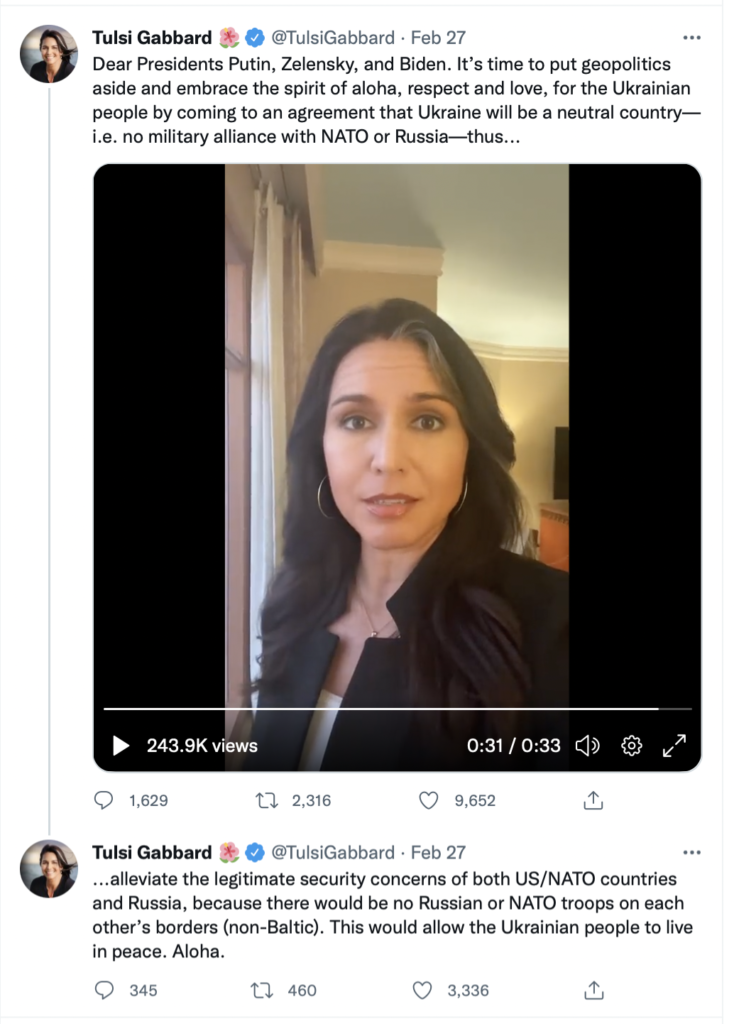
Second, Tulsi Gabbard tweeted this:

Third, Matt Taibbi reminds us that history matters:

I would like to point out that we already tried regime change in Russia. I remember, because I was there. And, thanks to a lot of lurid history that’s being scrubbed now with furious intensity, it ended with Vladimir Putin in power. Not as an accident, or as the face of a populist revolt against Western influence — that came later — but precisely because we made a long series of intentional decisions to help put him there.

Once, Putin’s KGB past, far from being seen as a negative, was viewed with relief by the American diplomatic community, which had been exhausted by the organizational incompetence of our vodka-soaked first partner, Boris Yeltsin. Putin by contrast was “a man we can do business with,” a “liberal, humane, and decent European” of “alert, controlled poise” and “well-briefed acuity,” who was open to anything, even Russia joining NATO. “I don’t see why not,” Putin said. “I would not rule out such a possibility.”

Fourth, this excerpt is from Glenn Greenwald's detailed analysis of our tribal dysfunction that mushroom when that exciting topic of war hits the tabletop:

In the weeks leading up to the Russian invasion of Ukraine, those warning of the possible dangers of U.S. involvement were assured that such concerns were baseless. The prevailing line insisted that nobody in Washington is even considering let alone advocating that the U.S. become militarily involved in a conflict with Russia. That the concern was based not on the belief that the U.S. would actively seek such a war, but rather on the oft-unintended consequences of being swamped with war propaganda and the high levels of tribalism, jingoism and emotionalism that accompany it, was ignored. It did not matter how many wars one could point to in history that began unintentionally, with unchecked, dangerous tensions spiraling out of control. Anyone warning of this obviously dangerous possibility was met with the “straw man” cliché: you are arguing against a position that literally nobody in D.C. is defending.

. . .

There is a reason I devoted the first fifteen minutes of my live video broadcast on Thursday about Ukraine not to the history that led us here and the substance of the conflict (I discussed that in the second half), but instead to the climate that arises whenever a new war erupts, instantly creating propaganda-driven, dissent-free consensus. There is no propaganda as potent or powerful as war propaganda. It seems that one must have lived through it at least once, as an engaged adult, to understand how it functions, how it manipulates and distorts, and how one can resist being consumed by it.

I will end with a photo:

Continue ReadingUkraine: Forbidden Discussions

Ira Glasser: “Speech Restrictions Are Like Poison Gas.”

Ira Glasser served as the fifth executive director of the American Civil Liberties Union from 1978 to 2001. Here is an excerpt from his new article, "Social Justice Requires Free Speech."

"Hosannas for publishing Burt Neuborne’s scintillatingly clear and powerful piece on the danger of allowing universities to punish faculty for sloppy or obnoxious speech.

Along with David Cole’s excellent piece in The New York Review of Books, and Erwin Chemerinsky’s spirited piece on the Ilya Shapiro case at Georgetown, all three did a great job of explaining the distinction between supporting the right of someone to speak and disagreeing vigorously and loudly with what they say.

Free Speech For Me But Not For Thee book cover I have long regarded the failure to understand that distinction as one of the two major obstacles to widespread public support for free speech, and all three pieces do a superb job of explaining it."

Continue ReadingIra Glasser: “Speech Restrictions Are Like Poison Gas.”

How to be a Human Animal, Chapter 13: My New Quest as an Author

Chapter 13: My New Quest as an Author

One of the main reasons I am engaging in this 100-Day Creative Project is to find a new voice as a writer of essays.Since 2006, I have written more than 7,000 articles here at Dangerous Intersection. Since becoming an attorney in 2006, I have drafted thousands of court filings, including hundreds of lengthy appellate briefs. Doing so much of this work doesn’t mean that I’m good at it, but I do think I’ve learned a lot of things along the way and I do seem to be competent at that writing style.

But I want to learn how to be a better writer by exploring new styles. Most of my writing to this point has been technical and precision advocacy of a point of view. I am using this Project to explore a new style of writing. Still persuasive, but also more fluid, more free, more creative and with a dash of humor here and there. The only way I'll know to get better at a new style is to have a lot of reps. Over and over for 100 days would be a good start. I’ve addressed (in my former writings) many of the ideas I am discussing in my lessons for “the newborn baby,” but I’m now working to present them in newer ways that might be more effective for a different audience. I hope t break down some old writing habits so that I can draw from heretofore rather quiescent parts of my brain. I hope those parts have been merely sleeping and that they haven’t completely died off.

I was inspired to create new styles of articles as my 100 Day Project after enjoying about a dozen essays by Freddie DeBoer, who describes himself as a “Marxist of an old-school variety.” https://dangerousintersection.org/2022/02/15/the-type-of-real-life-government-freddie-deboer-can-believe-in/ With his writing, Freddie successfully does a lot of the things that I want to do better. This Project will thus be a 100-step experiment and it’s clearly off to an uneven start, although I am clearly writing in a more unvarnished and less edited style (as you can see from the typos). I am forcing myself to write a lot and to do it more spontaneously. I am keeping in mind Mario Andretti's admonition: "If everything seems under control, you're not going fast enough." I'm not striving for any length of these essays, but I am noticing that by the time I've emptied out my quiver, I've spilled out more than 1,000 words, which is a fairly grueling pace for me in the context of the other demands (including self-demands) I face in my life.

I am consciously trying to modify many deeply ingrained and ossified writing habits. I hope that by the end of this project I will have noticeably moved the needle regarding my style. It would be fun to see a difference by the hundredth essay, but more importantly, that the difference is for the better, which is not a given when one screws with some that has worked reasonably well. For more insight into a few of the things I'm aiming to accomplish, here's an excerpt from my new writing guru Freddie DeBoer’s recent article: “If you Absolutely Must: a brief guide to writing and selling short-form argumentative nonfiction from a somewhat reluctant professional writer.”

Your politics are your affair. But fear all political fads, resist all political peer pressure, and be ruthless in asking yourself whether you actually hold a position or if you are just afraid of the consequences of appearing to not hold it. Then express yourself. Whatever you do, be weird. As a consumer of writing, please, for me, be weird. Whatever this profession needs, it does not need more hall monitors or commissars and it does not need more writers who seem to have nothing to offer beyond looking down their glasses at the world in shrill derision. That territory is covered. That corner has been taken. The whole point of writing, the only reason to have an alphabet, is to say what no one else is saying. To be singular. What is the value of replicating words that have already appeared in the same order? You can’t choose to be good and you can’t choose to be successful. But you can choose to be your own.

Be brave and tell the truth. Absolutely everyone and everything in the life you are choosing will try to force you to conform. They will hate you if you break ranks, but they’ll hate you if you say something inoffensive but easily misrepresented too. All they want is to root out heretics; it’s the only thing that makes them feel alive. So you may as well not live in fear. If you let them in there will be little of you left when they’re done, so don’t let them in. If you can hold on to some piece of yourself that does not care what they say, you can have the one pure thing left in an industry now made up only of snitches and nuns, that last virtue for a writer, the courage to be human.

. . .

But do write a lot. Writing is like playing an instrument: it’s all about reps. I know that this is as banal as advice gets. But I think we live in an age of distraction where there are so many other things fighting for your time; I think it’s easy to tell yourself that composing social media posts improves your longform writing when it does not; and I think there remains some unfortunate impression, perhaps left over from the Beats, that great writers produce writing the way a bird produces song.

Continue ReadingHow to be a Human Animal, Chapter 13: My New Quest as an Author

Chapter 12: How to Disagree with Others

Chapter 12: How to Disagree with Others

Here’s another lesson for you, my hypothetical newborn baby. As you keep eating and pooping, I’m going to keep giving you pointers on how to make sense of this crazy world. These are the sorts of things I wish I had known when I was a lot younger . . .

We’ve already discussed (in Chapter 10) that the brain is overrated as a truth-finding device. It functions well to find truth only in certain specially-tuned environments such as laboratories, where scientists who are well-trained to disagree civilly (using the scientific method) want to know if and when they are wrong so that they can advance the kind of research that allows airplanes to actually fly. Most of the time, human animals are not in that kind of specialized environment. Much of the time, we wander around using our brains to concoct arguments that we are correct, even when we have little or no evidence that we are correct. For instance, we constantly employ these three-pound miracles as tools for making arguments to convince others to give us resources such as food, sex and big screen TVs, but not necessarily in that order.

In a later chapter, we will discuss the topic of social intuitionism, the human animal tendency to make shit up in our head to justify what our bodies want. That tendency probably describes 50% of the utterances that come out of human mouths. But wait? It just now occurred to me that we also call our mouths “pie holes,” which is fascinating. The same orifice we use for making noises at conferences is also used for transporting biomass to our stomachs. Natural Selection is such an innovative tinkerer!  And we are such a strange type of animal! Sometimes I pretend I am an alien anthropologist. At those fanciful moments, I see the human animal as a mobile intestinal tract adjoined to a sophisticated and acutely tribal PR apparatus seeking out ways to make copies of itself. But that is my cynicism showing. Let’s move on, because there is an important topic at hand: We struggle to talk to one another.

We are always tribal, but especially when death or uncertainty is in the air. That is the basic holding of Terror Management Theory. Mortality salience reactivates the high school part of the brain and we flap around seeking acceptance from tribes of humans who seemingly are be best position to provide ample orgasms and iPhones. We glom on to those groups like flies onto shit. It’s really something to behold because the process of ingratiating ourselves to groups rewires the brains of human animals. If the tribe dresses in suits and ties, we dress in suits and ties. If the tribe sings songs that claim that there are more than two biological sexes or that a virgin can have a baby, we join in and sing those songs. If the tribe defines up as down, no problem. If the tribe vociferously asserts that non-stop warmongering is a good thing, we sign up for the military. Again, it’s a surreal spectacle. For reasons unclear, some of us are not wired to be groupish, so we are spared from social contagion and from having these illusions. Independent thinking is an enormous benefit. I hope you are one of the lucky ungroupish humans so that your brain doesn’t become distorted these sorts of bizarre claims that serve as identifying markers to help hold the group together. Here’s the downside. If you aren’t groupish, you’ll feel somewhat nervous when you witness a big tribe engaged in energized chanting in unison. If you aren’t wired to be groupish, you’ll need to form your own social network, person by person, which can sometimes be a lot of work, causing you to feel awkward and isolated. If you are an independent thinker, you will be able to plainly see it with your own eyes that groupish people bask in the glow of the group. It's like a powerful drug and they are willing to through skeptical truth-seeking out the window for a lifetime of basking.

But here’s a problem. When groupish people talk to us, it can be almost impossible to understand each other because we see the world so differently. Even non-groupish people often have trouble understanding each other because each of us is such a complex animal who enter conversations having been tuned for decades with lifetimes of idiosyncratic experiences. What can we do about this struggle?

I am part of an organization called Heterodox Academy, which encourages its members (teachers and professors) to reach out to engage intellectually (and otherwise) with people who don’t think the same way. Why?  Because schools are supposedly places to learn and we won’t learn much of anything if we limit ourselves to hanging out people who think the same. Heterodox Academy’s mission statement is straightforward: “To improve the quality of research and education in universities by increasing open inquiry, viewpoint diversity, and constructive disagreement.”

The cornerstone of HxA is known as the five-point HxA Way, a set of easily understandable guideposts for talking with people with whom you disagree. In my experience, it works well as a general rule. It works much less well with groupish people, but it's the best tool we've got. Here are the five points:

1. Make your case with evidence. Link to that evidence whenever possible (for online publications, on social media), or describe it when you can’t (such as in talks or conversations). Any specific statistics, quotes, or novel facts should have ready citations from credible sources.

2. Be intellectually charitable Viewpoint diversity is not incompatible with moral or intellectual rigor — in fact it actually enhances moral and intellectual agility. However, one should always try to engage with the strongest form of a position one disagrees with (that is, “steel-man” opponents rather than “straw-manning” them). One should be able to describe their interlocutor’s position in a manner they would, themselves, agree with (see: “Ideological Turing Test”). Try to acknowledge, when possible, the ways in which the actor or idea you are criticizing may be right — be it in part or in full. Look for reasons why the beliefs others hold may be compelling, under the assumption that others are roughly as reasonable, informed, and intelligent as oneself.

3. Be intellectually humble. Take seriously the prospect that you may be wrong. Be genuinely open to changing your mind about an issue if this is what is expected of interlocutors (although the purpose of exchanges across difference need not always be to “convert” someone, as explained here). Acknowledge the limitations to one’s own arguments and data as relevant.

4. Be constructive. The objective of most intellectual exchanges should not be to “win,” but rather to have all parties come away from an encounter with a deeper understanding of our social, aesthetic, and natural worlds. Try to imagine ways of integrating strong parts of an interlocutor’s positions into one’s own. Don’t just criticize, consider viable positive alternatives. Try to work out new possibilities, or practical steps that could be taken to address the problems under consideration. The corollary to this guidance is to avoid sarcasm, contempt, hostility, and snark. Generally target ideas rather than people. Do not attribute negative motives to people you disagree with as an attempt at dismissing or discrediting their views. Avoid hyperbole when describing perceived problems or (especially) one’s adversaries — for instance, do not analogize people to Stalin, Hitler/ the Nazis, Mao, the antagonists of 1984, etc.

5. Be yourself. At Heterodox Academy, we believe that successfully changing unfortunate dynamics in any complex system or institution will require people to stand up — to leverage, and indeed stake, their social capital on holding the line, pushing back against adverse trends and leading by example. This not only has an immediate and local impact, it also helps spread awareness, provides models for others to follow and creates permission for others to stand up as well. This is why Heterodox Academy does not allow for anonymous membership; membership is a meaningful commitment precisely because it is public.

I know you won’t need the HxA Way for awhile. Your main conflicts will first arise when you don’t want to go to sleep. Then your main conflict will be that you won’t want to share your toys and you start to constantly fight with your caretakers for endless streams of candy (I know this is difficult to believe, but your quest for candy will fade as you become an adult). Eventually, you will have more sophisticated conversations with people who will disagree with you. I hope you will have lots of these conversations, because that's the only way for you to intellectually grow. And when you are ready for these conversations, pull out this copy of the HxA way to make disagreeing agreeable.

Continue ReadingChapter 12: How to Disagree with Others