John McWorter Draws a Line in the Sand When Ibram X. Kendi Publicly Labels his Ideas “Racist.”

One of the things I find most disturbing about "anti-racists" is their demand that you must either agree to everything they say or else you are a "racist." Popular authors Ibram X. Kendi and Robin DiAngelo claim that if you are not an "anti-racist" you are a racist. There are only two options. Thus speak the anti-racists.  This false dilemma, this unjustified dichotomy, is just "because."

"Anti-racism" is not the opposite of racism, despite the misleading nomenclature. It is virulent new form of racism. To pull off this minor miracle of creativity, the "anti-racists" have invoked a new expansive definition of "racism" that has nothing to do with specific unfair attitudes or behavior of specific people. The "anti-racists" invoke a Manichean claim that it is OK to judge people as good and bad (respectively Blacks and whites) based on immutable physical appearance, just because. In doing this, they are dusting off that old disreputable idea that melanin should serve as a guilt barometer. This is something they have in common with racists of the Civil War and Jim Crow eras, although the new barometer is upside-down.

This "anti-racist" formula has worked all too well for the past several years. Well-meaning people who fervently disagree with this "anti-racist" claim, however, including the specific claim that "all white people are racist," are being held emotional hostage. They are afraid to speak up, to disagree in public places. It is truly bizarre to see so many people who disagree with these "anti-racist" claims who are afraid to speak up. I know this from numerous private conversations. It's starting to look like many religions, where the preachers preach at the flock and members of the flock merely nod their heads, even thought they know in every bone of their bodies that the Earth is not 6,000 years old, that virgins don't have babies and that (an example from my Catholic upbringing) eating the host is not literally eating bloody muscles and capillaries. Members of the flock sat in total silence when the NYT promoted claims that the American Revolution was primarily for the purpose of promoting slavery, a central claim of "The 1619 Project."

So this is where we are: the preachers are preaching and members of the flock keep sitting silently because they are afraid of going to "anti-racist" hell. For them, hell is what would happen is they were publicly called "racist."  Thus, members of the flock will sit in paralyzed silence, even when the anti-racists call all "white" people and their Black intellectual allies "racist" no matter how exemplary their lives have been. Isn't that weird? "White" people are already being called racists as a group merely by their skin color, yet they fear being called "racist" as individuals. And what drives this fear is, ironically, that they hate racism. This is stranger than any fiction any creative writer could concoct. These "anti-racist" threats of name-calling are successfully turning many people into Zombies (this reminds me of how many types of wasps sting and zombify other bugs to use as hatcheries). After getting stung by the threat of being called "racists," the fearful zombified flock is willing to sit in silence even when the "anti-racists" make patently false claims that no racial progress has occurred since 1619, since the Civil War or since the Civil Rights era.  They sit in silence while the "anti-racists" ridicule Martin Luther King's idea that we should not be judged by the color of our skin, but only by the content of character.

Once this creepy dynamic settled into place, anti-racists, such as Ibram X. Kendi and Robin DiAngelo, began getting free rides from individuals who knew better but who were afraid to speak out. More troublesome, the anti-racists' fact-free and oftentimes false diatribes also began getting luxury free rides from corporate HR departments, government agencies (and here) and many members of our sense-making institutions, including left-leaning legacy media. In addition to securing the silence of people who disagree under threat of being called names, the "anti-racists" employ another big weapon: the rage of Woke mobs who are willing to destroy the careers of anyone who dares to dissent (recent example).

Linguist John McWhorter has not been afraid to call out the anti-racists.  He has done this in many places, including his article in The Atlantic,  "The Dehumanizing Condescension of White Fragility: The popular book aims to combat racism but talks down to Black people." McWorther, a professor of linguistics, has taken a lot of flack from the far left for repeatedly calling out that the Emperor Has No Clothes.

McWhorter had more than his fill, however, when Ibram X. Kendi recently and publicly called McWhorter's ideas "racist."  Kendi has made dozens of claims that should be vigorously scrutinized by academics, book reviewers and the general public, but he has been surfing on the waves of fearful silence. That silence meant that the normally unflappable McWhorter had to fend for himself.  He decided it was time to push back dramatically, in a public way. Hence these excerpts from the November 23, 2020 episode of The Glenn Show with Glenn Loury:
Continue ReadingJohn McWorter Draws a Line in the Sand When Ibram X. Kendi Publicly Labels his Ideas “Racist.”

Heterodox Academy Offers Suggestions on How to Disagree Civilly

Heterodox Academy was founded in 2015 by Jonathan Haidt, Chris Martin, and Nicholas Rosenkranz

in reaction to their observations about the negative impact a lack of ideological diversity has had on the quality of research within their disciplines. What began as a website and a blog in September of 2015 — a venue for social researchers to talk about their work and the challenges facing their disciplines and institutions — soon grew into an international network of peers dedicated to advancing  the values of constructive disagreement and viewpoint diversity as cornerstones of academic and intellectual life.

All members of Heterodox Academy embrace a set of norms and values that they call “The HxA Way.

“I support open inquiry, viewpoint diversity, and constructive disagreement in research and education.”

HxA offers a tipsheet on how to how to approach moral disagreements in constructive ways. HxA encourages us to "engage in open inquiry and constructive disagreement can use these strategies to build mutual understanding and have better conversations on difficult issues."

I highly recommend visiting this entire article, but in this short article I'm setting out the basic ideas:

  • Lower the perceived state of the disagreement or conflict
  • Don’t sling pejorative labels or assign bad motives
  • Agree upon facts first ("Then talk about what to do about it or how best to address it. Start small and build out.")
  • Lower a disagreement’s visibility ("In public environments, including digital forums, there is much more pressure to conform to one’s group and to virtue signal. It is also far more embarrassing to admit you were wrong to the whole world than to a single person. People are generally much more reasonable in more intimate settings.")
  • Don’t demand too much from the conversation ("In cases of deep disagreement, the initial and primary goal should be simply to clearly understand where the other is coming from and to be well-understood oneself.")
  • Appeal to identity, values, narratives,and frames of reference
  • Speak to people in their own language ("people become much more willing to reconsider or even change their views and to accept controversial facts when presented to them in terms of their own values, commitments, and frames of reference")

The final point of this HxA tip sheet is to "Understand that it’s worth the effort." HxA elaborates:

If you do a deep dive into a radically alternative worldview with an open mind – that mind will be blown. The exploration might, at times, be disorienting, frustrating, or triggering – but you will learn a lot. You might not abandon your own commitments, but you’ll definitely come to see things in a dramatically different way. At the very least, you will discover that your rivals have legitimate reasons for holding the positions they hold on many issues. That in itself – really internalizing that – can be huge.

HxA position is that they prize pluralism and value constructive disagreement. They offer these additional five bullet points for accomplishing these goals:

  • Make your case with evidence.
  • Be intellectually charitable ("However, one should always try to engage with the strongest form of a position one disagrees with (that is, ‘steel-man’ opponents rather than ‘straw-manning’ them). One should be able to describe their interlocutor’s position in a manner they would, themselves, agree with (see: ‘Ideological Turing Test’)")
  • Be intellectually humble ("Take seriously the prospect that you may be wrong")
  • Be constructive.("The objective of most intellectual exchanges should not be to “win,” but rather to have all parties come away from an encounter with a deeper understanding of our social, aesthetic and natural worlds.")
  • Be yourself. This is a critically important point. Standing up to outgroups, in-groups and organizations sometimes takes considerable courage:

At Heterodox Academy, we believe that successfully changing unfortunate dynamics in any complex system or institution will require people to stand up — to leverage, and indeed stake, their social capital on holding the line, pushing back against adverse trends and leading by example. This not only has an immediate and local impact, it also helps spread awareness, provides models for others to follow and creates permission for others to stand up as well. This is why Heterodox Academy does not allow for anonymous membership; membership is a meaningful commitment precisely because it is public.

HxA offers many additional Tools and Resources for engaging in Heterodox Conversations. This is an excellent site to visit to prepare for conversations that might turn contentious.

Continue ReadingHeterodox Academy Offers Suggestions on How to Disagree Civilly

Professor Dorian Abbott of the University of Chicago Threatened for Expressing Dissent over DEI Policy

What is a hero?  There are many types.  One type of hero is someone who steps up to do what is right and say what is true knowing that the consequences will be painful and potentially damaging to one's livelihood.  The scene is the University of Chicago, which issued the strongly worded "Chicago Statement" in 2015. Here is an excerpt:

“Because the University is committed to free and open inquiry in all matters, it guarantees all members of the University community the broadest possible latitude to speak, write, listen, challenge, and learn . . . . [I]t is not the proper role of the University to attempt to shield individuals from ideas and opinions they find unwelcome, disagreeable, or even deeply offensive.”

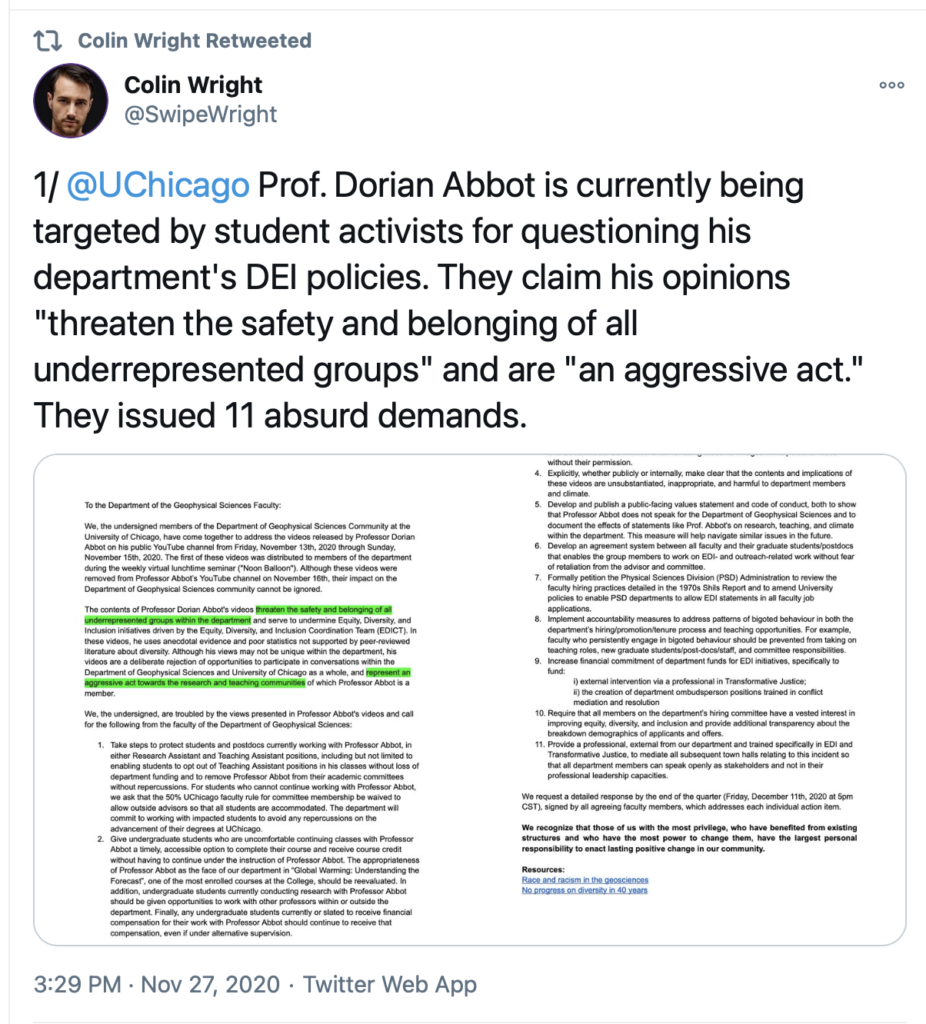
I learned of the story of Geophysics Professor Abbott through a series of tweets by Colin Wright. Abbot's crime was to question his department's DEI (Diversity, Equity and Inclusion) policies. His concerns included the following:

My basic points are: (1) We need to think through the consequences of DEI efforts to make sure they aren’t hurting promising scientists of all demographics, (2) There are major societal problems that we should try to fix as a society as well as by giving our own time and money off campus, but adjusting departmental ratios at elite universities does not really address them, and (3) the current academic climate is making it extremely difficult for people with dissenting viewpoints to voice their opinions.

Abbot's concerns resulted in a letter to Geophysics Department signed by 130 graduate students and post-docs demanding that Abbott be stripped  of all titles, courses, and privileges. Those signing the letter claimed that Abbot's opinions "threaten the safety and belonging of all underrepresented groups" and are "an aggressive act." They issued 11 absurd demands that, again, include a demand that the University ruin Professor Abbott's career. Here is the starting point (click on this link to jump in):

Professor Abbott detailed events of Mid-November in this document.  Here's an excerpt from his report:

On Saturday, 11/14/20, friends started telling me that there were a large number of people on Twitter misrepresenting what I was arguing, saying untrue things about me, and even demanding that I be fired. One friend noted that there were a number of tweets using the logic: “I don’t feel safe when you object to my premises, therefore you cannot object to my premises on campus.” I found this very upsetting because it confirmed my fear that certain people are exploiting the language of personal trauma to silence anyone with dissenting opinions on these issues.

Analysis: I believe that this situation was caused by the collision of two different strongly held worldviews. I subscribe to the traditional University of Chicago perspective, as outlined recently in what has become known as the Chicago Statement. In this view academic freedom and the tolerance of dissenting views are given prominence. The reason for this is that it is important for promoting the discovery of new knowledge, which is the main purpose of a modern university. I and many other faculty specifically chose to work at the University of Chicago in part because it has always affirmed this attitude. The alternative viewpoint is that certain groups feel inherently threatened on campus, and need to be protected from anything that might make them feel unsafe or happy to pursue their work. I am sympathetic to this viewpoint and agree in some cases, such as general department and classroom climate, but I feel that it cannot be applied to intellectual discussions. The reason is that it is associated with the type of logic noted above, in which the position is taken: “I don’t feel safe when you object to my premises, therefore you cannot object to my premises on campus.” This is similar to what philosophers call “begging the question,” or “assuming the answer,” and obviously is not an effective way to resolve an intellectual dispute correctly.

I invite you to click on these links and to keep following this story to see whether the University of Chicago will honor its stated principles that universities must always be places where dissent will always be invited.

Continue ReadingProfessor Dorian Abbott of the University of Chicago Threatened for Expressing Dissent over DEI Policy

People Who Refuse to Read What J. K. Rowling Writes about People Who are Transgender Hate Her for her Writings.

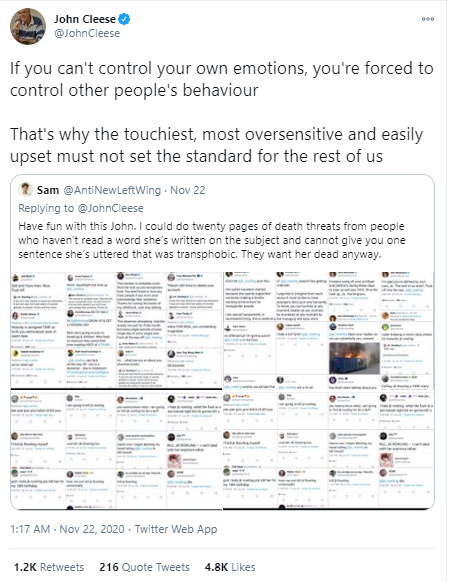
This Tweet and others by John Cleese on transgender issues are eye-opening and raise an important point. This can be confirmed quickly by cruising Twitter. Numerous people refuse to read what J. K. Rowling writes about people who are transgender, yet they hate her for what she supposedly said. This is even more distressing than the large number of people who read only headlines before responding to posts or sharing the entire article. "59 percent of all links shared on social networks aren’t actually clicked on at all, implying the majority of article shares aren’t based on actual reading." I've seen it repeatedly on Twitter that Woke Folk claim that Rowling has said things that she never said.  Tweets by or about Abigail Shrier draw hate from the same crowd (and from large media outlets), most of whom claim that she is "anti trans," when 1) there is no evidence of this and 2) Shrier's book, Irreversible Damage, focuses only on teenagers who are undergoing surgery and hormone treatment based upon self-diagnosis and without the benefit of any counseling in an attempt to change their gender. 

Continue ReadingPeople Who Refuse to Read What J. K. Rowling Writes about People Who are Transgender Hate Her for her Writings.

ACLU Attorney Joins a Nationwide Effort to Ban Abigail Shrier’s Book: Irreversible Damage

In today's WSJ, Abigail Shrier describes the environment into which she released her book, Irreversible Damage:

Social contagions exist, and teen girls are particularly susceptible to them. The book takes a hard look at whether the sudden spike in transgender identification among teen girls is yet another social contagion to befall girls who, in another era, might have fallen prey to anorexia or bulimia . . .Many transgender adults, including some I interviewed for the book, agree that teen girls are undergoing medical transition too fast with too little oversight. Others disagree and have written books. Amid a sea of material unskeptically promoting medical transition for teenage girls, there’s one book that investigates this phenomenon and urges caution. That is the book the activists seek to suppress.

The WSJ article is titled:  "Does the ACLU Want to Ban My Book?"

Despite the importance of Shrier's book, it is being treated as though it an attempt to harm teenage girls when it is actually providing critically important information aimed at protecting teenaged girls as well as encouraging a much needed conversation.

There is nothing hateful in suggesting that most teenagers are not in a good position to approve irreversible alterations to their bodies, particularly if they are suffering from trauma, OCD, depression, or any of the other mental-health problems that are comorbid with expressions of dysphoria. And yet, here we are.

Target removed Irreversible Damage from its shelves this week, until it received an uproar from Twitter supporters of Shrier's right to promote her concerns. This is despite the fact that Robin DiAngelo's blatantly racist book, White Fragility, has been freely available at Target. Amazon has refused to allow Schrier's publisher to advertise her book on its site despite the fact that Irreversible Damage is the #1 book in several categories at Amazon.  Newspapers and magazines are refusing to review Irreversible Damage:

In any case, every major newspaper and legacy magazine summarily turned interested journalists down. Whether they would have reviewed my book favorably or unfavorably, I have no idea—and it doesn’t matter. Kirkus, which reviews 10,000 titles per year, including self-published and obscure works—pretended my book didn’t exist. Its editors, too busy heaping praise on the Trans Teen Survival Guide, When Aiden Became a Brother, Jack (Not Jackie), Rethinking Normal, and of course, Beyond Magenta: Transgender Teens Speak Out.

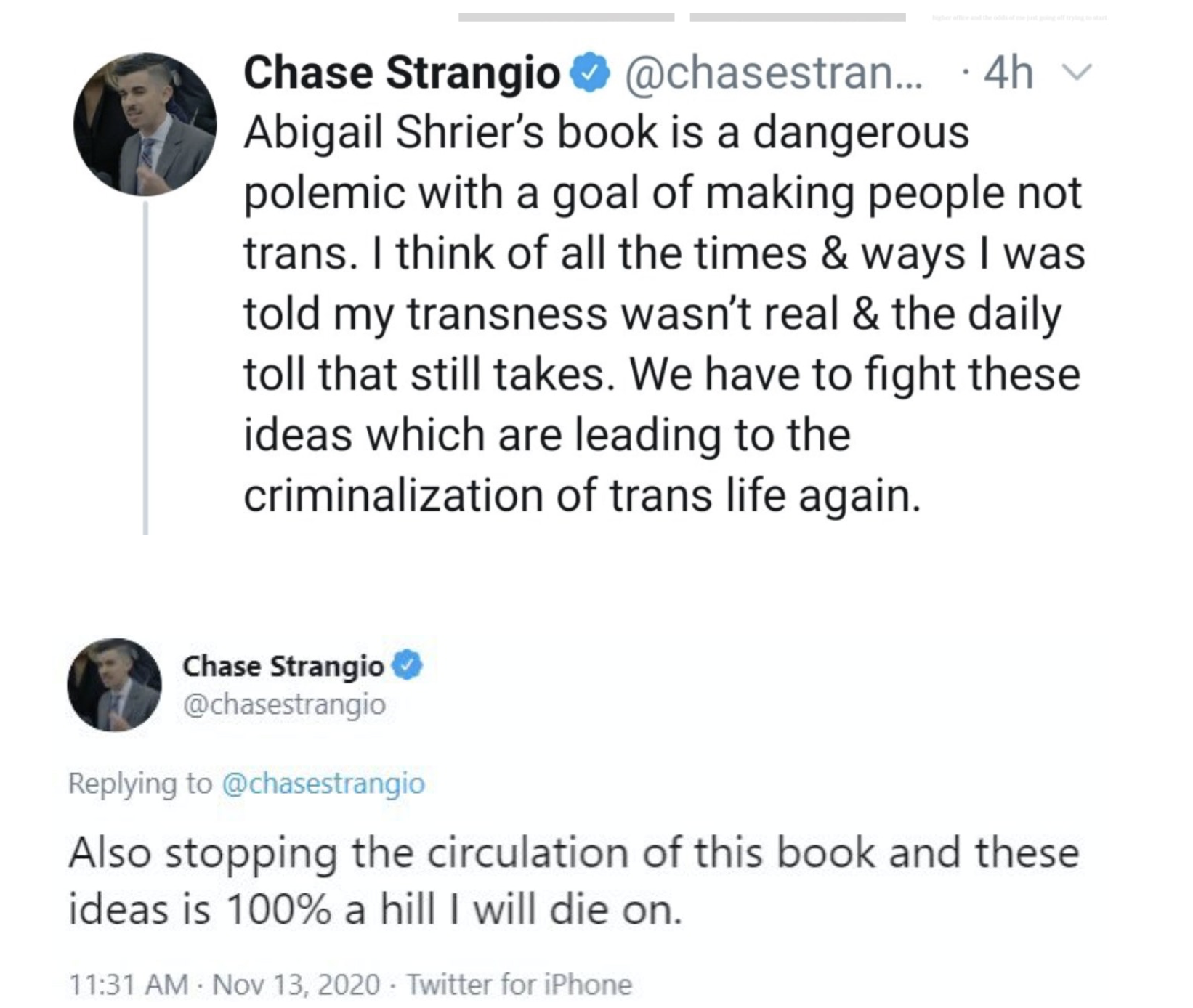
Two days ago, Chase Strangio of the "free speech" ACLU Tweeted that Shrier's book should be censored.

This is the sort of Tweet on posts when one has not actually read Shrier's book.  I am halfway thru her book (and I had seen her lengthy interview with Joe Rogan). Strangio's Tweet completely mischaracterized Shrier's book, which shows absolute deference to the personal decisions of transgender adults. She urges that they should all receive the full protection under the law.

In response to Strangio's outrageously false Tweet, Glenn Greenwald writes:

It is nothing short of horrifying, but sadly also completely unsurprising, to see an ACLU lawyer proclaim his devotion to “stopping the circulation of [a] book” because he regards its ideas as wrong and dangerous. There are, always have been, and always will be people who want to stop books from being circulated: by banning them, burning them, pressuring publishing houses to rescind publishing contracts or demanding corporations refuse to sell them. But why would someone with such censorious attitudes, with a goal of suppressing ideas with which they disagree, choose to go to work for the ACLU of all places?

As far the claim that Shrier is engaging in "hate speech," consider this excerpt from her recent article at Quillette "Gender Activists Are Trying to Cancel My Book. Why is Silicon Valley Helping Them?"

Sean Scott, a member of the National Association of Science Writers (NASW), heard of my book in the fall, and shared what he knew with other science writers. He noted that Nature Communications had published a study “to investigate whether autistic traits were elevated in transgender and gender-diverse individuals.” (To no one’s surprise, they are: Autistic children develop all kinds of strongly expressed fixations about the world they perceive.) Then he wrote: “This, along with [Wall Street Journal] columnist [Abigail Shrier’s] recent book on the onset of transgenderism amongst young girls… should hopefully shed some overdue light on a very sensitive, politically charged topic that potentially carries lifelong medical consequences.” Sound like hate speech? I didn’t think so.

This saga will continue with the political Left increasingly embracing its new role as the anti-free-speech party.  The Left is showing an increased willingness cancel good-hearted people based on false pretenses and an exuberant willingness to peddle faux science at least as well as any nut job on the political Right. And perhaps even better than the political Right.

As noted by Shrier in Quillette, she has received much support from parents who are seeing signs of transgender social contagion in their daughters.  The sought to share this information with other concerned parents. GoFundMe quickly shut down these efforts:

Parents who’ve lived through this social contagion—who’d seen it strike daughters who’d never before exhibited signs of gender dysphoria in childhood—became so alarmed at suppression efforts that they dug into their own pockets to promote my work. That’s how I became one of the few authors in the world to have her own billboard in West Hollywood. Other parents started an account on GoFundMe, a website that facilitates fundraising efforts for all sorts of causes. GoFundMe closed the account. The parents started another campaign. GoFundMe closed that account, too. If a mentally fragile 18-year-old wants help removing her healthy breasts, GoFundMe will happily facilitate it. (The site currently hosts over 35,000 campaigns to pay for female “top surgery” alone.) But if you believe your daughter has become caught up in a movement that will leave her angry, regretful, maimed, and sterile, you’re out of luck.

This saga will continue with the political Left increasingly embracing its new role as the anti-free-speech party.  The Left is showing an increased willingness cancel good-hearted people based on false pretenses and an exuberant willingness to peddle faux science at least as well as any nut job on the political Right. And perhaps even better than the political Right.

Where do you draw your line? When are you going muster the courage to speak out against the excesses of Woke culture? Is it when an Attorney for the ACLU actively seeks to ban an important well-researched book by a good-hearted woman? Yes, I'm referring to the ACLU, whose core principle is advocating for free speech. Or is it when there is a concerted nationwide effort (including Amazon, Target and GoFundMe) to refuse to allow discussion of blatantly anti-scientific claims that endanger millions of teenage girls in the U.S.? Not long ago, only 1 in 10,000 people were diagnosed with sexual disphoria. Are we really willing to stand by when 2% of teenagers have now been convinced by activists on social media and disreputable profit-taking healthcare providers that they were born in the wrong bodies?

Continue ReadingACLU Attorney Joins a Nationwide Effort to Ban Abigail Shrier’s Book: Irreversible Damage