Bill Maher (to Adam Corolla):
Jimmy Kimmel, you know he's very mad at me, and I know you're close to him. I help you tell him that, you know I'm sorry that you know he they got bent out of shape. I don't think I did anything wrong. We can have disagreements. I agree you and I don't agree on everything. Look at this clash now, and yet we're cool (Bill Maher and Adam Corolla), like the Republicans are always.
This is the difference between the right and the left. It bugs me so much. My tribe is supposed to be the left, but these are the people who just can't talk to you unless you're exactly there, whereas the Republicans, they always fucking come to my show. John Kennedy from Louisiana, right? was on last week, took his beating like a man, like they all do, and we came across lovingly and smilingly and happily. And we can disagree when you and I aren't always completely on the same page, although we're very close because we're both smart guys. But like, I just don't get that from Jimmy. I'm sorry. Like, I think he is one of the nicest guys. I did a mea culpa when we exchanged emails, not about what he was complaining about, but just saying, like, you know, sometimes I am a little brash about me when they compare me with the other late night guys.
And I'm not like, you guys. I'm not. You could all exchange your monologs, all of you, and no one would know the difference in tone, okay? Whereas me? I'm not there. I don't just buy into the left wing bullshit, and I never stop making fun of the right wing bullshit at all right? If that's not good enough for you, then I think you're the asshole. And I don't think Jimmy is an asshole. No, I think he's a great guy. And it bugs me . . .
Jimmy Kimmel is an excellent proxy for what has happened to many people on the Left. I'm not referring to all people who lean Left, but a significant sub-set. I know many of them. I've been de-friended by more than a few. This subset utilizes a litmus test. If you don't check all of their boxes, they see you as the enemy, as a republican, as a nazi, as a threat. But time for a reality check: All people disagree with all other people on at least some things and, usually, many topics. It is fantasy to assume that any two people align on every topic and sub-topic of the day. Emphasis on sub-topic here. Immigration, transgender, foreign policy, public assistance, race relations, social justice and every other "topic" is actually a big complex basket of subtopics. Every one of these subtopics invites nuanced conversations involving minor or major disagreements.
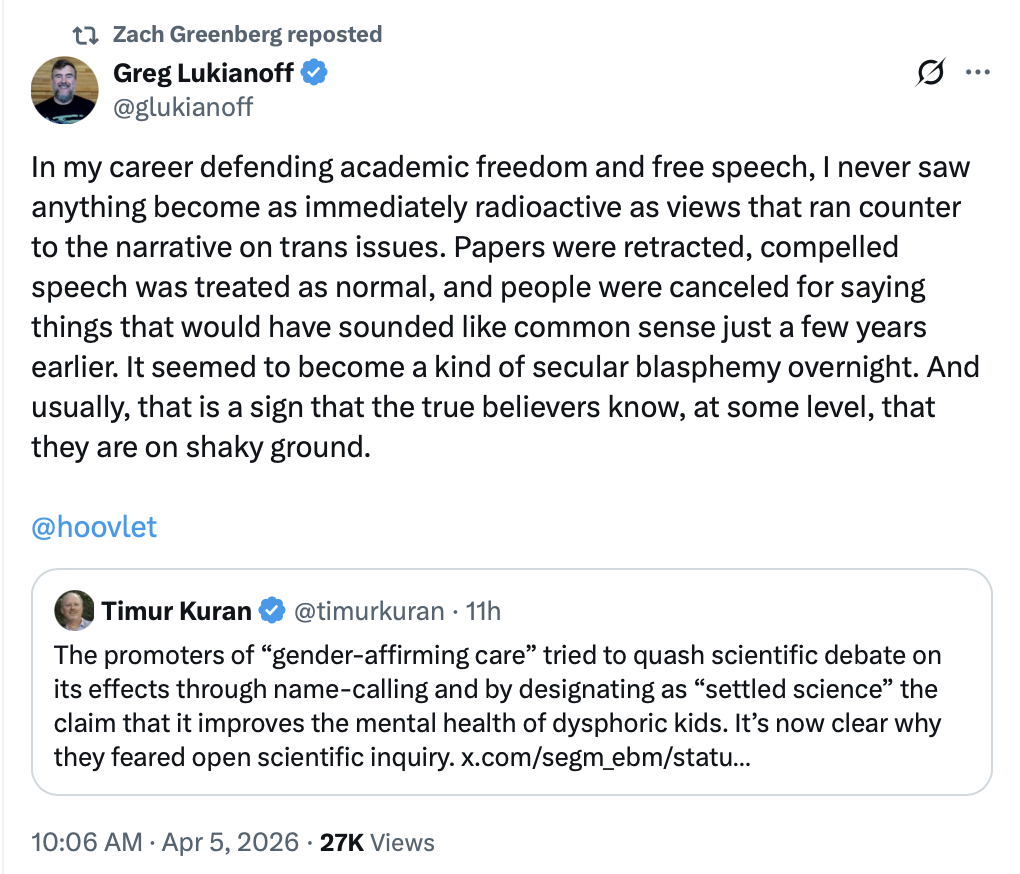
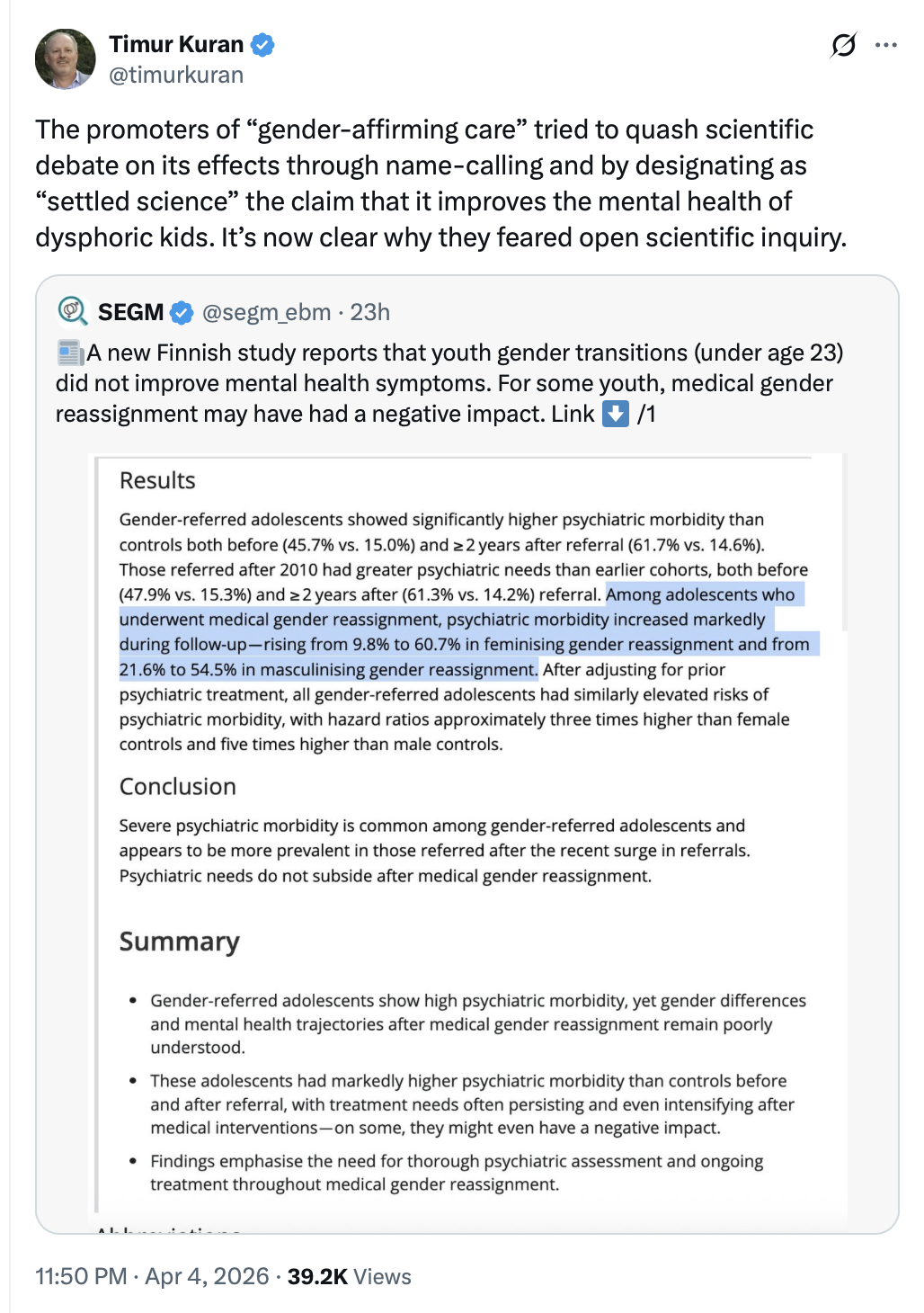
Take for instance, the big basket of topics falling under the label of "transgender." As I have written often, I think every adult should be allowed to do anything they want with their own body and they must be respected, honored and invited to associate with any other person and to fall in love with anyone they choose. Many people on the Left , however, demand absolute obeisance, telling you that if you don't chant exactly like they do, in unison, exactly when and where they chant, you must be kicked out of the friendship. There are many important sub-issues to transgender that should be considered individually. For instance, A) Whether society should change its language to accommodate the alleged (and perhaps real) pain of other people B) whether people who identify as transgender should be treated equally under the law, C) whether it is OK for grade school math teachers to talk about sex with students without their parents' knowledge and consent, D) whether confused children and adolescents should be subjected to surgeries (including mastectomies), "puberty blockers" and cross-sex hormones that leave them permanently disfigured and/or sterile, E) Whether a minor can meaningfully consent to permanent changes to their bodies that render them sterile, F) The extent and type of psychological counseling a minor should undergo before being allowed to engage in transgender surgeries and drugs, G) the extent to which social contagion accounted for the rise (and more recently the fall) in minors declaring that they are "transgender." Whether biological males should be allowed to compete in women's sports, H) whether it is biologically true that trans women are women, I) whether it is OK for a state government to take children away from their parents when state employees disagree with parents on transgender issues, J) Should males be imprisoned along with women, even though rapes and pregnancies are now being reported in those prisons (see here)? K) Whether "LGBTQIA+" is a meaningful descriptor for a a singular community, given the the inherent conflict among those referred to by the letters? I could go on and on.
There are many other sub-issues to "transgender" topic that I could list. For instance, J.K. Rowling has listed a dozen of these sub-issues in her Sept 1, 2025 post on X. I would bet that many people who lean Left would agree with Rowling on many or most of the issues she lists. Yet she has bee labeled a "terf" and threatened with death on many occasions.
The way the topic of "transgender" splinters into countless sub-issues is true of every political and social issue. Anyone being honest knows that, as a country, we face hundreds, potentially thousands, of sub-issues.
This much is indisputable: Every person disagrees with every other person on many of the countless sub-issues of the day. It is impossible for any person to lack any disagreement on some of the sub-issues of the day even with their closest and most loyal friends.
During the Great Awokening, we were falsely convinced that when a friend disagreed with us about an issue or sub-issue it was a personal attack, not a mere disagreement. We started disparaging maxims like "Sticks and stones may break my bones, but names will never hurt me." And this one: "To each his own." The need to express disagreement is embedded in the Constitutional foundation of the United States. That is why our Founders have a brilliantly devised set of checks and balances for resolving or compromising our inevitable differences.
Anyone currently claiming that they have friends who completely agree with them is not talking about someone they really know. They are not talking about actual friends. They are referring to a relationship steeped in dishonesty, based on fear of speaking openly.
I challenge anyone reading this to ask themselves this question: Am I willing to keep loving and engaging freely with friends who disagree with me on some topics and sub-topics? If not, you don't have real friends. Instead, you are starring in your own Truman Show, self-imprisoned in a social cage.
Luckily, you've got the key to you own liberation.
[More ...]