
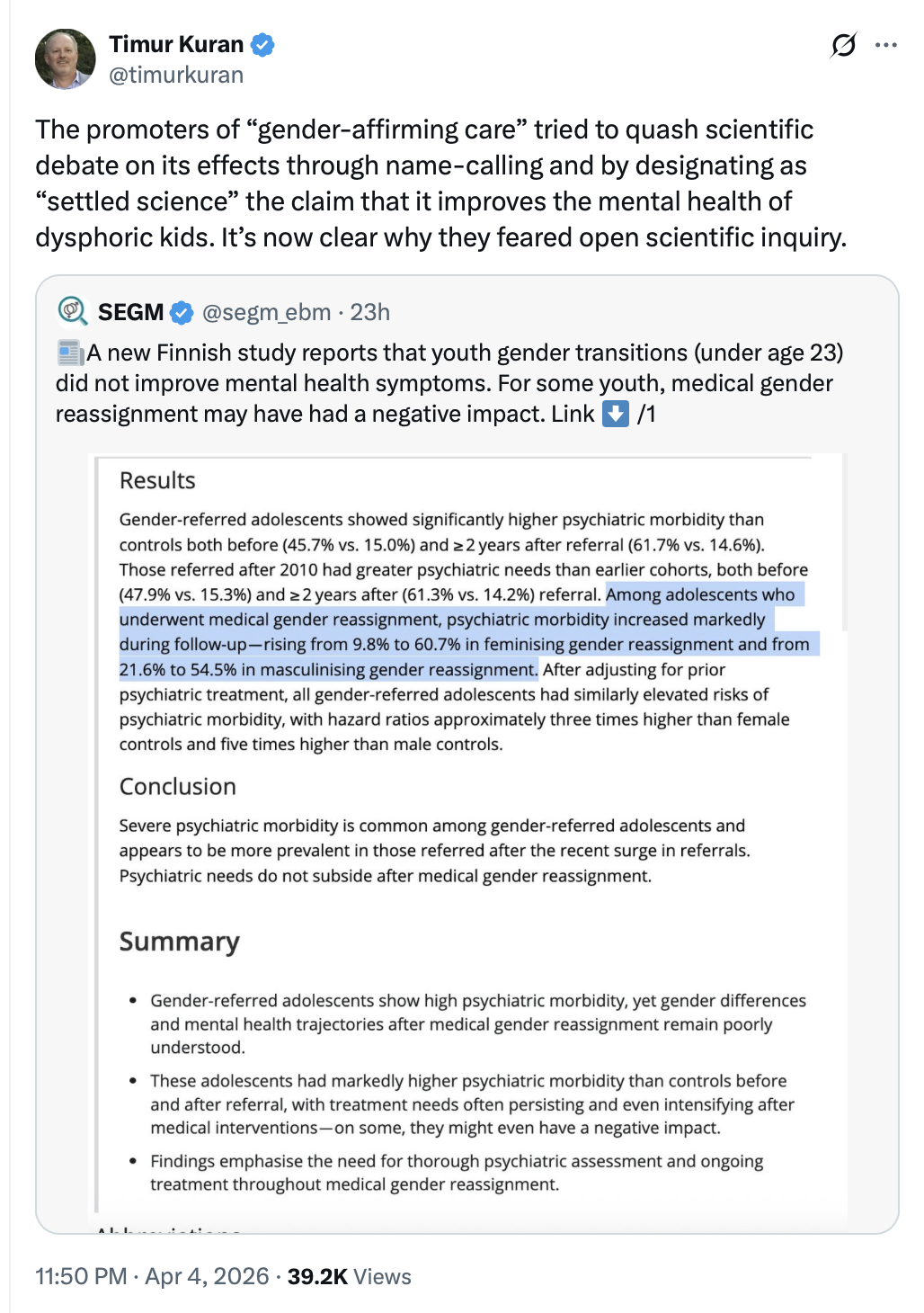
The you remember the inorganic wave of brand new “obvious” things we were all supposed to believe and say about transgender topics? I agree with Greg Lukianoff that it was surreal. I spoke up with questions and concerns that were repeatedly blasted with religious fervor. But here we are now, and it’s clear that the transgender religious movement distorted everything around it, including our First Amendment rights. One big moment to upright the ship was the Cass Report. Another was Abigail Shrier’s courageous book. Another was the mass closing of transgender clinics, starting with Tavistock. And now a new Finnish study.
[You can see many many posts on this topic (I published more than 150 articles at this site) here:
Greg Lukianoff:
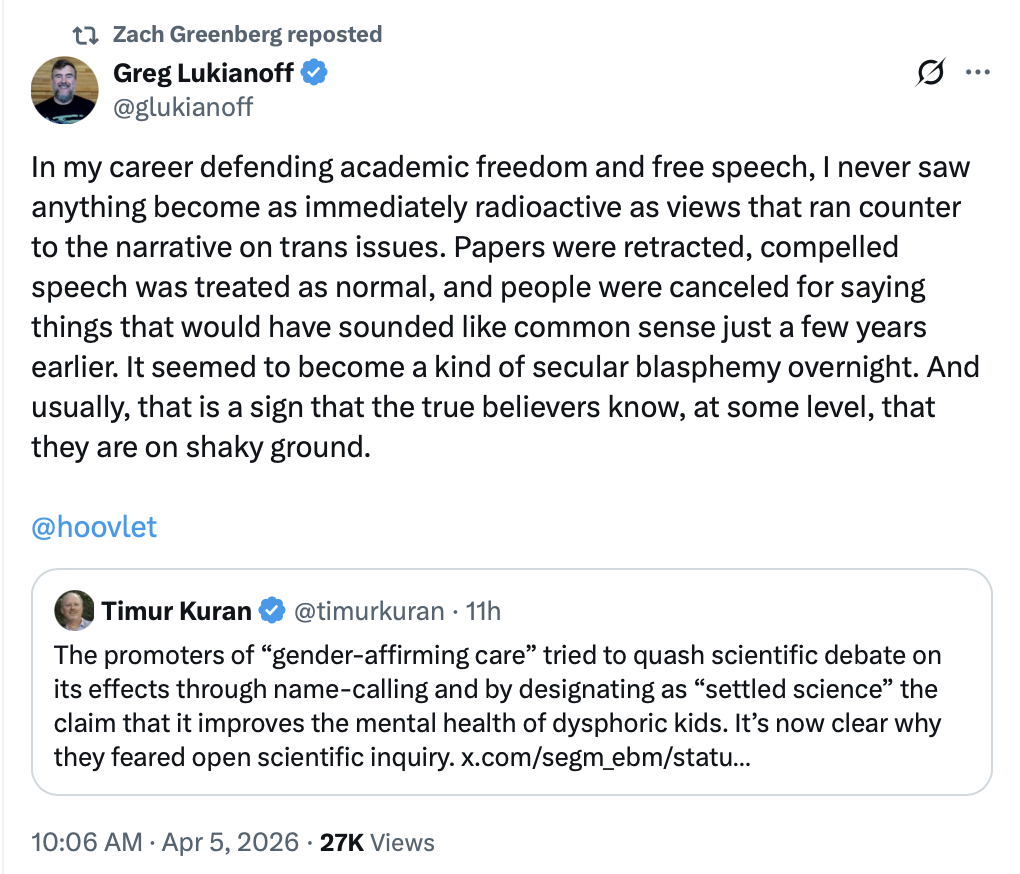
In my career defending academic freedom and free speech, I never saw anything become as immediately radioactive as views that ran counter to the narrative on trans issues. Papers were retracted, compelled speech was treated as normal, and people were canceled for saying things that would have sounded like common sense just a few years earlier. It seemed to become a kind of secular blasphemy overnight. And usually, that is a sign that the true believers know, at some level, that they are on shaky ground.
[Supp]
Why did this tsunami happen? Lukianoff:
As my co-author Jonathan Haidt has pointed out, morality on the left became increasingly unipolar, with care for victim groups treated as perhaps the only important moral end. But once people on the left had defended other perceived victim groups, there seemed to be only one place left to go. The result was that the issue was pursued as a quasi-religious social movement rather than as a scientific or public policy question that needed to be carefully thought through and rigorously examined. Once people’s identities revolved around the idea that compassion and care were the highest moral ends, and therefore essentially sacred, hysteria was bound to follow. The Founders tried to guard against this kind of dynamic through things like the pairing of the Free Exercise and Establishment Clauses, but those protections do not work as well when the ideology in question does not call itself a religion.
This is a real problem. I have been thinking a great deal about how to address the problem of religious-like certainty attaching itself to beliefs that are not formally religious, and I still cannot see a solution that would not risk becoming a disaster itself. But I am still pondering it.

