Cancel Culture, Again

Today I felt compelled to post this on Facebook, where it will probably fly over the heads of the intended targets:

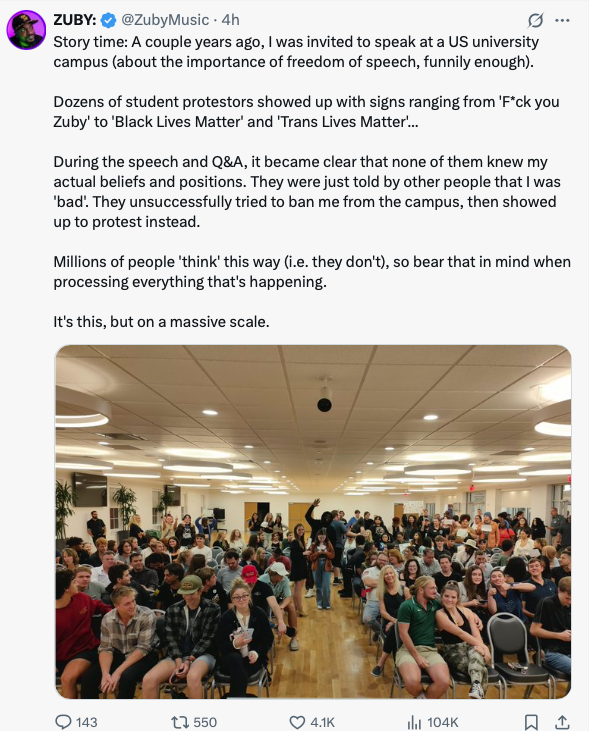
When I read something I disagree with, it has never occurred to me to engage in ad hominem attacks, in other words, to call the author names or to characterize them as morally repulsive or suspect. I don't comment on posts and articles that I haven't actually read. And when I read something I disagree with, I put some effort into giving the author his or her best foot forward. I work hard to avoid characterizing people as "good" or "bad." "Good" people often make errors or have lapses in judgment. "Bad" people often say things that are true, even wise.

If one disagrees with a post, there's always the option of disagreeing with the content (foregoing the ad hominem attacks). One can also ignore the post or even stop following that person. To the various people on this site who prefer ad hominem attacks to civil discourse (they might not realize who they are), I suggest "The Canceling of the American Mind," an excellent book by Greg Lukianoff. https://www.simonandschuster.com/books/The-Canceling-of-the-American-Mind/Greg-Lukianoff/9781668019153

Continue ReadingCancel Culture, Again

Stark Sex Differences Re Intolerance of Opposing Viewpoints

Fascinating research from "The Eternally Radical Idea." Worth reading Chapin Lenthall-Cleary's entire article here.

Amazingly, it turns out that men are often more tolerant of the opposite side than women are of their own side.

The data comes from FIRE’s annual College Free Speech Rankings, which is designed to gauge the state of free speech on American college campuses as well as student attitudes toward free speech. This includes gauging students’ feelings towards allowing various hypothetical speakers on campus, which we can break down by various characteristics. When evaluating the data based on gender, some shocking trends arise.

Men are, on average, significantly more tolerant and less censorious than women. By contrast, while political affiliation makes people more biased towards speakers on their side, it affects their overall willingness to let speakers speak, regardless of ideology, very little. However, regardless of party or ideology, men are significantly more tolerant than women, so much so that the gender difference dominates the ideology difference. This effect is even more acute in the extremes: men are over 3.5 times more likely than women to be “perfectly tolerant” of opposing views — meaning they would definitely allow any campus speakers, including those they disagree with.

Further,

And while left-wing women are stereotypically seen as being uniquely censorial, the reality is that this tendency applies to all groups of women, regardless of ideology.

And this:

Democrat-leaning independents are more tolerant of both sides than Democrats, and Republican-leaning independents are more tolerant of both sides than Republicans. Again, however, we see the stark effects of gender on these measurements: male Democrats are more tolerant of right-wing speakers than female Republicans.

And this:

Many women display extreme censorial attitudes, and only towards right-wing speakers.

What is causing this? 

My suspicion, corroborated by other research, is that women have much stronger general opposition to speech that may cause emotional discomfort and a preference for harmoniousness.

One of the above sources was a 2021 Psychology Today Article. Here an excerpt:

  • In a 2019 study, 59% of women said protecting free speech was less important than promoting an inclusive society, while 71% of men felt opposite.
  • Two recent studies of online adults revealed that women were more censorious than men.

Continue ReadingStark Sex Differences Re Intolerance of Opposing Viewpoints

Two Flavors of Free Speech

Before we have a debate about a topic--here, "free speech"--we should decide exactly what we mean by "free speech," which encompasses far more than the First Amendment. Excellent point by Geoffrey Miller:

Constitutional free speech is grounded in clear rights, laws, precedents, & principles, centered around retraining gov't from meddling in public discourse. We should strongly protect constitutional free speech, and be very wary of gov't censorship -- whether directly, or through gov't collusion with Big Tech, social media, or AI companies.

However, cultural free speech is much more complicated, nuanced, and subject to renegotiation -- which is what we've been seeing over the last ten years, and especially in the last week.

Civilized people accept thousands of informal restraints on cultural free speech. For example, we use the power of informal social rewards and punishments to discourage

- kids from lying

- spouses from dissing each other

- journalists from acting like propagandists

- teachers from indoctrinating students

- companies from violating traditions and trust

- people from burning our flag

- sociopathic trolling on social media

- comedians from making false & incendiary claims

- politicians from demonizing their opponents to incite political violence among their supporters

All of these are restraints on 'cultural free speech', and they could be seen as micro-versions of 'cancel culture', but they're widely supported, and they're not directly related to gov't censorship or First Amendment law.

Yes, the First Amendment helps establish and reinforce the social norms around cultural free speech, and cultural free speech helps reinforce the willingness of citizens, politicians, & judges to protect our First Amendment rights.

But I see a lot of people, on both Left and Right, confusing the two forms of our civilization's commitment to free speech.

Continue ReadingTwo Flavors of Free Speech

The Function of “Words Are Violence”

Translation of “Words are Violence”: A) You need to shut up and let ME talk. B) I am the sole judge of what words you are permitted to speak. C) I’m so fragile that I can’t bear to talk with people I disagree with. D) I forbid you to use facts, logic and persuasion while we talk. E) If you say anything I don't like, it will be blasphemy and sacrilege and it proves that you are a bad person engaged in "hate speech." F) I am justified ending our relationship and/or inflicting violence on you if your words piss me off.

The above attitude does not invite meaningful debate of anything of importance. Thus:

In "Bury the ‘words are violence’ cliché," Greg Lukianoff reminds us that words are not like bullets:

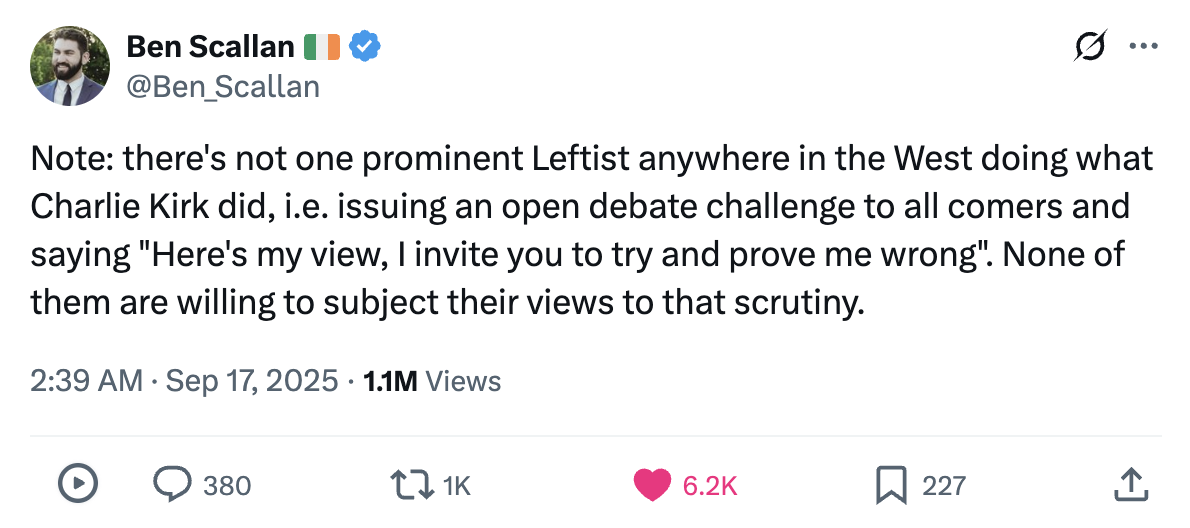
I had my disagreements with Charlie Kirk—sometimes sharp ones—but none of that matters right now. What I respected, and too many of his critics never noticed, was that he showed up. He stood in the quad, took hard questions, argued back, let students argue back at him. That takes time, patience, and courage. Our culture has been teaching young people to scorn that everyday civic courage and to treat contested speech as a kind of physical harm. On that Utah campus we received the final proof that “words are like bullets” is a poisonous and cruel metaphor.

In other words, what looks like a plea for civility is actually a threat. This pertains to both "Words are Violence" and claims of "Hate Speech."

Continue ReadingThe Function of “Words Are Violence”