Christopher Hitchens Advocates for Free Speech
Excellent presentation by Christopher Hitchen, discussing free speech in 2006:

Excellent presentation by Christopher Hitchen, discussing free speech in 2006:
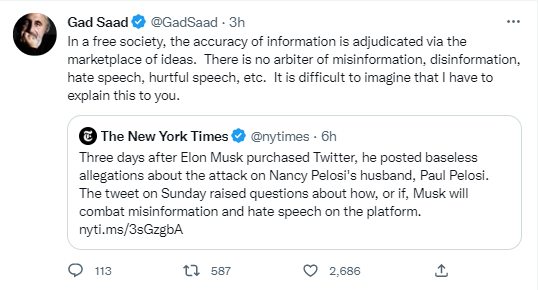
I am repeatedly stunned by the number of people, many of them claiming to be politically progressive, who willingly and consciously refuse to recognize this distinction:
I wholly disapprove of what you say and will defend to the death your right to say it.
Voltaire
We need to be more aggressive about the evil of censorship. Censorship is a blatant lie, disguised as an action. It is the false claim that there is no other side to the story. Or it's a false claim that any challenge to the prevailing narrative is bullshit before we even hear it. Censorship constitutes lies of omission. It is a technique for manipulating people by deceiving them. When used on social media, censorship is a tactic for fooling innocent users that a view is universally embraced when it is actually contested and, in fact, might be the minority view.
Walter Kirn has personally and repeatedly seen the corruption of Twitter. An excerpt from his article at Common Sense:
My forebodings were confirmed with the launch of the “Russiagate” investigation. I doubted its premises highly from its inception, but when I voiced these doubts on Twitter curious things occurred. My tweets on the subject, my followers reported, often were invisible to them, and yet, to my eye, they drew engagement. Strange. The Twitter users who “liked” my tweets tended to have tiny followings, I found, and they didn’t follow me. Their profile photos were often stock images. I ran an experiment one night and sent out a tweet of a controversial nature which I expected would be suppressed or screwed with, and then, when it was, I used screenshots of the mischief to prove to my followers that Twitter was dishonest.
I looked crazy. Concerned DMs arrived. One accused me of grandiosity for thinking I mattered enough to provoke intervention from on high. Innocence about Twitter still prevailed then; its cheerful bluebird logo still charmed the public mind. We had yet to learn, as we finally did this week (in a manner which confirmed my worst suspicions) of the hidden but direct coordination between Twitter’s management and the government, including the Department of Homeland Security, to suppress and guide opinion on topics from war to public health. (“One could argue we’re in the business of critical infrastructure, and the most critical infrastructure is cognitive infrastructure,” one government official put it.)