Matt Taibbi’s Commentary on the Tearing Down of Old Twitter and (Hopefully) its Rebirth

As I've expressed repeatedly on this site (but more often and with detailed substantiation on my website, Dangerous Intersection), I have no little respect for much of what passes as "journalism" at America's best known legacy media outlets. They have repeatedly preached to us and censored dissenting views on major stories instead of letting the facts fall where they may and inviting us to evaluate those facts on our own. That is why trust in major media is at an all time low: only 11% of us have a lot of confidence in our newspapers and television news. For years, Twitter has been the water cooler for those seeking to shape media narratives and jam them down our throat. That is changing and I am ever cognizant of the wailing and gnashing of teeth, along with the gaslighting, I am hearing from the increasingly disempowered "journalists" who have been the most active at censoring. I applaud the efforts of Matt Taibbi, Bari Weiss, Michael Shellenberger and others who are now revealing the many ways in which Twitter has been falsely presenting itself as a forum for free speech.

Today, Matt Taibbi posted background on the ongoing Twitter revelations. I expect that many people will appreciate these revelations but will not comment publicly (though many will applaud these development privately to me, as they have been doing for several years on many contentious issues). I also expect that more than a few people will publicly respond to Taibbi's comments (and my own) with a creative barrage of ad hominem comments--that's exactly what people do when can can't make honest arguments. Every time I see this behavior, I recognize it as stark symptoms of Nietzschean ressentiment. Here is an excerpt from Taibbi's most recent article, "Note to Readers on the "Twitter Files"":

A lot has been made about the line about how I “had to agree to certain conditions” to work on the story. I wrote that assuming the meaning of that line would be obvious. It was obvious. Still, the language was just loose enough to give critics room to make mischief, and the stakes being what they are, they of course did. That’s on me, and a lesson going forward. For the record, the deal was access to the Twitter documents, but I had to publish on Twitter. I also agreed to an attribution (“Sources at Twitter”). That’s it.

Everyone involved with the project, including myself as well as Bari Weiss and Michael Shellenberger, has editorial control. We’ve been encouraged to look not just at historical Twitter, but the current iteration as well. I was told flat-out I could write anything I wanted, including anything about the current company and its new chief, Elon Musk. If anything, the degree of openness on that front freaked me out a little initially, being so far from any other experience I’ve had.

In our initial meeting, Musk talked about how he thought a “full confessional restores faith in the company,” and everything I’ve seen since seems to confirm he’s sincere about his desire for full open-kimono transparency with the public. He says we’re “welcome to look at things going forward, not just at the past,” and until I run into a reason to believe otherwise, I’m taking him at his word. I’d be crazy not to, considering the access we’ve already been given. This is a historic opportunity, and I think we’re all trying to treat that opportunity with the appropriate respect, which among other things means staying as focused as we can be on the documents, and trying to make as much sense of them as we can, as quickly as we can....

In this particular instance, the story has to come out on Twitter. There’s the obvious deep irony of using the familiar drip-drip-drip format and uncontrollable virulality of Twitter to roast Twitter itself. We’re also using an inherently destabilizing medium to expose efforts to turn Twitter into an authoritarian instrument of social control. There’s genius in this. Now I would feel wrong even thinking of doing it any other way.

This is especially the case since a major subtext of the Twitter Files project is what a burn it is on conventional/corporate media, whose minions tried for years to turn Twitter into a giant conformity machine, and cheered each new advance in censorship and opinion control. Those same people now have to watch in helplessness as one horrifying revelation after another spills out, guerrilla-style, into what was not long ago their private playground. This, too, couldn’t be scripted better. It’s like sending an intercontinental shit-missile screaming into the dais of the White House correspondents’ dinner at 15,000 m.p.h. If you can’t see the humor in this, you probably never had a sense of humor to begin with.
Continue ReadingMatt Taibbi’s Commentary on the Tearing Down of Old Twitter and (Hopefully) its Rebirth

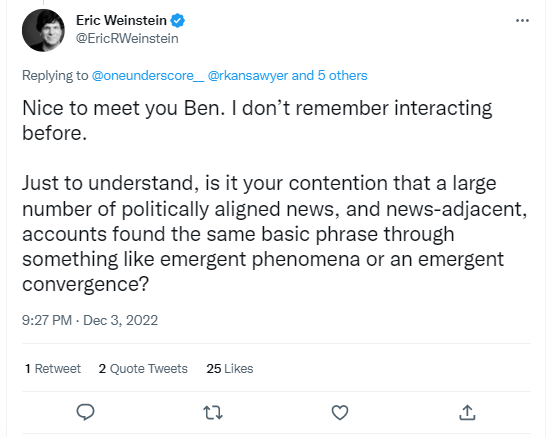
Eric Weinstein Schools Ben Collins on Cookie Cutter Talking Points Employed by Elitists Pretending to be Journalists

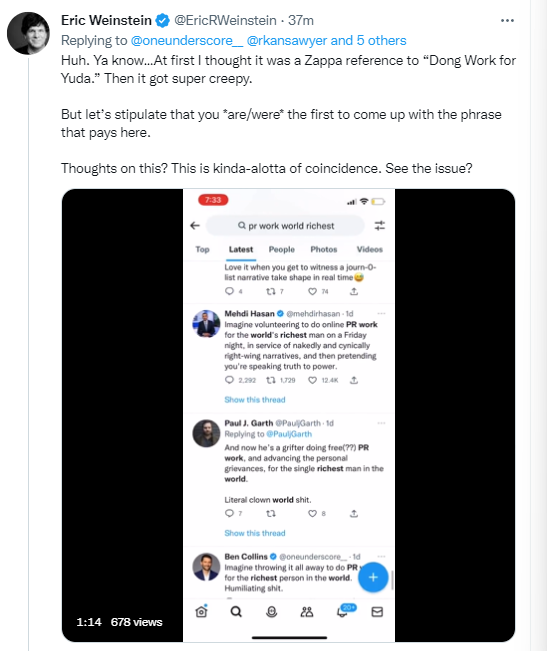
Eric Weinstein Points out a big problem for Ben Collins and others pretending to be journalists of Legacy Media Outlets:

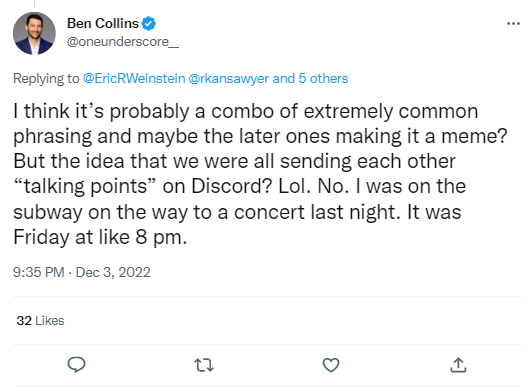
Ben Collins protests too much:

Weinstein then inserts the dagger (click this image to let it scroll for the full effect):

Collins is such a joke, not a journalist.

Continue ReadingEric Weinstein Schools Ben Collins on Cookie Cutter Talking Points Employed by Elitists Pretending to be Journalists

Elon Musk’s New Role as Guardian of the Gates of Hell

Today's pro-censorship crowd doesn't seem to want to understand that the censorship powers they put into place today will eventually be used against them, possibly in the new future. Here's an excerpt from Glenn Greenwald's latest post:

It was easy to predict that there would be an all-out war from Western power centers if Musk sought to mildly reduce censorship on Twitter. Still, the media outdid itself.

It is hard to overstate how manic, primal and unhinged is the reaction of corporate media employees to the mere prospect that new Twitter owner Elon Musk may restore a modicum of greater free speech to that platform. It was easy to predict — back when Musk was merely toying with the idea of buying Twitter and loosening some of its censorship restrictions — that there would be an all-out attack from Western power centers if he tried. Online censorship has become one of the most potent propaganda weapons they possess, and there is no way they will allow anyone to dilute it even mildly without attempting to destroy them. Even with that expectation in place of what was to come, the liberal sector of the corporate media (by far the most dominant media sector) really outdid itself when it came to group-think panic, rhetorical excess, and reckless and shrill accusations.

In unison, these media outlets decreed that not only would greater free speech on Twitter usher in the usual parade of horribles they trot out when demanding censorship — disinformation, hate speech, attacks on the “marginalized,” etc. etc. — but this time they severely escalated their rhetorical hysteria by claiming that Musk would literally cause mass murder by permitting a broader range of political opinion to be aired. The Washington Post's Taylor Lorenz even warned of supernatural demons that would be unleashed by these new free speech policies, as she talked to a handful of obviously neurotic pro-censorship “experts” and then wrote about these thinly disguised therapy sessions with those neurotics under this headline: “‘Opening the gates of hell’: Musk says he will revive banned accounts.”

Continue ReadingElon Musk’s New Role as Guardian of the Gates of Hell

MIT Advises How to Write a Winning Diversity Statement

At Why Evolution is True, Jerry Coyne posts on how to please the DEI department by writing an acceptable diversity statement.

The MIT site says this:

A diversity statement alone is unlikely to get you an interview or a job offer, but a well-written diversity statement may enable you to stand out among a large pool of qualified candidates.

. . . in reality, in some places like Berkeley, if your diversity statement isn’t up to muster you have no chance of getting a job, no matter how good your academic qualifications are (see here and here). And since you have to talk about efforts you have made in the past to increase diversity, as well as your philosophy of diversity, you have to start doing social-justice work well before you intend to apply for jobs. Woe to those students who have immersed themselves wholly in quantum mechanics or classical literature out of the love of the field and of knowledge. Without a track record in promoting diversity, as well as a philosophy of diversity, those people are doomed.

I don’t of course object to universities encouraging diversity efforts as a way to “broaden” a candidate, but there are many ways to be broad besides fighting for equity of races and genders. These include doing general outreach to high schools, writing popular books and articles on your field, doing an internship at a newspaper or other organization,, and so on. But those don’t count nearly as much as showing your history of fighting for equity. And is this attempt to turn universities from places of learning into instruments of specific types of social justice that bothers me. As Stanley Fish said (it’s a book title): “Save the world on your own time.”

And, in the end, DEI statements may be illegal. As my colleague Brian Leiter (a law school prof) pointed out, such required statements, if used to cull candidates, may constitute illegal “viewpoint discrimination”. As he notes:

I recommend that those applying for jobs in the University of California system say only this in the diversity statement: “I decline to supply this statement which constitutes illegal viewpoint discrimination in violation of my constitutional rights.” There are already lawyers gearing up to bring legal challenges; I hope they act soon. If you have been rejected from a University of California search, and suspect it was on grounds of insufficient ideological purity about “diversity,” please get in touch with me. I can connect you with one public interest legal organization looking for plaintiffs.

FIRE (Foundation for Individual Rights and Expression) is also concerned about Diversity Statements. Here is an excerpt from FIRE:

FIRE is concerned by the proliferation of college and university policies requiring faculty applicants or current faculty to demonstrate their commitment to “diversity, equity, and inclusion,” often through a written statement that factors into hiring, reappointment, evaluation, promotion, or tenure decisions. In our newly released Q&A and full Statement on the Use of Diversity, Equity, and Inclusion Criteria in Faculty Hiring and Evaluation, we explain how DEI statement policies can too easily function as ideological litmus tests that threaten employment or advancement opportunities for faculty who dissent from prevailing thought on DEI.

Over the past few years, FIRE has heard from countless faculty members concerned that their university’s DEI statement policy violates the First Amendment, academic freedom principles, or both. Numerous complaints have prompted FIRE’s intervention.

Our statement provides guidance to universities to ensure they respect faculty members’ expressive freedom when seeking to advance DEI.

Continue ReadingMIT Advises How to Write a Winning Diversity Statement

Everyone Sometimes Goes Off the Rails: Sam Harris Takes a Pratfall in the Limelight

Some people call the problem "hubris," which makes it sound like it's a problem stemming from conscious conceit. I see the problem as more insidious. The cause is completely silent and invisible, capable of toppling us in broad daylight even when we are trying to be step-by-step careful with our facts and analysis. Daniel Kahneman warned us ever so clearly in Thinking: Fast and Slow.

The silent process by which our thought-process falls off the rails is based on a cocktail that includes confirmation bias (evidence that conflicts with our view of the situation is invisible) and WYSIATI (We tend to focus on the thing in front of us to the exclusion of everything else). Jonathan Haidt warns us that the only way to protect ourselves from the confirmation bias is to engage with a heterodox crowd, constantly and enthusiastically subjecting ourselves to many viewpoints and perspectives, including those we find distasteful and sometimes even odious. Engaging with otherly others is the only way to protect ourselves from falling off the rails. The key is that you can't merely pretend to listen to other viewpoints. You gain nothing by trying to simply look open-minded. You need to consciously entertain those viewpoints and to let those often distasteful challenge your deepest convictions.

I suspect that "hubris" mostly caused by the thought that although other people fall off the rails, we are immune because we are especially smart/careful/creative/self-critical. That overconfidence makes us vulnerable to massive intellectual failures that can only be seen by others, not by ourselves. Sam has been brilliant for many years on many topics. He has engaged with some of the most serious-minded people in the world on complex topics. The paradox is that even though his work serves him well as an intellectual gymnasium, it seems to have given him the false confidence that he was so good that there was no risk that he would fall off the rails. Maybe he assumed that his own impressive intellect (and it has been impressive) did its on self-critical thinking. It often did. But that is not enough. One cannot really also be one's own critics, not day in and day out.

Choosing to test our views by subjecting them to views other other people that we find distasteful is John Stuart Mill 101. Those who fail to do this don't understand the views of anyone else and they don't even understand themselves. JSM: “He who knows only his own side of the case knows little of that."

Sam Harris has been running through more than a few stoplights over the past few years. He has often become intensely personal in his attacks against extraordinarily thoughtful people such as Glenn Greenwald and Brett Weinstein. His recent decision to cancel his Twitter account also seems to be a personal attack aimed at Elon Musk's quest to disband most of the censorship department at Twitter.  Sam's recently-expressed hesitance about free speech, however, is a dangerous short-term myopic reaction. Sam didn't appreciate it, but he needed more exposure to more viewpoints that challenged his own. He needed this strong medicine regarding his rigid views on CDC guidance re COVID, for example, something that he finally seemed to admit a few days ago on his visit with Bill Maher on the Club Random podcast. [More ... ]

Continue ReadingEveryone Sometimes Goes Off the Rails: Sam Harris Takes a Pratfall in the Limelight