
The Hate Speech Exception to the First Amendment

Contrary to the title of this post, there is no hate speech exception to the First Amendment.

FIRE explains

There is no “hate speech” exception to the First Amendment. So, many Americans wonder, "is hate speech legal?"

Contrary to a common misconception, most expression one might identify as “hate speech” is protected by the First Amendment and cannot lawfully be censored, punished, or unduly burdened by the government — including public colleges and universities.

The Supreme Court of the United States has repeatedly rejected government attempts to prohibit or punish “hate speech.” Instead, the Court has come to identify within the First Amendment a broad guarantee of “freedom for the thought that we hate,” as Justice Oliver Wendell Holmes described the concept in a 1929 dissent. In a 2011 ruling, Chief Justice John Roberts described our national commitment to protecting “hate speech” in order to preserve a robust democratic dialogue:

Speech is powerful. It can stir people to action, move them to tears of both joy and sorrow, and—as it did here—inflict great pain. On the facts before us, we cannot react to that pain by punishing the speaker. As a Nation we have chosen a different course—to protect even hurtful speech on public issues to ensure that we do not stifle public debate.

In other words, the First Amendment recognizes that the government cannot regulate “hate speech” without inevitably silencing the dissent and dialogue that democracy requires. Instead, we as citizens possess the power to most effectively answer hateful speech—whether through debate, protest, questioning, laughter, silence, or simply walking away.
Continue ReadingThe Hate Speech Exception to the First Amendment

How to Marginalize Ideas and People to Create an Illusion of Consensus, Hurting People in the Process

A story of hubris by the powers that be. This could also be characterized the sort of thing Jonathan Haidt would characterize as "structural stupidity":

People who try to silence or intimidate their critics make themselves stupider, almost as if they are shooting darts into their own brain.

What follows is an Excerpt From The Free Press. "Government Power v. People Power," By Dr. Jay Bhattacharya:

From the beginning of the Covid-19 pandemic, I was a vocal critic of lockdowns and school closures that I believed would cause more harm than good. In October 2020, with Sunetra Gupta of Oxford University and Martin Kulldorff of Harvard University, I wrote the Great Barrington Declaration, which proposed protecting vulnerable people while lifting lockdowns for the majority of the population. In other words, it advocated a return to classic principles of pandemic management that had worked to limit the harm of other respiratory virus pandemics. Tens of thousands of scientists signed on.

Four days after we wrote it, the head of the National Institute of Health, Francis Collins, wrote to Anthony Fauci, labeling us as “fringe epidemiologists” and calling for “a quick and devastating published takedown” of the declaration. A propaganda campaign quickly ensued, with various media sources falsely accusing me of wanting to let the virus rip. It wasn’t just the press. Recently I learned in these pages that Twitter placed me on a secret blacklist to limit the reach of my tweets.

So what did I learn in 2022? I learned in a very concrete and painful way the effects of Washington and Silicon Valley working together to marginalize unpopular ideas and people to create an illusion of consensus.

This censorship and smear campaign deprived the world of a needed debate over Covid policy and might have avoided much unnecessary suffering by children, the poor, and the working class harmed by lockdowns.

[Dr. Jay Bhattacharya is a professor of health policy at Stanford University, where he has taught in the medical school for over two decades].

Here is an excerpt from the Great Barrington Declaration:

Fortunately, our understanding of the virus is growing. We know that vulnerability to death from COVID-19 is more than a thousand-fold higher in the old and infirm than the young. Indeed, for children, COVID-19 is less dangerous than many other harms, including influenza.

As immunity builds in the population, the risk of infection to all – including the vulnerable – falls. We know that all populations will eventually reach herd immunity – i.e. the point at which the rate of new infections is stable – and that this can be assisted by (but is not dependent upon) a vaccine. Our goal should therefore be to minimize mortality and social harm until we reach herd immunity.

The most compassionate approach that balances the risks and benefits of reaching herd immunity, is to allow those who are at minimal risk of death to live their lives normally to build up immunity to the virus through natural infection, while better protecting those who are at highest risk. We call this Focused Protection.

Continue ReadingHow to Marginalize Ideas and People to Create an Illusion of Consensus, Hurting People in the Process

Ibram Kendi’s Confession

I sometimes think back to 2021, when Ibram Kendi unwittingly self-destructed. The episode was described by Professor of Political Science and author Wilfred Reilly at FAIR:

On October 29, the newly minted MacArthur “genius” posted the results of a widely discussed survey project on Twitter, saying simply: “More than a third of white students lied (about their race) on their college applications.” Kendi went on to claim that about half of the students who chose dishonesty falsely identified themselves as Native American—presumably to benefit from affirmative action programs—and that “more than three-fourths” of all students who lied about their racial background were accepted to colleges they applied to. As any academic should, Kendi duly linked his source, which I also provide here.

The backlash to Kendi’s comments was immediate, and, frankly, rather predictable. As Oliver Traldi details for Quillette, and as Jerry Coyne does for the popular blog Why Evolution Is True, conservative and heterodox intellectuals pointed out that Kendi’s claim about white students seeking to benefit from affirmative action logically debunks the main thesis of his scholarly work. Founder and former editor of The Intercept Glenn Greenwald not only questioned the objective accuracy of Kendi’s data, but also noted that his argument “negates every core contention about American society on which his career is based.” Journalist Alex Griswold described Kendi as having “blown up his life’s work,” noting that Kendi would “have to delete” his tweet, which, in fact, he did.

Reilly is the author of an excellent book of topics we should be discussing regarding social justice: Taboo: 10 Facts You Can't Talk About (2020).

Continue ReadingIbram Kendi’s Confession

The Clouds Part and the Twitter Disclosures Stream In

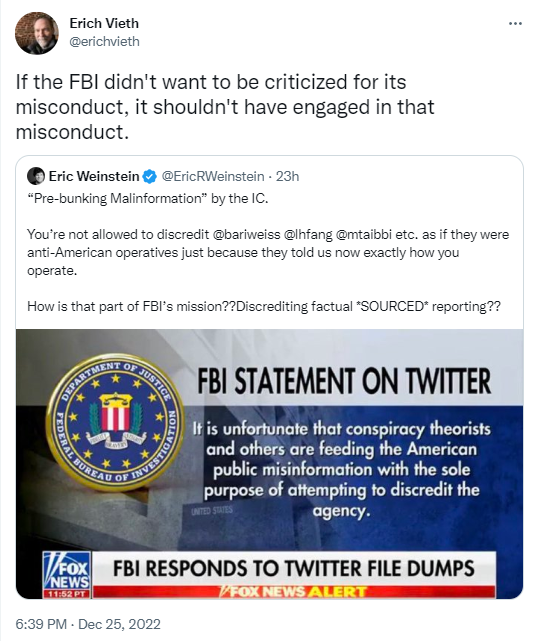
For the past couple weeks, I've been following the release of the Twitter files closely, reading them, piece-by-piece on Twitter (here is Part I of the nine parts so far released). I'm not reading the tamped-down, strategically-filtered and papered-over characterizations of the Twitter files published by self-interested legacy media.

Most people I know are refusing to read the actual Twitter files being dug out of the Twitter archives for us by Matt Taibbi, Bari Weiss and her team, Michael Shellenberger and Lee Fang. They don't understand or care to understand the difference between independent journalists and the big corporations that pretend to employ only serious journalists. Most people I know refuse to read the Twitter files with their own eyes, arguing that they are sure these disclosures are groundless/false/uninteresting/ even though they have not read them. I can understand their hesitancy, given the extent to which they have been misled and betrayed by the "news" outlets they have been trusting. Mark Twain once commented on this challenge: "It’s easier to fool people than to convince them that they’ve been fooled.”

Again, I have read the Twitter files. Every last one of them. Based on these detailed disheartening revelations that our own government has fully and secretly embraced the role of virulently pro-censorship nanny-state, my emotional reaction has been similar to way Matt Taibbi describes his own reaction:

Sometime in the last decade, many people — I was one — began to feel robbed of their sense of normalcy by something we couldn’t define. Increasingly glued to our phones, we saw that the version of the world that was spat out at us from them seemed distorted. The public’s reactions to various news events seemed off-kilter, being either way too intense, not intense enough, or simply unbelievable. You’d read that seemingly everyone in the world was in agreement that a certain thing was true, except it seemed ridiculous to you, which put you in an awkward place with friends, family, others. Should you say something? Are you the crazy one?

I can’t have been the only person to have struggled psychologically during this time. This is why these Twitter files have been such a balm. This is the reality they stole from us! It’s repulsive, horrifying, and dystopian, a gruesome history of a world run by anti-people, but I’ll take it any day over the vile and insulting facsimile of truth they’ve been selling. Personally, once I saw that these lurid files could be used as a road map back to something like reality — I wasn’t sure until this week — I relaxed for the first time in probably seven or eight years.

I'll end with the purported mission statement of Twitter during this lengthy period of abject corruption, government malfeasance and censorship:

The mission we serve as Twitter, Inc. is to give everyone the power to create and share ideas and information instantly without barriers.

In how many ways did Twitter violate its own mission statement. Let us start counting the ways . . .

Continue ReadingThe Clouds Part and the Twitter Disclosures Stream In