Google’s Structural Stupidity
Jonathan Haidt explains that based on Gemini, Google has a serious case of structural stupidity.
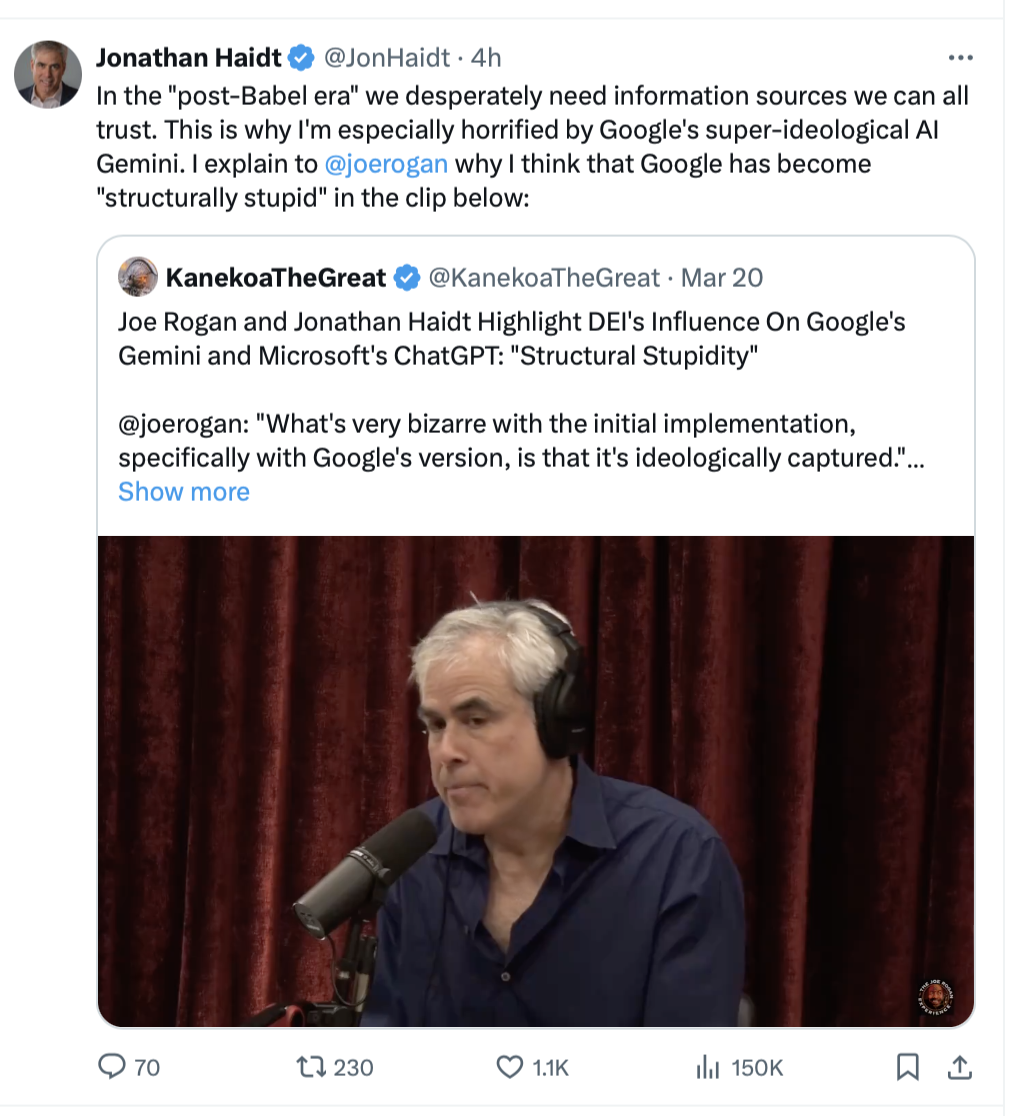

Jonathan Haidt explains that based on Gemini, Google has a serious case of structural stupidity.
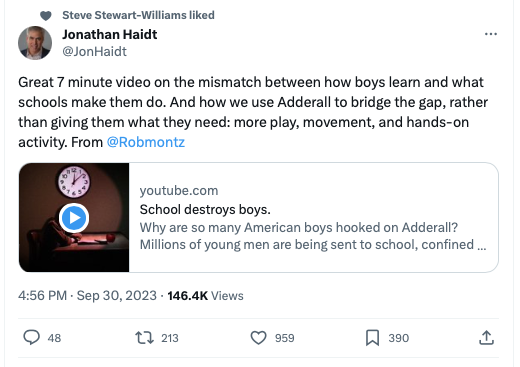
What's more broken? Boys or Schools? This excellent short video recommended by Jonathan Haidt puts much of the blame on schools.
Wokeness is a form of "De-Tot," Decentralized Totalitarianism. Jonathan Haidt discussed this phenomenon with Melissa Chen and Angel Eduardo at FAIR:
So, you know, I, perhaps like many in the audience, have lost money. I was going to say investing in cryptocurrencies, but I'll just say gambling and speculating. And one of the things that's kind of fun about, it's just learning about the blockchain and decentralized finance and realizing that the technology makes it possible to have all kinds of things without anybody in charge.
Many have observed this began in 2015. So I co-founded Heterodox Academy with some other social scientists. Some of our members from Eastern Europe were saying, this is just like what we had in the communist countries: the fear of speaking up the witch trials, the purity spirals.
People ever since then have been using his metaphors like what's happening on campus, what's happening in the world is somehow like the totalitarian countries. But yet, there was no dictator. There was no totalitarian person or authority or office. I think what we have is you might call "De-Tot" It's decentralized totalitarianism. The difference between totalitarian and a dictator is that a dictator tells you what he wants, and he'll kill you if you don't do it. But totalitarianism means it gets into the totality of your life. "We're going to control how you raise your kids what to think the food you eat, the science, everything, control everything." That's very hard to do. It's only been tried a few times, certainly the Russians, the Chinese. Only a few countries have been tried to control everything of your life. And in a way this thing that we call wokeness has elements that are totalitarian, but there's no person. There's no authority. So what you have when everybody can record everybody, when everybody can shame everybody, you get human behavior reacting as if you were in a totalitarian country, but yet there's no totalitarian
I've closely followed the writings of Jonathan Haidt. His conclusions are closely tied to scientific findings. He crosscuts the current American political divide. He is hopeful that we will find our way as a country.
In this recent article at The Atlantic, "Jonathan Haidt Is Trying to Heal America’s Divisions: The psychologist shares his thoughts on the pandemic, polarization, and politics," Haidt explains what has gone wrong with many of those who consider themselves to be liberals and conservatives. What they have in common is authoritarianism populism:
Haidt laments the state of contemporary American politics, believing that on both the right and the left we’re seeing populism that responds to real problems but in illiberal ways. “On the right,” he said, “the populism there is really explicitly xenophobic and often explicitly racist … I think we see strands of populism on the right that are authoritarian, that I would say are incompatible with a tolerant, pluralistic, open democracy.”
Looking in the other direction, Haidt says, “we’ve messed up the word liberal and we’ve used it to just mean ‘left.’ I’ve always thought of myself as a liberal, in the John Stuart Mill sense. I believe in a society that is structured to give individuals the maximum freedom to construct lives that they want to live. We use a minimum of constraint, we value openness, creativity, individual rights. We try hard to maximize religious liberty, economic liberty, liberty of conscience, freedom of speech. That’s my ideal of a society, and that’s why I call myself a liberal.”
But on the left, Haidt said, “there’s been a movement that has made something else sacred, that has not focused on liberty, but that is focused instead on oppression and victimhood and victimization. And once you get into a framework of seeing your fellow citizens as good versus evil based on their group, it’s kind of a mirror image of the authoritarian populism on the right. Any movement that is assigning moral value to people just by looking at them is a movement I want no part of.”
Haidt went on: “I think this is a very important point for us to all keep in mind, that left and right in this country are not necessarily liberal and conservative anymore. On the left, it’s really clear that there are elements that many of us consider to be very illiberal; and on the right, it’s hard to see how Trump and many of his supporters are conservatives who have any link whatsoever to Edmund Burke. It’s very hard for me to see that. You know, I would love to live in a country with true liberals and true conservatives that engage with each other. That, I think, is a very productive disagreement. But it’s the illiberalism on each side that is making our politics so ugly, I believe.”
The key quote from the passage above: "Any movement that is assigning moral value to people just by looking at them is a movement I want no part of.” This is a modern version of MLK's classic advice that is scorned by many modern day "liberals": "I have a dream that my four little children will one day live in a nation where they will not be judged by the color of their skin, but by the content of their character. Why has this beautiful sentiment become so difficult today?
Jonathan Haidt explains why there are not any civilizations without temples, starting at minute 14 of this video. This is the 2013 Boyarsky Lecture at Duke University. About 10,000 years we went from an almost instantaneous transition from hunter-gathers to Babylon. A huge part of our evolutionary development is this newly learned ability of humans to circling around sacred objects (religious and political objects are two dominant examples) in order to form teams. As we circle around, we generate a social energy that knits the social fabric, but also encourages Manichean thinking--us versus them, blinding us to our own faults and faulty thinking. No shades of gray are allowed when we are intensely groupish. This kind of groupish thinking is radically incompatible with scientific thinking. Science is squeezed out, replaced by sacred objects, groupishness and authoritarian obeisance. At min 24, Haidt gets to the crux of his talk. Those of us who focus on the "care" (empathy) foundation of morality, often circle about it bonding with others like us, rejecting and denigrating the impulses and ideas that tend to drive those who are politically conservative.